DbcultAccessing Vault...
Film vs Film
Select two cult films to compare side by side.
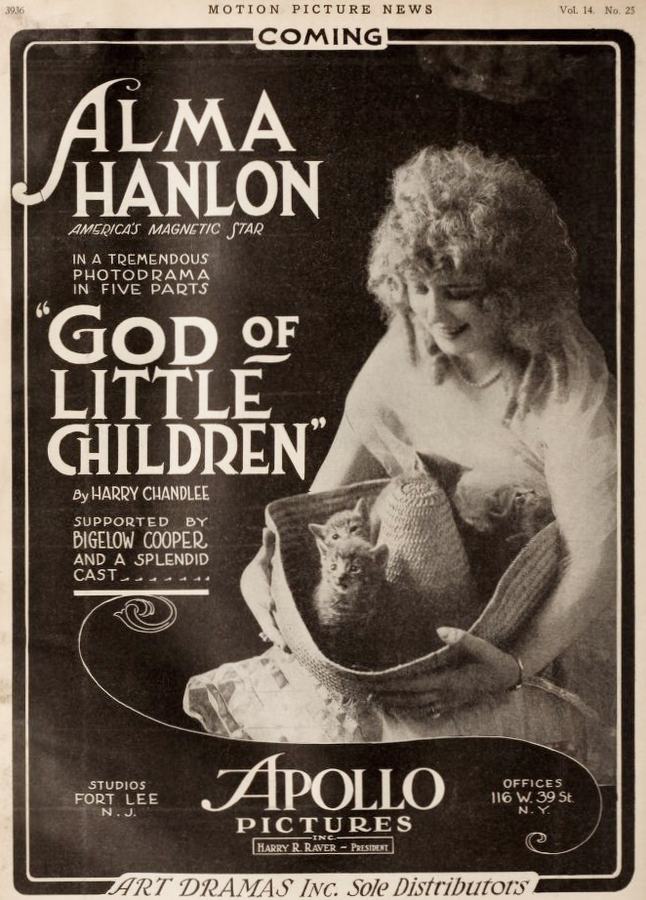
God of Little Children Synopsis
Mary Keene did not realize that when placed in the office of John Ingalls to assist in carrying out Robert Moran's plot to secure Ingalls' money she would spoil the whole scheme of things by falling in love with her big-hearted employer. Mary had always been "straight" in spite of her association with Moran and his band of blackmailers. But she had erred against man-made laws, though innocently, and fearing disgrace and prison if exposed by Moran she was compelled to assist in his nefarious schemes. Moran discovered that Ingalls loved children, and that he lived a secluded, lonely life. Mary's advent in John Ingalls' life was for the purpose of introducing a supposed little sister of hers into the Ingalls' home and through this child, thoroughly trained for the task assigned her, ultimately reach Ingalls' store of wealth. Moran's plans were successful until Mary began to realize she loved Ingalls and rebelled against further deception. Ingalls loved Mary and offered her his hand. The wedding ceremony was simple but pretty. Meanwhile, Moran had been planning along different lines. Why not force Mary to get a large sum from her husband and leave with him for foreign shores? Moran has long coveted Mary and he believes this his opportunity. Mary, for once in her bitter life, enjoys the utmost happiness. This joy is increased by the realization that she is soon to become a mother. Time has flown backward ten years in the life of John Ingalls. He feels the blood of young manhood coursing through his veins. Soon Moran presents his plan to Mary, who pleads with Moran to have pity and leave her in peace; but there is no alternative, she must go or see herself and husband disgraced by Moran's exposure. At home, Mary ponders long over her duty. She looks out on the placid lake from her window and with a prayer to the "God of Little Children," decides to give up the struggle and end her life, Moran, meanwhile, has plotted carefully. For a few dollars "Hard Tack," his willing accomplice, will put John Ingalls out of the way. The public will believe he committed suicide because his wife deserted him. The note she writes upon leaving will be found beside the body. Then with John Ingalls' widow in his power nothing shall come between Robert Moran and a fortune. Seated in his library, John Ingalls little dreamed that the hand of an assassin was near. Beside the lake Mary is about to end her life. She looks up at the library window with a silent prayer to Ingalls not to misjudge when she sees a crouching figure holding a pistol, silhouetted against the blind. Mary rushes into the house and reaches his side just in time to divert the bullet from Hard Tack's weapon. Ingalls conquers Hard Tack, who is hurled through a window. He is killed by his fall. Moran, waiting outside for Mary to meet him according to promise, overhears the pistol shot and, becoming alarmed at Hard Tack's long absence, boldly comes into the library, revolver in hand. Mary, seeing Moran and believing Ingalls' life again in danger, takes aim with the gun she picks up and fires at Moran. He falls dead, the bullet piercing his heart. The story ends happily.
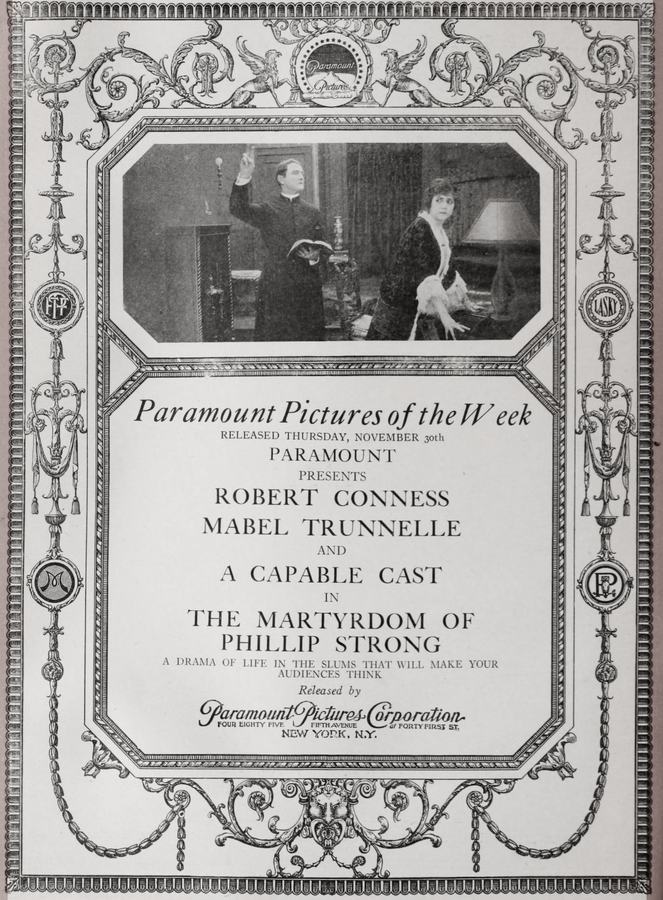
The Martyrdom of Philip Strong Synopsis
"Man, you are a living lie." Thus is Philip Strong, the rising young pastor of a fashionable Calvary Church, addressed by Brother Man (symbolizing the Spirit of Christ on earth). Surrounded by luxury, lionized by a wealthy congregation, Philip Strong suddenly realizes the force of these words. He has been preaching the doctrines of Christ, but his work has been the work of bare words only. To prove the truth of what he says. Brother Man leads Philip to the slums, and shows him the misery and squalor of a world which he has never known. The starving women and children, the kitchens of Hell where whiskey ruins the lives of men, impresses Philip deeply. He sees his real mission in life. He must help the downtrodden. Sarah, Philip's wife, wrapped in her social ambition, is horrified when Philip announces his determination. She refuses to permit her little daughter, Irma, to play with an orphaned child of the slums, whom Philip has brought home to shelter. She pleads with Philip to give up his new work. It means ruin and social ostracism. She scolds and bursts into a rage of fury, but Philip is firm. Goaded on by her mother, who pictures the disgrace of Philip's close association with the slums, Sarah leaves the home, taking Irma with her. Time finds Philip living in the slums, immersed in his work. Fighting the battle of the downtrodden, he arouses the hate of powerful forces. The rich of his congregation, owning the properties which house saloons, and the owners of these saloons, combine to bring about his downfall. Undaunted by threats of personal harm, he wages his war. Cheered by Brother Man in the moments when things seem most hopeless, he fights his battle with new energy. His friends gone, his little daughter dead, the wife whom he loves opposing him, he fights on. Scenting an opportunity to discredit him, the interests cause Sarah to believe that Loreen, a consumptive derelict, whom he has redeemed and sheltered in his home, is his mistress. The story is disproved and Sarah relents, but too late. The body bearing the spirit of Philip is not equal to the task. Wrecked by worry and ill-health, he gives up his life and his soul passes to the One Whose work he has been doing, and like Whom he has been crucified.
"God of Little Children" holds a slight edge in general audience appreciation, but "The Martyrdom of Philip Strong" offers its own unique cult appeal.
Suggested Watch:
God of Little Children