DbcultAccessing Vault...
Film vs Film
Select two cult films to compare side by side.
Joan of Arc Synopsis
At Domremy, a town situated close to the river Meuse, little Joan, the daughter of Jacques d'Arc, heard the tales of the war which was then devastating her country. Mercenary troops of the Duke of Armagnor fought in defense of King Charles VII. They were opposed by the soldiers of the Duke of Burgundy, allied with the English. Devastation and pillage followed in their wake. The peasantry passed their days in wretchedness and terror, hanging round the castles imploring aid and assistance. It was a constant din of battle, galloping horses and the clash of arms. All houses were solidly barred. Joan lived thus in the midst of trouble and anxiety. At times the sound of distinct and melodious bells reached her ears when tending her sheep and cattle in the meadows. She knelt for hours, listening to those mysterious and sweet sounds. One evening she heard a voice calling her in the sweetest tone imaginable. The maiden knelt; a great flood of light dazzled her. St. Michael was standing before the bewildered girl and spoke to her. His words sounded like music to her ear, "Beloved Joan, hearken to the duty that lies before thee. Go to Lord Baudricourt and then to the King. Ask for arms and soldiers, and fight the enemies of France." Some days later, St. Margaret and St. Catharine appeared to Joan and confirmed St. Michael's order, encouraging her and recommending, at the same time, virtue and resolution. Joan was now firmly assured of her mission. The Lord of Baudricourt receives Joan's supplication with derision. "I do not believe a word of all this," says he to Joan's uncle, who has accompanied her, "She is dismissed." Bertrand de Poulangy, a young man secretly in love with Joan, entreats her not to despair. He accompanies her on a second visit to the Lord of Vaucouleur and she finally succeeds. Baudricourt consents to furnish Joan with a small body of knights who will accompany her to the King. Joan, accompanied by Bertrand, puts on a coat of mail, girds her sword and mounting her steed rides at the head of her squires to the castle of Chinon, the actual residence of the King. More than three hundred barons and feudal lords of the realm were then assembled at the King's Court. Desirous of judging for himself whether Joan's mission was really inspired, the King disguises as a courtier, among whom he mixes. Joan enters amid the assemblage. Her rustic beauty causes quite a flutter; the ladies whisper, the knights admire her. Without the least hesitation, she walks straight up to the King, before whom she kneels and says, "Kindly Dauphin, I am Joan the Virgin, from Domremy. The King of Heaven has sent me to say that through my humble offices you will truly become King of France." Joan not only convinces the King of her heavenly mission, but also the King's councilors, all learned prelates, who ply her with numerous and intricate questions. The brilliant career of the Virgin Warrior has begun. At the head of ten thousand men Joan starts for Orleans. The French array was defending the city heroically, but has been reduced to extremities through lack of provisions. Joan crosses the Loire, gives battle, and on the evening of May 1, 1429, the glorious Virgin makes a triumphant entry into the beleaguered city. The next day she discusses with Dunois, commander of the city and the officers of the garrison, her plan of defense and studies the position of the enemy. Anxious and filled with pity for the many lives which must necessarily be lost through warfare, Joan shoots a missive into the English camp. She implores the Englishmen in the name of Heaven not to shed blood ruthlessly, but to raise the siege and depart in peace. This message is received with jeers and taunts, which affect Joan to tears. For fourteen hours the battle raged. One after the other the strong towers on the bridge were taken, and finally the English were forced to raise the siege. Joan, following up her advantage, pursues the flying horde and completely routs the English at the battle of Patay. Talbot was taken prisoner. Night falls on the field of battle. The heroic maiden helps the wounded. The tidings of Joan's magnificent victory stirs the Court and the vacillating King. Joan is received with unusual honors and succeeds in persuading Charles to go to Rheims, there to be crowned King of France in the sacred cathedral of that ancient city. The imposing pageant of the Dauphin Charles' triumphal procession, led by Joan holding aloft her standard, fills the population with enthusiasm and joy. As Joan proceeds, women and girls kiss the hem of her mantle; her path is strewn with roses. On July 11, 1429, the Dauphin Charles is duly crowned King of France, and thus it came to pass that the second part of Joan's mission was fulfilled. Joan is on the eve of returning to her native home when renewed activities of the English convince her that her task is not yet completed and cannot be until she has driven them all from French soil. However, the King's inborn pusillanimity, fostered by the envy, malice and hatred of both the Court and the Clergy, causes him to take an unwise and undignified course. He commands Joan to lay down her arms and retire in one of the royal residences. With intense sorrow, Joan places her sword and spurs and armor on the altar of Saint Denis. Many of her companions and soldiers are in tears. The people hold her in veneration and accompany her, singing hymns and acclaiming her frantically. Mothers bring their sick children to her; she blesses and restores them to health. Joan frets over her inactivity; the Duke of Burgundy's troops are still active and Joan longs to go out and meet them. One morning she starts at the head of her army and leads it under the walls of Paris. Despite the fact that she has been wounded, she again leads her forces to the attack, but is again repulsed. Finally she retires to Compiegne, when, falling into a trap, she is taken prisoner by John of Luxembourg. Joan's star is fading. She is kept a prisoner; her faithful Bertrand succeeds in reaching her in prison and endeavors to make a way for her escape. Joan of Arc heeds not the divine "voices" that remonstrate with her. In her rash attempt she falls on the rocks at the foot of the tower where she was imprisoned and is once more a captive. John of Luxembourg, greatly terrified, the effect of a demoralizing dream, delivers Joan into the hands of the English for the paltry sum of $10,000. Joan is accused of witchcraft. In her prison she is subjected to the insults of her guards and noblemen. Her confessor, the priest Loyseleur, betrays her. She is taken before the inquisition tribunal, which cross-examines her severely. Her replies to the subtle questions of the judges are dignified. The tribunal is confused, but inexorable. Joan is condemned to death by fire. Joan, dressed in white, is led to her doom. Loyseleur, the groveling monk, implores her forgiveness for his treachery. Bertrand, her faithful attendant, showers roses to her as a last tribute of love and respect. She ascends to the scaffold and is tied to the stake. She asks for a cross, which is given to her and which she kisses, praying at the same time for her enemies and invoking the saints. The flames surround Joan; her head droops, her lips faintly murmur the name of the Crucified and her noble and immortal soul appears to be home up to heaven by heavenly messengers. Even her enemies wept and were heard to say, "We have burned a saint."
On the Steps of the Throne Synopsis
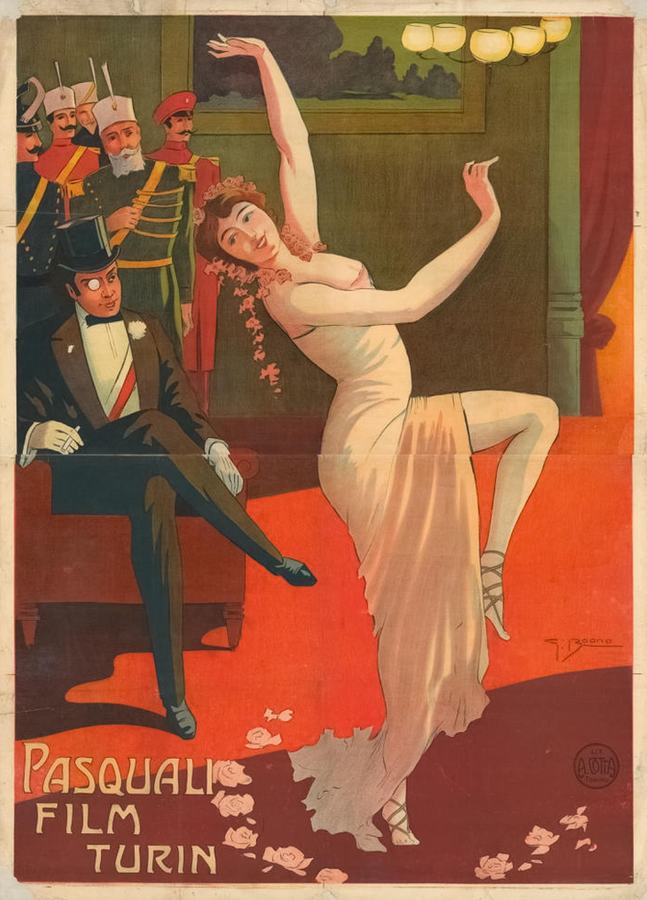
The kingdom of Silistria, during the minority of the heir to the throne, Prince Vladimir, is ruled by Count Backine as Regent. Backine, an ambitious, power-loving man, knowing that the end of his period of power is approaching with the Prince's twenty-first birthday, uses all his wiles to bring about a marriage between Vladimir and his niece Alexandra, trusting to the influence which he hopes to be able to exercise on the Prince through his wife to keep him still, in fact if not in name, the ruler of Silistria. Unhappily for the Regent's plans, Vladimir has already fallen in love with his pretty cousin Olga, and the lovers frequently meet secretly in the beautiful gardens of the palace. One of these meetings is witnessed by a creature of the Regent, who hastens to tell Backine what he has seen, and, alarmed at the danger thus threatened to his project, Backine, after an attempt to affiance Vladimir to Alexandra has proved unsuccessful, summons a meeting of the Council of State, and persuades his colleagues to decide that the Prince shall be requested to spend the time which must pass before his coronation in Paris. Vladimir cannot refuse the request, which is, in effect, a command, but before he goes he visits all his old friends in Silistria- not forgetting his old fencing master, with whom he engages in a last friendly bout, in the course of which an incident occurs which has an important bearing on future events. The master's foil slips and inflicts a wound on the Prince's forearm, which, although not serious, will leave a permanent scar. Later a series of superb stagings show him clad in the uniform of his regiment of guards leaving the palace after a passionate farewell to Olga, and entering a motor-car, in which, with an escort of soldiers, he is driven to the railway station", en route to the French capital. Backine has arranged for one of the lieutenants to accompany Vladimir, with secret instructions to induce the Prince, by plunging him into all the distractions which Paris can offer, to forget Olga and the promise he has made to her. Although, with a letter from his sweetheart always carried in his breast pocket, Vladimir is not likely to be untrue to her, he willingly enters into the amusements provided for him, and his admiration for Mile. Thais, a dancer who is the sensation of the hour, gives his enemies the opportunity they require. Backine's emissary in Paris is greatly struck with the resemblance which a rather shady young dancer, whom he encounters in a cafe bears to the Prince, and he thinks the discovery so important that he reports it to Backine in Silistria, and receives detailed instructions, upon which he acts immediately. Chicita, the dancer, calls upon Thais, who has fallen in love with the Prince, whom she believes to be an English nobleman, and, showing her a letter from Olga to Vladimir, in which she asks the latter to return to Silistria, informs her who her lover really is, and tells her that he will surely desert her at the first opportunity. Temporarily blinded by jealousy, Thais agrees to become an accomplice to the Regent's plans and writes to Vladimir asking him to meet her at a certain house - in reality one which Backine's employee has engaged. When the Prince arrives at the house he is shown into a sitting-room and a trap-door is released under his feet. He is plunged into a cellar which has been prepared, and from which there is no egress, and with Thais and one of the Regent's men as gaolers is left there while Chicita is hastily made up as the Prince, and prepared for the journey to Silistria. The formal coming-of-age of Prince Vladimir is announced, and at the same time publicity is given to his engagement to Backine's niece, Alexandra. A triumphant reception is arranged for the returning ruler, and the pretender is driven through files of soldiers, cheered by the populace of the capital, to the palace. The resemblance between the real Vladimir and the sham is so close that everybody is deceived but Olga, who at once knows as if by intuition that this is not the man. She makes known her suspicions to one-or two friends, am rig then the old fencing master, who vows to solve the puzzle. Challenging the supposed Prince to a bout with the foils, the master contrives to wound him slightly in the arm, and, on pretense of examining the wound, discovers that there is no trace of the old scar which his sword inflicted on Vladimir. The Regent has fathomed the suspicions of the fencing master, who is known, moreover, to be a firm friend of Vladimir, and gives instructions so that the faithful old man is shot while out for his morning ride, and his body thrown in the river. Seriously injured though he is, he manages to scramble to shore and to attract the attention of two officers, to whom be tells the story of the imposture he has discovered. Meanwhile, orders have been sent to Backine's agent in France ordering him to put the captive Vladimir to death, but, though the Prince is bound and the train of powder which is to blow him to pieces is almost lighted, Thais relents at the last moment and releases the Prince. When their enemy attempts to detain them lie is thrown on the trap-door, which hurls him into the cellar. The explosion occurs, and the villain meets the death he had destined for the Prince. Meanwhile, Coronation Day dawns in Silistria. One after another the superb ceremonies are carried through, and at last the sham Prince and his Consort are led, through a company of men clad in blazing uniforms and women in sumptuous dresses, to the steps of the throne. Then, before the actual act of coronation can take place, the real Vladimir with his few faithful friends bursts into the chamber, the usurper is swept aside, and while all look on with amazement, Vladimir goes to Olga, and, taking her by the hand, leads her to the steps of the throne which is rightfully his.
"On the Steps of the Throne" is currently leading in ratings, making it a stronger choice for newcomers to the genre.
Suggested Watch:
Joan of Arc