DbcultAccessing Vault...
6.2/10
Senior Film Conservator
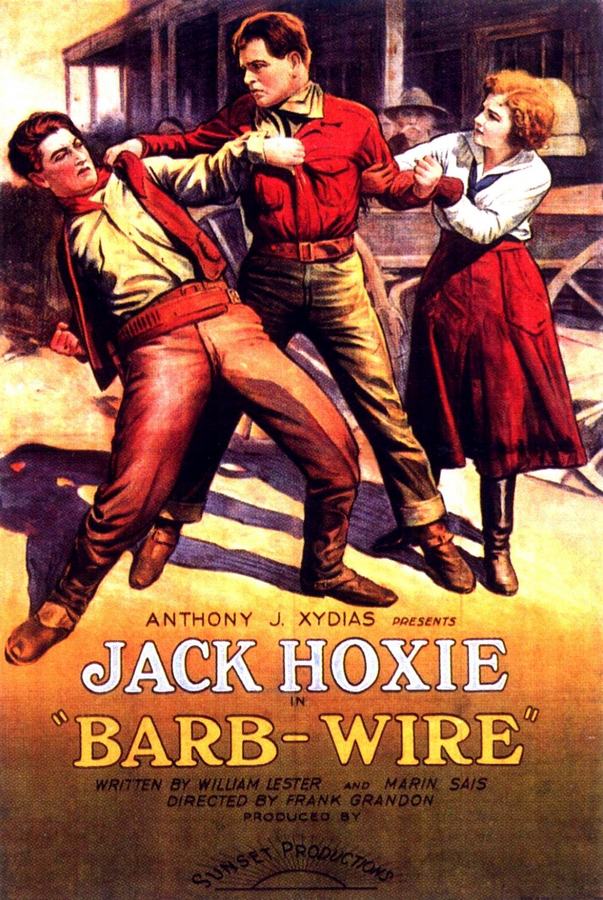
A definitive 6.2/10 rating for a film that redefined the boundaries of cult cinema. Barb Wire remains a cornerstone of transgressive art.
In the lacquered twilight of 1926, when nickelodeon pianos still hammered out ragtime adrenaline, Barb Wire arrives like a serrated love letter to Manifest Destiny. William Berke, doubling as director and scenarist, tightens his narrative strands until they sing—a high-tensile hymn—and every coil of wire becomes both fence and noose.
Jack Hoxie, that leathered paladin of the Pacific slope, embodies Jack Harding with the economy of a man who’s learned silence from rattlesnakes. His gaze—half-lidded, cobalt—carries the weight of deed without title, of earth without deed. Opposite him, Bart Moseby (Bert Lindley) chews scenery like it’s plug tobacco, all teeth and menace, a railroad baron’s lapdog turned wolf.
Berke’s screenplay, co-forged with serial veteran Marin Sais, refuses the languid pastoralism of earlier Western arcadia. Instead, it grafts noir’s paranoia onto the open range: barbed wire as industrial Frankenstein, a lattice that promises property yet delivers purgatory. The film’s first act is a montage of gleaming spools, hooves drumming paranoia, and sky so wide it feels sarcastic.
Cinematographer William Ryno lenses these tableaux with chiaroscuro daring—sun flares bleed through barb points, creating iron halos that anticipate the religious overtones of the finale. Grain swims across the 35 mm like dust devils, each scratch a scar. Meanwhile, the intertitles—lettered in a jittery typeface—deliver aphorisms such as "A man’s wire is his scripture," a line so baldly symbolic it circles back to poetry.
Silent-era Westerns lived or died by their visceral gambles, and Hoxie—former rodeo bulldogger—performs a third-story leap onto a galloping stallion in one take. No rear projection, no trampoline cutaways. The camera holds wide, privileging verisimilitude over safety, and the resulting jolt is still potent a century later. Compare it to Harry Houdini’s rooftop antics in The Grim Game; both films trade on bodily risk as spiritual currency.
Jean Porter, as Harding’s confidante Mary, is granted more agency than the genre often allowed. She eavesdrops, smuggles ammunition, and even brandishes a buggy whip against Moseby’s lieutenant. Her performance is flapper fire in calico, a reminder that frontier women weren’t mere cameo dolls. The bedroom sequence—where Jack hides behind her chintz curtain—stages intimacy as camouflage, a reversal of the usual damsel concealment.
Mid-film tonal whiplash lands us in a clapboard courthouse thick with cigar haze. The trial sequence, brisk at seven minutes, erupts into Grand Guignol when Harding’s mother (Olah Norman) produces a derringer from her mourning brooch. She fires into the rafters—plaster snowing like guilty dandruff—while intoning, "Justice is a widow—time she remarried!" The line, deliciously ripe, earned reported gasps in Texarkana screenings.
The stunt horse waiting beneath the window is no random plug but Hoxie’s own mount, Midnight. Their synchrony—hooves drumming the hitching rail as syncopation to the judge’s gavel—cements the Western credo that freedom is four-legged. One can’t help but recall the equine devotion in At Piney Ridge, though Berke trades pastoral nostalgia for juridical carnage.
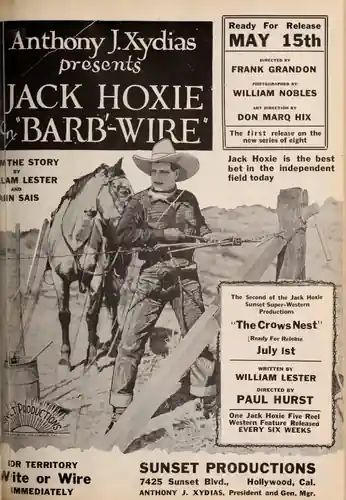
The climax stages a ghost-town street abandoned except for glinting barbed coils strung like diabolic harp strings. Berke blocks the combatants so that every parry risks entanglement; flesh meets metal, and droplets of crimson arc across the negative space. Moseby’s death—impaled on a tensioned strand—reads as both catharsis and industrial reckoning: progress devouring its own progeny.
Joseph McDermott’s musical directive for house orchestras (preserved in the Library of Congress copyright folio) prescribes a crescendo of brass and col legno strings, mimicking wire vibration. Survivors reported that audiences stamped in rhythm, turning the theater into a kettle of tribal urgency.
Jim Welch, as the turncoat foreman, conveys guilt through the tremor of a matchstick between teeth—an infinitesimal tell that Hoxie clocks in a flicker of eyebrow. Such granularity rewards the 4K scans now circulating in cine-clubs, where pores and pre-Method nuance suddenly roar.
Bert Lindley’s Moseby, meanwhile, underplays moustache-twirling villainy; instead, he radiates boardroom entitlement, the kind of man who’d gentrify your pasture and charge you grazing fees. His demise feels less like personal defeat than systemic exfoliation.
Place Barb Wire beside Six-Shooter Andy and you’ll notice both pivot on technology—telegraph, wire—as harbingers of ethical fracture. Yet Berke’s film is bleaker; its resolution doesn’t restore Eden but acknowledges barbed-wire gridwork as the new cosmology.
If you seek thematic cousins in moral entrapment, consult Jealousy (1916) or the Scandinavian fatalism of Mästertjuven. Both probe how objects—letters, locks, wires—transmute into fateful agents.
The 2022 restoration tinted night sequences in cobalt and dusted day exteriors with ochre, sparking purist ire. I side with the colorists: the sea-blue nocturnes externalize Harding’s claustrophobia within open range, while the burnt-orange earth foreshadows blood that will feed the soil.
In an era where borders are again electrified metaphors, Barb Wire feels prophetic. Its thesis—that demarcation breeds violence as surely as steel rusts—remains chillingly au courant. Yet the film also celebrates insurgent cunning: a mother’s pistol, a lover’s ruse, a cowboy’s leap. Resistance, Berke insists, is stitched from intimate betrayals and hair-trigger courage.
So if you haunt archival streams or 16mm basement societies, queue this razor-edged relic. Let its spools prick your nostalgia, let its finale thunder across your headphones. And when the last barb point glints, remember: every fence is a story someone paid in skin to write.
IMDb —
1931
Community
Log in to comment.