DbcultAccessing Vault...
Cult Review
Senior Film Conservator
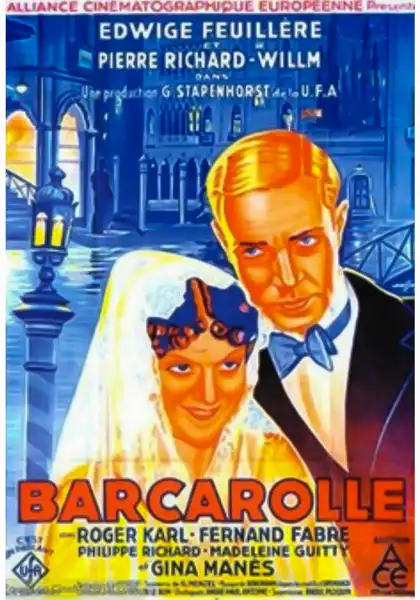
Alright, let's talk about Barcarolle. If you're a serious classic film buff, especially someone who digs into early French sound cinema, then yeah, this one’s probably worth a look. For everyone else? It’s a tough sell. You’ll either find its particular brand of melodrama enchanting or, frankly, a bit much. It’s got that old-world charm, sure, but it also asks for a lot of patience. 🎭
The premise itself is peak melodrama: a suave Venetian gambler, Don Juan (played by Pierre Richard-Willm), makes a boast. He bets he can win over Paquita (Edwige Feuillère), the spirited wife of a very jealous Mexican fellow named Ramon. You just know this isn't going to end well for anyone involved, but hey, that’s the fun of it, right?
Right away, the film tries hard to pull you into Venice. The sets are quite lovely, definitely giving off that romantic, old-world vibe. You can almost feel the dampness from the canals.
But then the pacing hits you. It’s slow. I mean, not just 'old movie slow,' but 'this gondola is barely moving' slow. One shot of the Grand Canal just seems to linger for ages, probably to set the mood, but my mind definitely started to wander a bit. 😴
The whole 'bet' idea kicks things off. Don Juan, this smooth operator, has this look in his eye, a mix of confidence and maybe a little bit of trouble. You can tell he’s used to getting his way.
Paquita, though. She’s the real spark here. Edwige Feuillère, she just lights up the screen every time she’s on. Her character is not some wallflower, which is great to see for the era. She’s got a temper, and she’s not afraid to show it.
Pierre Richard-Willm as Don Juan really leans into the charming rogue archetype. He has these moments where he just *smiles* at the camera, and you can practically hear the women in the 1930s audience swooning. It’s a specific kind of dashing that feels very period.
His attempts to woo Paquita are a masterclass in classic cinema flirtation. Lots of intense stares, dramatic pronouncements, and lingering touches. It's all very theatrical, which I suppose is the point.
Then there’s Ramon, the jealous husband. Oh boy. He’s played by Charles Redgie, and he embodies 'jealous' with every fiber. His eyes narrow, his jaw clenches. There’s a scene where he’s just watching Paquita dance, and his expression alone tells you everything you need to know about his suspicions. It’s almost *too* intense sometimes, like you want to tell him to just take a breath. 😤
One particular moment sticks with me: Paquita, frustrated with Ramon, just *throws her hands up* in exasperation. It’s a small gesture, but it feels so genuine amidst all the grandiosity. It felt like a little peek behind the curtain.
The musical score, as you might guess from the title, features a lot of barcarolle-style music. It's atmospheric, but after a while, it starts to blend into the background. It doesn't always *elevate* the scene as much as it just... is there.
There are some supporting characters, too, but they mostly serve to push the main trio's drama along. Roger Legris has a few moments of comic relief, which are much needed. His exasperated sighs are pretty good.
“Love, like a gondola, can capsize in stormy waters.” – A line that felt both profound and a little cheesy.
The whole love triangle gets super complicated, as expected. There are misunderstandings, duels, and passionate confrontations. The acting style, of course, is very much of its time. It’s all big emotions, sweeping gestures, and dramatic pauses.
Sometimes, the dramatic pauses go on for what feels like an eternity. A reaction shot might linger so long it almost becomes funny. You can almost feel the movie trying to convince you this moment matters *immensely*.
The ending, without giving anything away, is exactly what you’d expect from this kind of story. It's wrapped up in a way that feels both conclusive and a little bit inevitable. It’s not going to shock you, that's for sure.
I found myself wondering about the Goddess of Spring, another film from around this era, and how different its storytelling approach was. Barcarolle is very much rooted in human drama, while other films were exploring animation in fascinating ways.
Is it a forgotten masterpiece? Probably not. Is it an interesting historical artifact? Absolutely. It’s a snapshot of a particular kind of filmmaking, a certain style of acting, and a dramatic sensibility that’s largely faded today. If you’re curious about how films explored intense human emotions back then, this offers a pretty good look.
Ultimately, Barcarolle is a film for the patient viewer, for the one who appreciates the slow burn and the grand theatricality of early cinema. If you prefer your drama a bit more understated or fast-paced, you might find yourself checking your watch. But if you settle in with a cup of tea and let its rhythms wash over you, there's a certain charm to be found. ☕
IMDb 4.8
1932
Community
Log in to comment.