Audrey Munson
actress, writer
- Birth name:
- Audrey Marie Munson
- Born:
- 1891-06-08, Rochester, New York, USA
- Died:
- 1996-02-20, Ogdensburg, New York, USA
- Professions:
- actress, writer
Biography
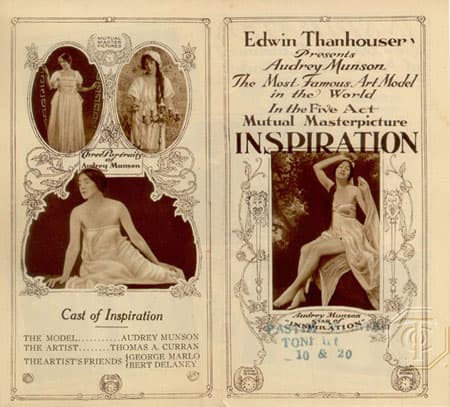
Rochester, New York, greeted Audrey Marie Munson on 8 June 1891, the solitary offshoot of Edgar and Katherine Mahoney Munson’s brief union. When the marriage cracked, Katherine packed her daughter’s childhood into a trunk and headed for Manhattan the moment Audrey turned seventeen. The city’s sculptors were hungry for marble muses; the teenager with the long, unbroken lines stepped straight into their studios and never left the city’s skin. Within months her silhouette was being chiseled into the Firemen’s Monument, the Pulitzer Memorial, and the towering Maine Monument in Central Park—an eternal salute to 260 sailors swallowed by a Havana harbor explosion in 1898. At twenty-three she crossed the continent as the face of the 1915 Panama-Pacific Exposition, posing for both heroic statuary and luminous canvases that lined San Francisco’s palaces of art. Somewhere along the way reporters mislaid her upstate roots and rechristened her a native New Yorker. That same year the flicker of a new medium came calling: Inspiration dramatized her life, letting audiences see the first fully nude performance sanctioned by a U.S. censor. Theaters in Boston and Philadelphia slammed their doors; a second showing anywhere was forbidden once word of the skin reached the balcony. Audrey shrugged and told interviewers she might try vaudeville next. Four years later the film resurfaced, re-cut as The Perfect Model. She appeared once more on-screen in 1921, drifting through long shots of Heedless Moths, another thinly veiled autobiography. Between frames, headlines tied her to a Gramercy Park murder trial: Dr. Walter Wilkins stood accused of poisoning his wife, and though Audrey was never charged, her name ran in bold type beside autopsy details. Studios quietly let her option lapse. By winter 1920 she had traded Manhattan boardinghouses for a drafty Syracuse attic, touring nearby towns for paid “personal appearances” that barely covered train fare. Desperate for anonymity, she begged a New York editor to print her obituary while she was still breathing; the story ran in October, complete with her confession that no studio would touch her. Job applications in Syracuse department stores vanished into wastebaskets. So she took to the Sunday supplements herself, drafting a serial memoir for the New York American between January and May 1921—twenty-one weekly confessions of art, scandal, and bounced checks. Between installments she announced a search for “the perfect husband,” a publicity stunt that boomeranged when papers in April 1922 printed her engagement to a Michigan aviator who never materialized. In May she swallowed bichloride of mercury in a boardinghouse bathroom; a landlady found her in time. She slipped back to the shadows of Oswego County, occasionally glimpsed when a theater revived Heedless Moths years after its release. In 1926 she bought a small farm outside Mexico, New York, installing her aging mother among the apple trees. On her fortieth birthday—8 June 1931—Katherine signed the commitment papers; a judge dispatched Audrey to St. Lawrence State Hospital in Ogdensburg, where she would outlive every headline. She died quietly at 104 on 20 February 1996, her ashes tucked beside her father, stepmother, and half-sister in New Haven Cemetery, the marble statues she once inspired still standing guard over a city that never quite remembered her name.