
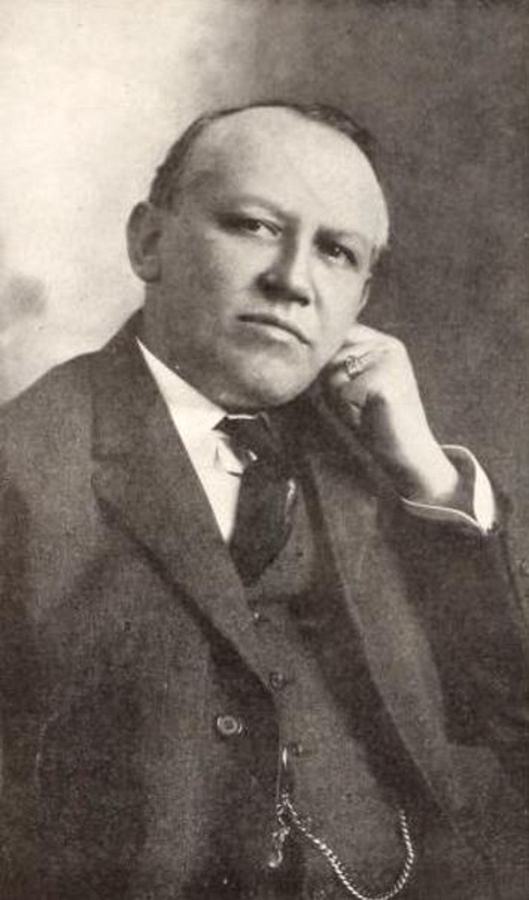
Carl Laemmle
actor, miscellaneous, producer
- Birth name:
- Karl Lämmle
- Born:
- 1867-01-17, Laupheim, Kingdom of Württemberg [now Baden-Württemberg, Germany]
- Died:
- 1939-09-24, Los Angeles, California, USA
- Professions:
- actor, miscellaneous, producer
Biography
"Carl Laemmle's pioneering spirit laid the foundation for Universal Pictures, beginning in 1906. After a stint as a bookkeeper in Oshkosh, Wisconsin, Laemmle returned to Chicago and ignited his entrepreneurial journey by establishing a chain of nickelodeons. This success quickly propelled the ambitious 39-year-old to organize the Laemmle Film Service, a burgeoning film exchange network that stretched westward and even into Canada. Initially part of the Edison Patents Company, Laemmle soon chafed under the obligation to pay royalties for advancing into film production.\n\nIn a bold move of defiance, Laemmle founded the Independent Motion Picture Company (IMP) in New York in 1909. For the next three years, IMP became a prolific producer of economical multi-reel films, even as Thomas Edison's powerful General Film Company, notoriously known as \"The Trust,\" relentlessly pursued legal actions and patent infringement claims against independents who refused to pay. While many of his peers, including future moguls Adolph Zukor and Jesse L. Lasky, sought refuge in California, Laemmle stood his ground, battling an astounding 289 legal challenges from GFC between 1909 and 1912, ultimately emerging victorious.\n\nThe triumphant IMP was reborn as Universal in 1912. After filming two final productions in New York—\"The Dawn of Netta\" (1912) and the one-reeler \"The Nurse\" (1912)—the company packed its bags and headed to Los Angeles. Between 1912 and 1914, Universal operated two California studios, one in Hollywood and the \"Oak Crest Ranch\" in the San Fernando Valley, before consolidating operations at the grand new Universal City (\"Taylor Ranch\") in 1914. A brief but significant dispute in 1912 saw the New York Film Company wrestle ownership of the Bison Motion Picture properties at Evendale and Santa Monica from Universal, though Universal retained the valuable \"Bison\" and \"101 Bison\" trade names, launching its Universal/Bison brand productions at the Providencia Ranch (the original Universal Oak Crest ranch, first Universal City) that same year.\n\nThe studio expanded its reach into newsreel production in 1913 under Jack Cohn. The year 1914 marked a monumental turning point when Laemmle acquired the Taylor Ranch north of the Hollywood Hills, embarking on the ambitious construction of Universal City. \"Damon and Pythias\" (1914) became the first film completed on this expansive lot, just months before the studio's official grand opening in March 1915. For a decade, until 1925, Universal City reigned as the world's largest and most productive studio, eventually surpassed only by the nascent MGM. Innovative studio tours, initiated in 1915, proved immensely profitable, though they were temporarily halted in 1928 with the advent of talkies, only to be revived in 1964. Lacking its own theater chain, Laemmle devised a clever three-tiered branding system to market Universal's diverse releases: \"Red Feather\" for low-budget features, \"Bluebird\" for mainstream and medium-budget offerings, and \"Jewell\" for prestigious, often roadshow attractions commanding premium prices. A strong emphasis was placed on concise one-, two-, and three-reel productions.\n\nUniversal cultivated a reputation as Hollywood's most paternalistic studio, affectionately known as \"Uncle\" Carl's domain, where virtually all of his relatives, including his son Carl Laemmle Jr. and his far more gifted nephew, William Wyler, found employment. The 1920s brought immense success, particularly with Lon Chaney's iconic performances in \"The Hunchback of Notre Dame\" (1923) and \"The Phantom of the Opera\" (1925), before the \"Man of a Thousand Faces\" was lured away by MGM. Without a proprietary theater network, Universal shrewdly targeted independent rural cinemas, offering flexible, affordable exhibitor packages that allowed for frequent bill changes. This astute marketing strategy, focused on appealing to rural audiences, sustained the studio through 1930. The 1920s also saw Europe emerge as a significant revenue stream, with Universal actively engaging in international co-productions.\n\nAs sound productions became the industry standard by 1929, Universal responded by elevating its production quality, earning its first Academy Award for Best Picture with the powerful anti-war epic \"All Quiet on the Western Front\" (1930) the following year. The studio then famously spearheaded the monster craze, launching with the chilling \"Dracula\" (1931), a phenomenon that captivated audiences well into 1935. However, the economic devastation of the Great Depression began to erode the success of Universal's other productions. Laemmle's commitment to quality films, unfortunately, misfired in the mid-1930s, forcing him to accept an unfavorable $750,000 loan from Standard Capital. The subsequent cost overruns on the lavish production of \"Show Boat\" (1936) proved to be the final straw, leading to his forced retirement from the industry in 1936.\n\nLaemmle sold Universal to Standard Capital Company, now headed by Charles R. Rogers, who immediately implemented drastic cost-cutting measures. Fortuitously, the studio's fortunes were dramatically reversed by the signing of the immensely popular Deanna Durbin, whose star power almost single-handedly rescued Universal from financial ruin between 1937 and 1940. Later, a new management team led by J. Cheever Cowdin bolstered the roster with other beloved stars, notably the comedic duo Bud Abbott and Lou Costello. Briefly in 1936, Universal also provided a temporary home for veteran low-budget producers Trem Carr and W. Ray Johnston, who were reforming Monogram Pictures after an unsatisfactory alliance with Republic Pictures.\n\nWhile many contemporaries criticized Rogers' stewardship of the \"New\" Universal, his decisive actions undeniably saved the studio during a perilous period. Carl Laemmle, the visionary founder, passed away in Los Angeles in 1939 at the age of 72 from a heart attack. During World War II, like most Hollywood studios, Universal experienced a production boom, releasing an average of one feature film per week by 1945. In 1946, the studio merged with International Pictures, an independent venture led by former 20th Century-Fox executives William Goetz and Leo Spitz, becoming Universal-International Pictures (a name that reverted to Universal in 1963). Crucially, having consciously avoided building its own proprietary theater chain, Universal remained unaffected by the landmark 1949 Supreme Court anti-trust decision, positioning it better than other majors as its revenue stream continued unabated. The company was subsequently acquired by and merged with Decca Records in 1952.\n\nThough not an early adopter of television production (most major studios, barring Columbia, initially resisted), the medium rapidly became a cornerstone of Universal City's operations in the late 1950s. In 1962, Universal was acquired by and merged with The Music Corporation of America (MCA), becoming MCA Universal. MCA's prolific television arm, Revue Television Productions, including its \"Leave It to Beaver\" unit, soon relocated to the sprawling Universal lot. A series of corporate transformations followed: Matsushita Electrical Industrial Co. purchased MCA in 1991, followed by The Seagram Co. in 1995, which led to the renaming of MCA Universal to Universal Studios. In 1998, Universal acquired the USA television network. The company then merged with the French global media giant, Vivendi Media Group, becoming Vivendi Universal in 2000. The most recent major evolution occurred in April 2004, when Vivendi Universal was acquired by and merged with the National Broadcasting Company (NBC), culminating in the formation of NBC Universal."
Filmography
In the vault (1)
Knowledge Base
Frequently Asked Questions about Carl Laemmle
Community
Comments
Log in to comment.