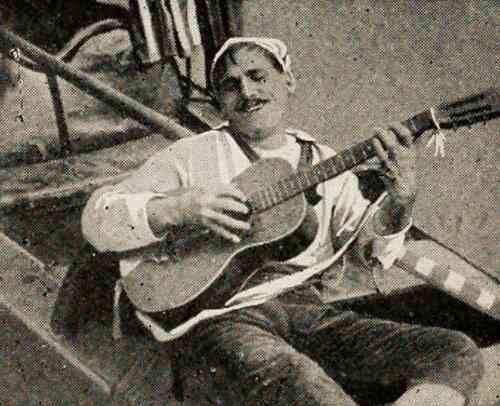
George Beban
actor, director, writer
- Born:
- 1873-12-13, San Francisco, California, USA
- Died:
- 1928-10-05, Los Angeles, California, USA
- Professions:
- actor, director, writer
Biography
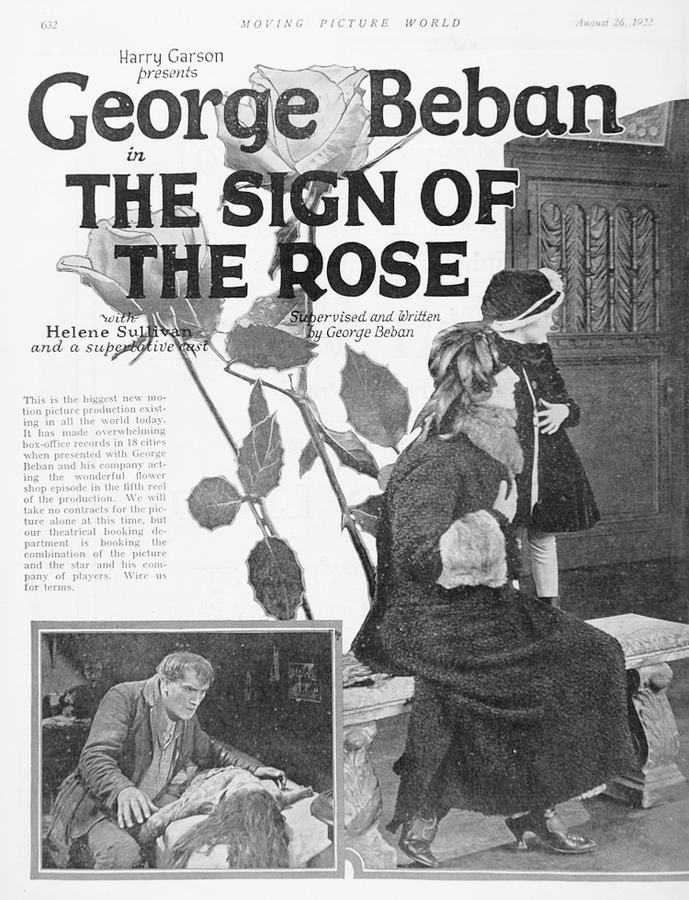
A formidable talent of the silent era, George Beban wore many hats: actor, director, writer, and producer, having honed his craft initially as a singer and vaudevillian. Hailing from San Francisco's Telegraph Hill, he was one of four sons born to Rocco Beban, a Dalmatian immigrant, and Johanna Dugan, who journeyed from County Cork, Ireland. His precocious singing talent quickly earned him the moniker 'The Boy Baritone' within San Francisco's vibrant theater scene. By the tender age of eight, as he recounted in a 1920 interview, his professional journey began with an $8-a-week gig singing at the Vienna Garden on Stockton Street. This was swiftly followed by boy parts in stock companies, first with McGuire, Rial and Osborne at the Grand Opera house, and later with McKee Rankin at the old California, where he performed under the stage name George Dinks. His father, however, staunchly opposed his theatrical ambitions, going so far as to get him dismissed from each of these early engagements. This paternal obstruction ultimately led young George to run away from home at the age of 14, determined to pursue his passion. He subsequently graced stages in light opera and shared bills with renowned vaudevillians Weber & Fields. Broadway beckoned when, around the age of 22, Marie Cahill offered him his inaugural opportunity in her debut starring vehicle, the musical comedy 'Nancy Brown,' presented at the Bijou. For many years, Beban traversed the worlds of vaudeville and legitimate theater, often specializing in caricatured French characters, before making his cinematic debut in 1915. He notably challenged prevailing stereotypes of Italian immigrants – often unfairly depicted as 'Black Hand' mafioso – through his impactful play (later adapted into a film) 'Sign of the Rose' (also known as 'The Alien'), and in Thomas Ince's compelling feature, 'The Italian.' In a 1910 interview with the San Francisco Examiner, he revealed that his childhood spent playfully teasing and pilfering fruit from local Italian gardeners and grape growers had endowed him with the skill to mimic Italian speech and dialect with authentic accent. More profoundly, he credited these interactions with cultivating his appreciation for Italian character, recognizing its inherent qualities of honesty, industry, and a gentle spirit. His later filmography saw him frequently take on writing and/or directing duties, though sadly, few of these productions have endured. Beban ultimately retired in late 1926, a decision spurred by the passing of his wife, stage actress Edith Ethel MacBride. By midsummer 1928, he had completed his dream residence, a magnificent home perched on a bluff overlooking the Pacific in Playa del Rey, California. His housewarming on August 19 became a global sensation when two of his guests, Western star Tom Mix and vaudevillian William Morrissey, engaged in a physical altercation. The dispute ignited over Morrissey's barbed remark that Mix's horse, Tony, would undoubtedly thrive in the upcoming 'talkies' because 'at least he could snort,' questioning Mix's own vocal prospects. Tragically, just five weeks later, while vacationing at June Lodge Dude Ranch in Big Pine, California, Beban suffered a severe injury on September 29, 1928, after being thrown from a horse. He succumbed to the combined effects of the fall and uremic poisoning several days later in Los Angeles. His remains were cremated. He was survived by his 14-year-old son, George Beban Jr., who, using the stage name Bob White, had appeared alongside his father in a handful of films and would later carve out a brief career in supporting roles during the 1940s. George Beban Sr. is also remembered as the grandfather of cinematographer Richard Beban and the great-granduncle of screen and TV writer Richard W. Beban.
Filmography
In the vault (4)