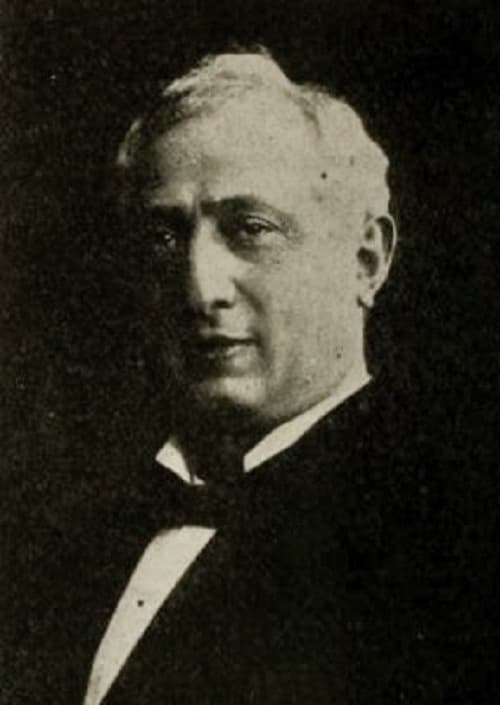
Jacob P. Adler
actor
- Birth name:
- Jacob Pavlovitch Adler
- Born:
- 1855-02-12, Odessa, Kherson Governorate, Russian Empire [now Ukraine]
- Died:
- 1926-03-31, New York City, New York, USA
- Professions:
- actor
Biography
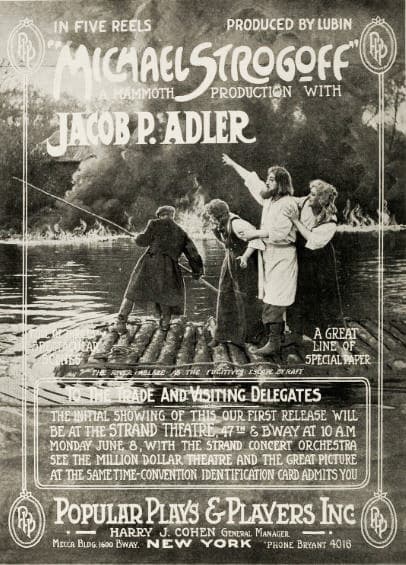
[ "Jacob Adler, famously dubbed 'The Great Eagle' (a nod to his German surname), stood as a titan of the stage, his gravitas often compared to the likes of Marlon Brando and Edwin Booth. More than just a performer, he was the progenitor of a theatrical lineage spanning over a century, steering the American theater away from hollow melodrama toward a profound, gritty realism. His odyssey mirrors the Golden Age of Yiddish theater—a saga of cultural defiance against a world intent on its erasure.\n\nBorn in Odessa within the Russian Empire on February 12, 1855, Adler found his calling in his youth. By the 1870s, he had joined the Rosenberg Troupe, one of Russia’s three primary Yiddish companies alongside those of Goldfaden and Sheikevitch. While he dazzled audiences as a dancer and actor, his inability to carry a tune barred him from the profitable world of operettas. This vocal limitation, however, forced him to sharpen his dramatic instincts, molding him into a master of the craft.\n\nWhile touring the Russian Empire with the Rosenberg Troupe, Adler found both a mentor in the troupe’s leader and a partner in his first wife, Sonia Oberlander. His breakthrough came through Karl Gutzkow’s 'Uriel de Acosta,' where he portrayed a 17th-century Marrano seeking enlightenment in Holland. The play’s intellectual depth resonated deeply, but its serious tone made the Yiddish theater a target for authorities who viewed such didactic art as subversive.\n\nAs the Yiddish stage evolved from the Haskala (Jewish Enlightenment), it faced existential threats. The 1880s brought brutal pogroms and a restrictive 1883 ukase from Czar Alexander III that outlawed Yiddish performances entirely. Forced into exile, Adler fled to London in November 1883. There, he found success in 'The Odessa Beggar' and Schiller’s 'The Robber,' the latter earning him international acclaim. Yet, the call of the New World was stronger; in 1889, he migrated to New York City, arriving with the established reputation of the 'Nesher Hagadol.'\n\nIn the 'Jewish Broadway' of the Bowery and Second Avenue, Adler became a beacon for the city’s massive Yiddish-speaking population. For families surviving on sweatshop wages, his performances were a vital luxury. Adler eventually established his own venues, the Union Theater and later the National. Rejecting the 'Shund' tradition—the populist, sensationalist melodramas championed by his rival Boris Thomashefsky—Adler sought social relevance. His partnership with playwright Jacob Gordin redefined the medium.\n\nGordin provided the scripts that would define Adler’s career: 'Sibina,' 'The Wild Man,' and his magnum opus, 'The Yiddish King Lear.' Debuting in November 1891, his Lear was a revelation. His second wife, the celebrated actress Sara Heine Adler, remarked that he wasn't merely acting that night, but manifesting a 'force.' This success proved that high-brow, classical adaptations could be both artistically prestigious and financially viable.\n\nAdler’s influence eventually crossed over to the mainstream. In 1903, he took his Shylock to Broadway in 'The Merchant of Venice,' humanizing a role that had long been a caricature of villainy. He also ventured into the nascent film industry in 1910, starring in the Selig movie studio’s 'Michael Strogoff.' Directed by J. Searle Dawley, this Jules Verne adaptation was a high-budget spectacle for its time, culminating in the cinematic burning of a Siberian city.\n\nAdler’s later years were spent documenting his life in his Yiddish memoirs, serialized in the socialist newspaper 'Die Varheit' between 1916 and 1919. Though a 1922 illness sapped his vitality, he returned to the stage one last time for Gordin’s 'The Stranger.' He passed away in New York on April 1, 1926, at the age of 81. His wife Sara, who survived until 1953, passed his philosophy down to a young Marlon Brando. The Adler legacy lived on through their children, Stella and Luther, who brought the realism of the Yiddish stage to the Group Theatre and the 'Great White Way,' influencing generations of actors like Paul Muni. As Adler himself wrote in his final pages, their theater was a monument built from the 'blood and tears' of their people." ]