

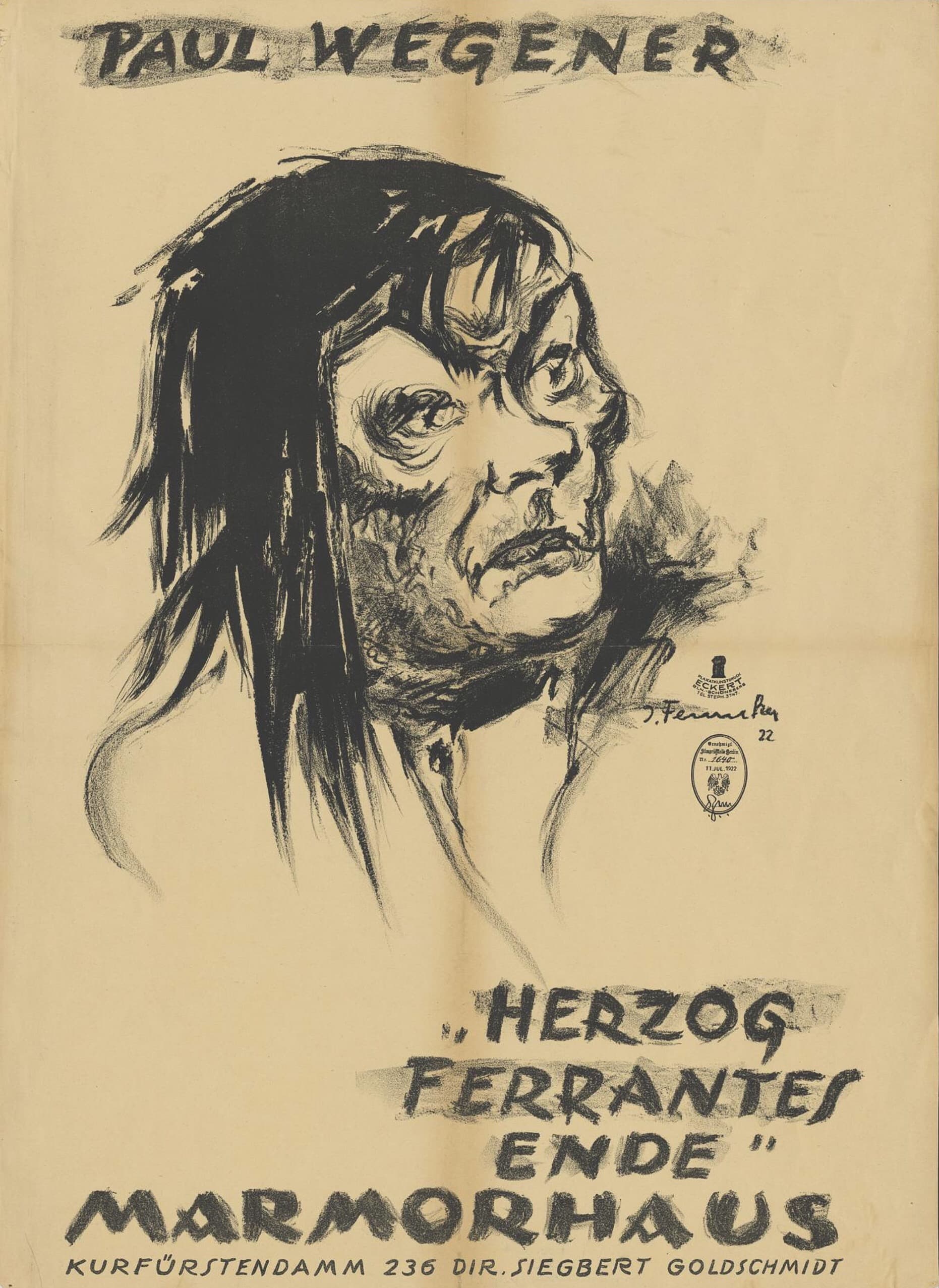
Paul Wegener
actor, director, writer
- Born:
- 1874-12-11, Arnoldsdorf, West Prussia, Germany [now Jarantowice, Kujawsko-Pomorskie, Poland]
- Died:
- 1948-09-13, Berlin, Germany
- Professions:
- actor, director, writer
Biography
Paul Wegener emerged in Arnoldsdorf, West Prussia—an area now known as Jarantowice in Poland—with a lineage steeped in academia, most notably his cousin Alfred Wegener, the pioneering theorist of continental drift. Often conflated with a later figure of the same name—a Nazi Party official—Paul carved his own path, diverging from legal studies to embrace the stage. By 1906, he had joined the ranks of Max Reinhardt’s illustrious theater company, a springboard that propelled him into the burgeoning world of cinema by 1912. Fascinated by the eerie and the supernatural, Wegener chanced upon a centuries-old Jewish folktale about the Golem in 1913. Partnering with writer Henrik Galeen, he co-wrote and co-directed *The Golem* (1915), a groundbreaking film that cemented his reputation as a master of eerie storytelling. He revisited the myth twice more: first with a satirical take in 1917, then with the hauntingly atmospheric *The Golem: How He Came into the World* (1920), a cornerstone of Weimar-era cinema. His work wove together a passion for visual trickery, mysticism, and the uncanny. As the Nazi regime tightened its grip, Wegener navigated a precarious balancing act. Though personally repulsed by their ideology—he secretly supported resistance circles while many of his peers fled or perished—he remained a fixture in 1940s propaganda films. After World War II’s devastation, he channeled his energy into rebuilding Berlin, serving as president of a civic organization to aid survivors. His stage career resumed briefly in 1945, but frail health curtailed it: he collapsed during a performance in July 1948, marking his final role. Retiring to recover, he passed away in September of that year, leaving behind his wife, Lyda Salmonova. Wegener’s legacy endures not only in his cinematic innovations but in the contradictions of a man who harnessed art to confront both wonder and tyranny.
Filmography
Written (1)
Knowledge Base
Frequently Asked Questions about Paul Wegener
Community
Comments
Log in to comment.
Loading comments…