Yevgeny Bauer
director, production_designer, writer
- Birth name:
- Yevgeni Frantsevich Bauer
- Born:
- 1865-01-22, Moscow, Russian Empire [now Russia]
- Died:
- 1917-06-22, Yalta, Taurida Governorate, Russia
- Professions:
- director, production_designer, writer
Biography
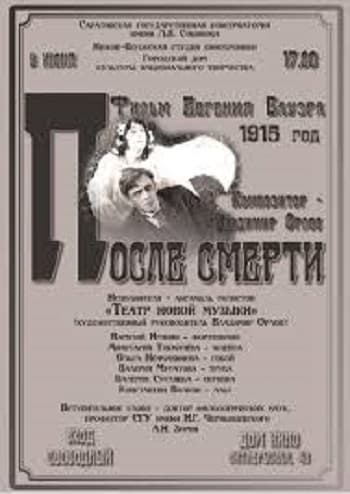
A whirlwind of ink, greasepaint, and nitrate, Yevgeni Frantsevich Bauer compressed a lifetime of art into five pre-revolutionary winters, leaving Moscow with roughly eighty silent witnesses before 1917’s tide washed the old world away. Born in 1865 to a house that never quieted—zither chords from his father Franz, arias from his mother, future footlights for his sisters—Bauer learned early that every surface could sing. Five years at the Moscow School of Art, Sculpture and Architecture taught him to make canvas breathe; musical-comedy stages taught him to make cardboard palaces glow. Between rehearsals he caricatured politicians for the papers, hustled as an impresario, and froze city life in silver-rich photographs that sneaked into magazines during the belle époque. The flicker of moving pictures caught up with him in 1912: Drankov and Taldykin needed someone who could turn a patriotic pageant about the Romanovs into visual splendour. Bauer delivered, then demanded the director’s chair. Four films later he hopped to Pathé’s Moscow plant for another quartet, and in 1913 Aleksandr Khanzhonkov—tsar of Russian producers—opened his doors. The partnership burned white-hot: seventy titles in four years, fewer than half still breathing in today’s archives. Out of the smoke emerged *After Death* (1915), *Her Sister’s Rival* (1916), and *Revolyutsioner* (1917), with Ivane Perestiani’s weathered insurgent glowering at history. Bauer’s signature became the aching social drama. In *Daydreams* (1915), a widower—played by Alexander Wyrubow—chases the ghost of his wife through an actress’s face; the camera clings to grief like perfume. By now 40,000 rubles a year flowed into the Bauer coffers, yet wartime xenophobia nudged him to borrow his spouse’s surname; some 1914 prints credit “Ancharov.” He polished the gleam of Ivan Mozzhukhin, wrapped Vera Kholodnaya in thirteen rapid-fire projects, and coaxed Bolshoi legend Vera Karalli from the stage to the screen for *After Death* and *The Dying Swan* (1917). His tool kit was pure alchemy: shafts of light carving through curtains, lenses that crawled up walls, split screens, deep-focus parlours that looked looted from Rembrandt. Windows framed distant heartbreaks; gauze softened faces until emotion seemed sculpted in mist. While Europe still learned to pan, Bauer’s camera glided, climbed, peered through keyholes, then curled into colossal close-ups that felt like trespass. When Petrograd’s streets grew treacherous, the industry slipped south to Yalta’s Mediterranean evenings and tsarist villas. Bauer arrived as co-owner of Khanzhonkov’s new Crimean studio. There he crafted *For Happiness* (1917), handing the brush—literally—to apprentice Lev Kuleshov when a shattered leg stranded him in a wheelchair. Undeterred, he rolled onto the set of the would-be epic *King of Paris* (1917). Infection stalked him; pneumonia finished the job on 22 July 1917 (Old Style: 9 July). Colleague Olga Rakhmanova stitched the unfinished film together while Yalta cemetery claimed the body that had once raced through corridors of light. Off-screen, Bauer’s heart belonged to Emma Ancharova—actress, dancer, wife—since their first backstage waltz in the 1890s. She later fluttered through *The 1002nd Ruse* (1915) as a wife whose cupboard conceals more than crockery. Sister Emma Bauer also stepped before his lens, ensuring the family trade lived on celluloid if not in flesh. No other Russian director of the nickelodeon age bent space, time, and shadow with such brazen poetry; the revolution devoured many futures, yet Bauer’s surviving frames still flicker like lanterns hurled down a long, dark corridor.