DbcultAccessing Vault...
Film vs Film
Select two cult films to compare side by side.
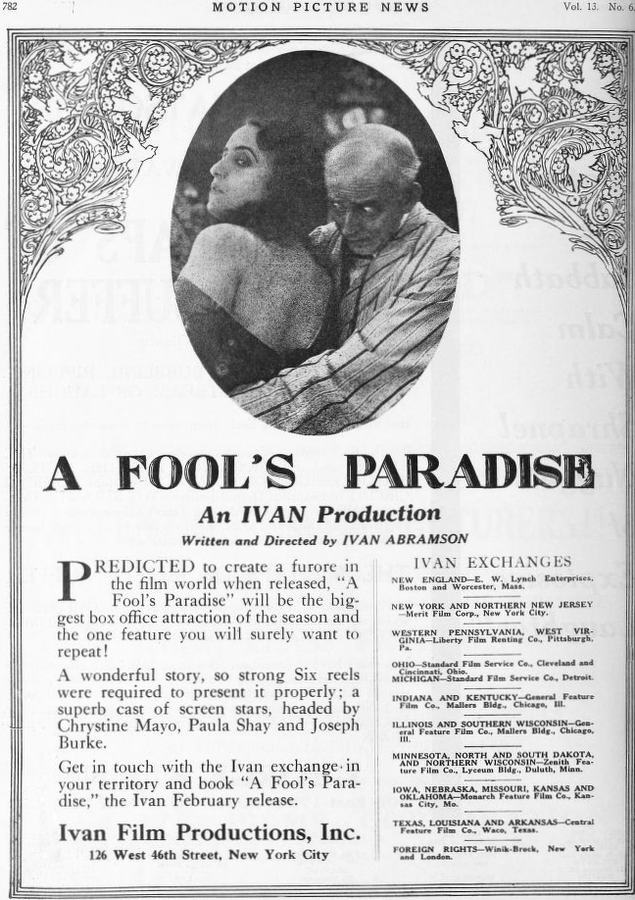
A Fool's Paradise Synopsis
Retired banker Daniel Morgan lives with his wife Paula and their daughter June, who is married to experimental scientist John Lansing. June gives birth to a daughter while Paula is on her deathbed; Paula's last wish is that her granddaughter be named for her and that Daniel present her $50,000 necklace to the girl on her wedding day. Morgan promises to carry out her wish. She dies. For five years, Morgan finds consolation in faithful devotion to the welfare of his daughter and her family. One day he takes them to Atlantic City for a rest. There, induced by June, Morgan visits Maxine, a clairvoyant, who predicts tor him a second marriage to a young woman "who will make his life an earthly paradise." Morgan succumbs to the clairvoyant's wiles, and the next day June finds her father in Maxine's company. Meanwhile, June's husband meets with an accident in New York and June returns to him; Morgan stays in Atlantic City, stating that he has an important "business engagement"--and marries Maxine. Two days later, he brings his wife home. June gives her a cool reception, and as time passes the women become bitter enemies. Later, Maxine persuades Morgan to give her the necklace bequeathed to June's daughter; when June sees it around Maxine's neck, her anger knows no bounds. Maddened with fury, June tears the jewel from the charlatan's throat. Morgan, entering the scene, heeds his wife's reproaches, and in frenzied rage orders June and her husband and daughter from his home. When the governess 30 years in Morgan's service rebukes him for his heartless conduct and warns him that "he is living in a fool's paradise," she too is ordered from the house. June, now living in a cheap boardinghouse with her family in poverty, is about to have another baby. Terrified at the thought of further responsibilities and the bitter recollection that the venom of Maxine's malice has transformed her kind father into a brute who forced this misery on her. June conceives a desperate plan to avoid the consequences of motherhood, but fortunately, her intentions are defeated in time by her husband. John now decides to see Morgan and tell him the facts. Morgan informed by John of their poverty and June's desperate notion, resolves to come to their aid, but, here too Maxine comes forward unexpectedly, orders John from the house, and tells Morgan "she doesn't want his pauper relatives around." One evening, Rufus Stone, Maxine's lawyer and friend takes her to a performance of "Faust." Morgan remains at home. In their absences, he compares "Faust's" with his own life. He sees himself as "Faust" giving the jewels to Maxine, as Marguerite; while Rufus, as Mephisto, laughs mockingly at his folly. Morgan, now awakened, realizes that the old governess was right when she accused him of living in "a fool's paradise." Late that night, Morgan finds Maxine in the arms of Rufus. His infatuation turns to hatred, he tells Rufus, "You love my wife? Take her." He tears the necklace from Maxine's neck and orders the pair from his home. He restores his daughter and family to his home. Maxine now proposes marriage to Rufus, but he tells her she is too late. A week later, while the family is celebrating their reunion, Maxine appears like an ugly shadow from the past. It is her last attempt to regain the old man's affections. He again starts to weaken before her poisonous charm, but his little grandchild rushes to his aid and with her magic power she overpowers the vampire's pretense. Morgan gives Maxine a liberal allowance and freedom and commands her to leave, and she goes forth into the night.
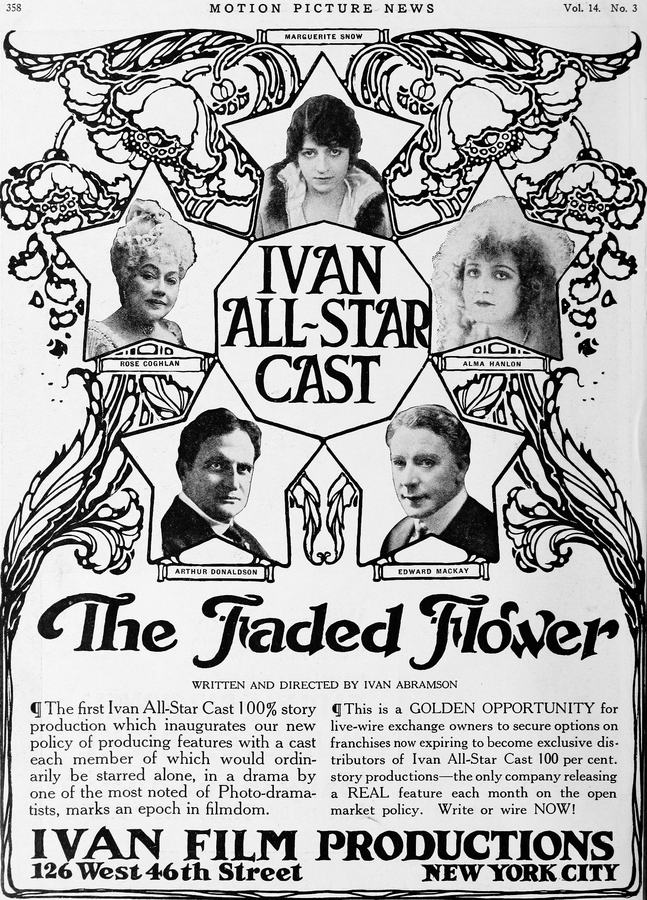
The Faded Flower Synopsis
Elderly millionaire widower Wilbur Mason, father of only child Anne, proposes to his stenographer Lillian Hill, who accepts him because he declares that he will devote his fortune to restoring her blind mother's sight. In the presence of struggling playwright Henry Parker, Lillian introduces Mason to her mother as her future husband. Parker, who thinks himself in love with Lillian, imagines that his heart is broken. After the Masons' honeymoon, Mason engaged a renowned specialist whose operation on Mrs. Hill is unsuccessful. Lillian now sadly realizes that her sacrifice was in vain and becomes cold towards Mason. Two years later Lillian and Anne meet Parker, of whose great success they have read. Parker and Anne fall in love; at Anne's suggestion, Lillian invites him to call on them. He does, hoping to see Anne, but finds Lillian alone. She gives him a rose from among those Mason plucked for her that morning because he knew she loved them. Mason, unseen, sees this gesture and concludes that Lillian's love for Parker is the cause of her indifference toward him. His jealous rage becomes ungovernable and he makes his presence known and orders Parker from the house after tearing from the latter's coat the rose Lillian gave him. Mason thereafter repeatedly charges Lillian with being false to him and in love with Parker. Parker meeting Anne, accompanies her to the gateway of her home, where she leaves him. Mason discovering him there alone believes that Parker has clandestinely met Lillian, whom he later upbraids, again thrusting the rose before her. Lillian, as the result of Mason's accusations, becomes grief stricken and ill. Despondent she leaves her husband's home and returns to her mother where she fades like roses in the autumn winds. Mrs. Hill, fearing for her daughter's life, goes to Mason who is moved by her heart-broken and anguished appeal. He accompanies her, repentant and remorseful, to Lillian's bedside which he reaches in time to receive with her expiring breath the pardon for which he pleads and to hear the doctor pronounce her dead. Crazed with sorrow, scarcely hearing the doctor's words, Mason is about to lift the coverlet from Lillian's face when he is stricken with paralysis. Later at his home he weeps in secret at sight of the now-faded rose which to him has become a symbol of Lillian. Repenting his mistake, he bids Anne send for Parker and consents to their marriage. Troubled by his conscience, Mason's overwhelming woe permits him no rest, and he goes at dead of night to Lillian's burial place, carrying with him roses which in life she so dearly loved, which he tenderly places over her dust. "Lillian, my faded flower," he cries, "you died a martyr to my unfounded jealousy. May your soul find peace in the Kingdom of Heaven."
"A Fool's Paradise" holds a slight edge in general audience appreciation, but "The Faded Flower" offers its own unique cult appeal.
Suggested Watch:
The Faded Flower