DbcultAccessing Vault...
Film vs Film
Select two cult films to compare side by side.
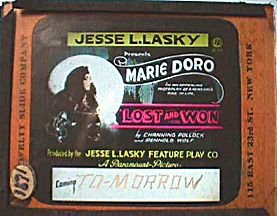
Lost and Won Synopsis
Cinders, a news girl, with a love for books, idealizes as her hero a "Daddy Long-legs," who will someday make her a great lady. Bill Holt, a reporter, is one of her best friends. Walter Crane and Kirkland Gaige observe Cinder's independence as she turns over to a policeman a man who has been annoying her. Later Crane wagers $50,000 that within a year he can transform and improve the girl that one of the men will want to marry her. Crane places her in the care of his aunt, who sends her to a boarding school. At the end of a year she returns home and at once becomes a favorite. Cleo Duvene, an adventuress, demands of Gaige a necklace which he is unable to purchase. Crane meets with reverses and Gaige, anxious to win Cinders, reveals the bet, suggesting she marry him in order that Crane may realize the $100,000 stake. She refuses and goes to her friend. Holt, securing a position as reporter on the paper. Crane accepts the position of assistant cashier in the bank of which Gaige is vice president. In order to buy the necklace for Cleo Gaige takes a bag of currency and Crane, accused of the theft, is placed in jail. Cinders goes to Gaige and by placing chewing gum on the end of her umbrella, picks up the pieces of a receipted bill for the necklace. She gets into the apartment of Miss Duvene, and is demanding that she tell all she knows of Gaige just as he comes in. They bind Cinders but she manages to get the telephone receiver down, calls Holt, who hears the conversation of the three, and with Crane and a policeman apprehend the guilty man just as he is about to escape. Crane frees the brave little girl and takes her to his arms with the statement that it pays to lose some bets.
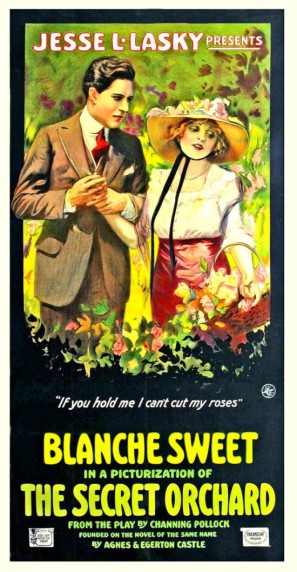
The Secret Orchard Synopsis
The sound of merry voices and the clinking of wine glasses came through the closed door of a child's room in an apartment situated in a quarter of Paris where night life predominates and where revelers know they may come and go as they please. It was late at night. The child had been asleep, but awakening, frightened, she stepped to the door a moment to listen and then fearlessly, having heard the musical laugh of her mother, she opened the door and entered a large room. It was filled with men and women, whose gaiety may have had some inspiration from the bottles which poked their heads above the rim of ice buckets, which formed an outer fortification around the banquet table. At the sight of the child the conversation ceased for a moment, then burst forth at some indiscreet remark. A woman arising from the head of the table hurried across the room, caught the child in her arms and carried her back into her room. The woman was Cora May, the child her daughter Diane, age four. Cora May was one of the stirs of the Parisian demimonde. The next morning Cora took the child to a convent, bade her a tearful farewell, and returned, sorrowful, to Paris. In her ears there still rang relentlessly the words spoken by a friend the previous evening when he saw the child, "She has the devil in her eyes, Cora, just like you." The little girl, Diane, grew up in the convent, learned to love the sisters and their sweet ways, blossomed into lovely girlhood and at 19 she left the convent to pass a vacation at a friend's home by the seashore at Narbonne. "Monsieur le Chevalier" saw her one day. Her beauty attracted him, her innocence kept him at a distance, but her eyes, those eyes wherein the "devil" was lurking, baffled and confused him. There followed a flirtation, innocent enough, a few words between them, a declaration of love and Diane had fallen a victim to the worldly wiles of "Monsieur le Chevalier," who was, in fact none other than the Duke of Cluny. Meanwhile Cora May, Diane's mother, had died, never having seen her child from the day she had taken her to the convent. Deserted by her care-free friends she found sympathy in a woman of rank, Duchess of Cluny, who sat at her bedside and watched an unhappy life ebb swiftly away. The Duchess made one promise: she would seek out the child, Diane, and take her into her home and guard her from temptation. Diane, still stunned by the experience of her betrayal, dedicates her life to the friendship for the kind Duchess, never associating her with "Monsieur le Chevalier." Subsequently Diane and the Duke, filled with remorse because of his indiscretion, recognize each other yet spare the Duchess, whom each loves from their secret. The past would have remained untold had Diane and not Lieutenant Dodd, U.S.N. fallen in love. The young woman refuses marriage but withholds her reasons, but the young American is obdurate and in time the truth dawns upon him. In a duel he kills the Duke of Cluny who by death atones for his sin, and we are left with the reasonable conclusion that in time Diane and Lieutenant Dodd find happiness together.
"Lost and Won" holds a slight edge in general audience appreciation, but "The Secret Orchard" offers its own unique cult appeal.
Suggested Watch:
Lost and Won