DbcultAccessing Vault...
Film vs Film
Select two cult films to compare side by side.
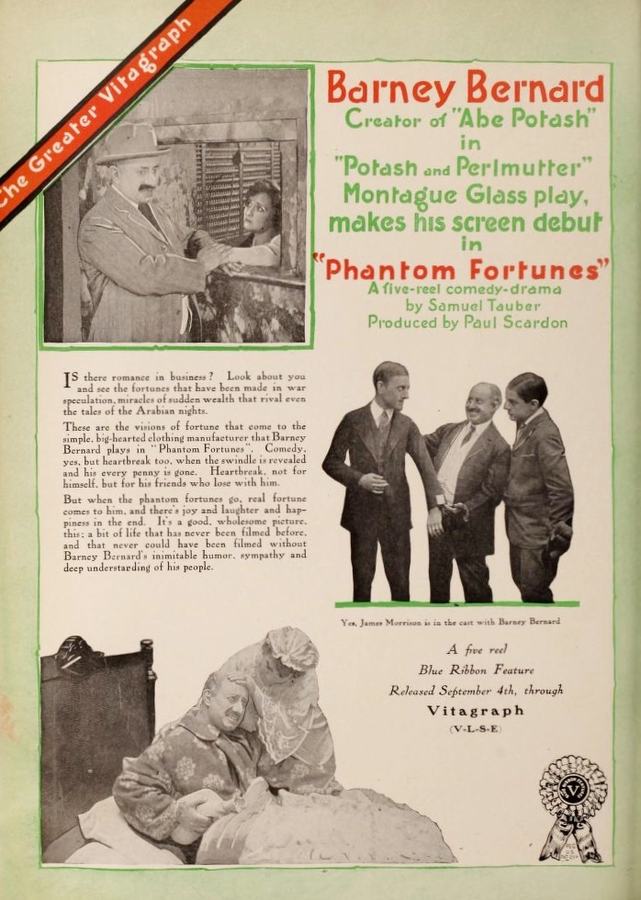
Phantom Fortunes Synopsis
Bob Deering on his way to business meets his sweetheart, Molly Sherman. He arrives at Milliken and Co., stockbrokers, his place of employment, just in time to save Herman, Zalmon Pinsker's 14-year-old son, from a very rough engagement with the other messengers in the office. For this act Herman takes him to his father's shop and obtains a suit at wholesale, and it is here that Bob meets Ike Mandell, who is in love with Dora, the daughter of Pinsker. Previous to this meeting Pinsker re-engaged Mandell after having hired and fired him at least ten times, and also just previous to Bob's arrival with Herman, Moses Hecht and Israel Classman had an argument with Mandell, who, trying to look after Pinsker's business, tried to force them to pay certain notes which had been endorsed by Pinsker. Mrs. Pinsker and Dora arrive and realize that if Pinsker keeps up this pace of unorganized charity they will have little if any chance of obtaining the new dresses for which they came. Later the stock market closes on account of the war, and both Herman and Bob are out of a job. Bob calls upon Molly, who is a telephone operator in a hotel. There he meets "Red" Dorgan, who interests him in war orders. Clothing, sweaters, and shirts are needed for the allied armies, so Bob goes to Pinsker and agrees to get him a contract that will at once make him a rich man. Pinsker is overjoyed. Bob returns to Dorgan, and it is arranged that the manufacturer shall meet the commission. Ike Mandell has a cousin, Abie Lefkowitz, another clothing manufacturer, and he feels that if he can give Pinsker the double cross and get the business for Lefkowitz he will be able to marry Dora. Ike arranges with Dorgan to switch the order to Lefkowitz, who has to give Ike an advance commission of $8,000 for his work. Bob apprises Molly of what he has done for Pinsker, but she has her misgivings about Dorgan. The contestants for the big war order is requested by the commission, which has quarters in the hotel in which Molly is a telephone operator, to have samples of their goods at the commission's offices. The different clothing manufacturers comply, and when each at different times receives most encouraging reply concerning their samples each refuses domestic orders so that all time possible may be devoted to the commission's order. The hotel detective becomes suspicious and after a short conversation with a Scotland Yard man who has been on Dorgan's trail for months, they, with Bob, examine the commission's quarters. They are now firmly convinced that the scheme is a fake, and Bob conveys this information to Pinsker. He is greatly discomfited over the revelation, but Bob gets an idea which will net Pinsker a considerable sum. All the other clothing manufacturers are refusing domestic orders pending advices from the commission, so Bob helps Pinsker to corner the home market. This scheme is successfully executed. Ike Mandell, jealous, is busy instituting a strike among the employees, but his plan is soon frustrated by Bob. Lefkowitz scenting that something is wrong, goes to the hotel, where he is told of the fake affair. The crooks are captured. It is then that Lefkowitz tells of a $6,000 check and that it was made out to Bob. The police now go with Lefkowitz to the shop of Pinsker, where they try to fasten the check upon Bob, but he has given it to Dorgan, and Pinsker agrees that if his is the only signature on it, he, Pinsker, will make good for Bob. Molly goes to Pinsker, who introduces her to his new partner, Bob Deering, and assures her that she need not "hello" any more if she will marry this live businessman. Molly is pleased, and is further glad to know that Mandell has lost out with Dora, who is going to marry Glassman, who is now making his fortune through Bob's methods of wide-awake business.
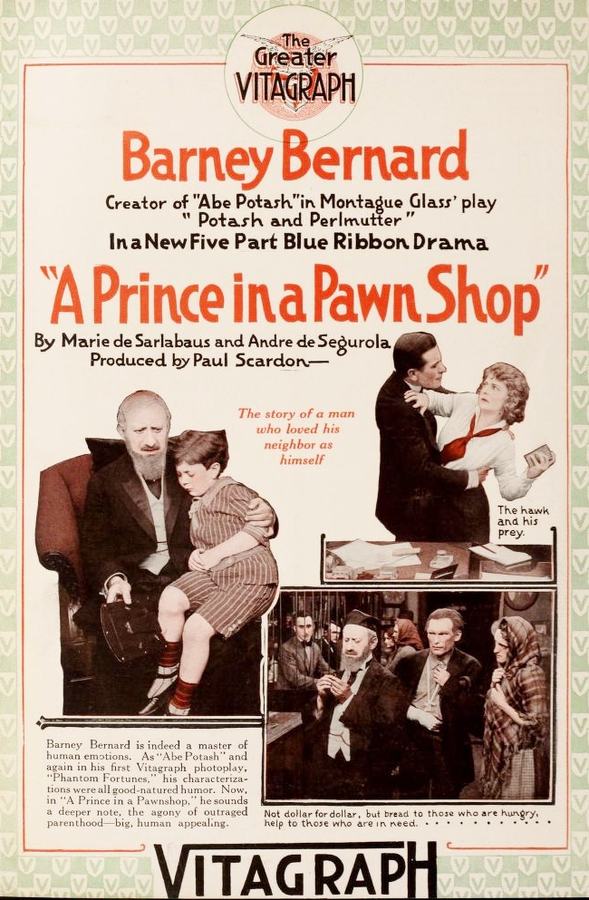
A Prince in a Pawnshop Synopsis
David Solomon, a wealthy banker, is merciless in his dealings with his rich clients, from whom he exacts the highest interest. He aids the poor as much as possible. To facilitate his kindness among the people of the Ghetto, he runs there a pawnshop, unlike all others, for to the needy he measures out money, not according to the value of the articles they offer, but according to their needs. David's son, Maurice, is given to high living. It grieves his father, who is, however, consoled by the fact that his daughter, Ethel, seconds her father's charities by maintaining a day nursery for the children of the poor. One day David sees a young girl fall unconscious in the street. He takes her to the hospital where the doctor tells him that the girl, Mary, is suffering from exhaustion. David's heart is touched and he resolves to make Mary's future his own care. When she has regained her strength he finds her a position as a model in a dress house of a friend, Silver. Ethel visits the dress house to buy gowns, bringing Maurice with her. He sees Mary for the second time, having noticed her upon the street. Maurice arranges to meet Mary under an assumed name, and pursues his courtship with all seeming love. She so learns to worship Maurice that she gives him all, not stopping to count the cost, nor to demand the wedding ring. For a brief while Mary tastes of a great happiness, but Stevins, the man for whom she once worked, and who, because she would not encourage his advances, drove her from every honest position, naming her as a thief, visits the dress house to get gowns for "The Bunch of Flowers," a set of girls so termed by Maurice who has been much in their company. He recognizes Mary, repeats the accusation, and her employer discharges her. Mary returns to the little flat supported by Maurice, where she tells her story. Maurice has begun to tire of her. He seeks Stevins, who tells a seemingly truthful story. Maurice believes it and leaves Mary, writing to this effect. He, however, does not know that the girl he has wronged is about to become a mother. Six years elapse, and we find Mary and her little son, living in poverty. Again she is rescued by David Soloman, who has called to see a deserving case next door to Mary, the object of his charity being Mrs. Payne, the landlady who drove Mary from her door, and who is now a paralytic. Mary tells David her story, showing him the letter from her lover. He recognizes the writing of his own son. He takes his grandson home with him where the child is seen by Maurice, who is conscience stricken. Heinstitutes a search for Mary. Stevins, the man who hounded Mary, needs a further extension of his loan from David. But David, having learned what he has done, Mary forces him to the wall and ruins him. Goldstein, who has been a faithful secretary to David, resigns. He loves the daughter of David, but being a poor man does not declare his love and so decides to leave for other parts of the country. David has watched the love which has existed between Ethel and Goldstein, and gives Goldstein a check for a large amount, quite sufficient to start them on their honeymoon. David informs Maurice by telegraph, not signing his name, where Mary may he found. He then goes to her with her little son. Maurice arrives, and makes reparation by marrying Mary.
"Phantom Fortunes" holds a slight edge in general audience appreciation, but "A Prince in a Pawnshop" offers its own unique cult appeal.
Suggested Watch:
A Prince in a Pawnshop