DbcultAccessing Vault...
Film vs Film
Select two cult films to compare side by side.
The Bigger Man Synopsis
In a prologue, the relationship between capital and labor throughout history is shown in caveman days, Biblical times, and the feudal period. In the main story John Stoddard, a construction chief building a gigantic bridge for capitalist Courtlandt Van Nest, sympathizes with the workers' dissatisfaction with low salaries and subsistence conditions. When his attempts to negotiate with Van Nest fail, the workers, led by agitator Lavinsky, prepare to strike. Van Nest's daughter Janet, who is engaged to a militia captain, visits the site and is appalled by the squalor. Despite their differences, Janet and Stoddard fall in love. When the strike breaks, Van Nest sends in the militia. As they prepare to fire, Stoddard sees Lavinsky about to throw dynamite, and wrestles it away. He then agrees to Van Nest's demand for settling the strike that he refrain from seeing Janet. After Janet leaves home to help poor families, Van Nest looks for her at Stoddard's house where Stoddard demonstrates that because of their similar ancestry, he and Van Nest are not very different. When Stoddard's sister Edith allows Van Nest to witness the surprise reunion of a worker and his wife from Europe, to whom Janet had sent transportation money, Van Nest softens and agrees to Janet's marriage to Stoddard. An epilogue follows showing blindfolded Justice saying to fat Capital and burly Labor, "Why quarrel? You are worthless without the other."
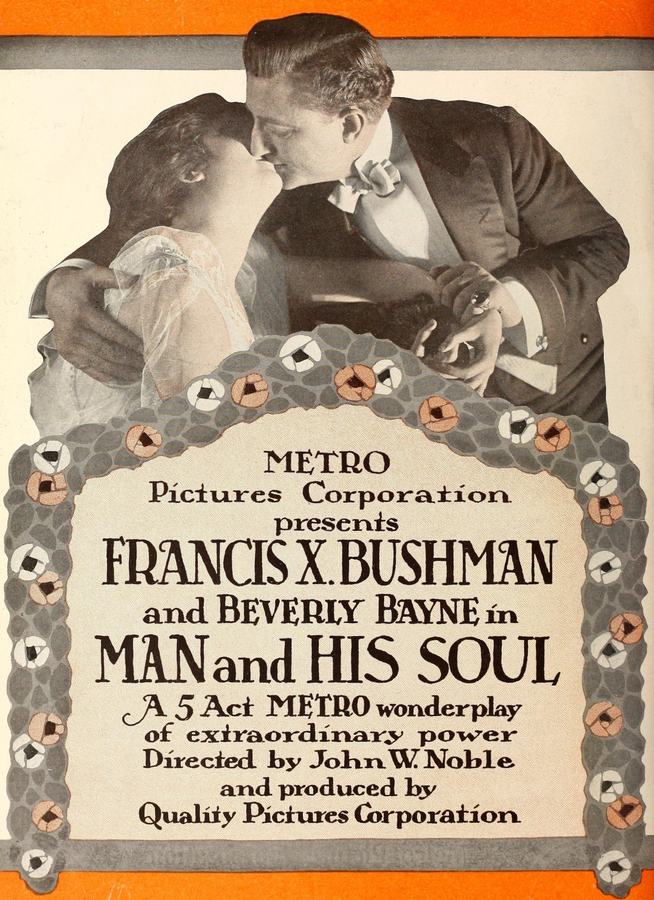
Man and His Soul Synopsis
The allegory which begins the story represents the world before the creation of man. Out of the elements is born Conscience. Conscience is then present at the fall of the first parents, and drives them from the garden. Conscience is again present when Moses breaks the tablets of stone in his anger at the Israelites for their idolatry on Sinai. At last Conscience sustains the Christ when He stands on trial before the Roman Governor of Judea, Pontius Pilate. Then begins the story. A child is born, bearing the name of John Conscience. The figure of the allegory is seen to touch the newborn babe, and it is fore-ordained that he is to be a creature of Conscience. The child grows to manhood. He holds the chair in economics in a great university, and is delivering an exhortation to the graduating class. He tells the young men of some of the shameful conditions the wealthy employer class is imposing upon the poor and helpless class. He bids them go forth with conscience to guide their careers, and that they will be successful in the real sense. The wealthy men, trustees of the university, etc., who are in audience, disagree with John Conscience's principles to such an extent that they demand his resignation, as the result of the speech. One of them, however, Stephen Might, whose son Stephen Might. Jr., is among the students, feels that John Conscience will be a great success in some business where the question of conscience will not be raised, and tells him that he will have a position for him whenever be may want it. John Conscience, sustained by the encouragement of his mother, tries in various fields, without success. He happens to see a girl who is about to end her efforts to succeed and still remain good, by plunging into the river. He dissuades her and takes her to his mother. She tells her story, how she had left her father's roof to earn her living and be useful in the world, and the mother advises her to go back to her father. John is inspired with new hope after his good deed, goes to Stephen Might, obtains a position for himself, and also one for the girl. He rises in position with this concern, and a love affair develops between them, but Stephen Might, Jr., also falls in love with the girl. At a time when a rival company is trying to bribe John Conscience to divulge secrets which will mean the undoing of Might and Company, John Conscience comes upon Mary Knowles, the girl, in the arms of Stephen, and thinks she has accepted him. His mistake causes him to throw off conscience, and begin a grinding, resolute, uncompromising drive for wealth. In Chicago John Conscience takes the name of John Power. He comes to the control of great interests, owns factories, and rules over all these interests with a hand of iron. His employees are but mechanical parts of his structure, and he has no soul, no heart. When the girl realizes what he had meant to her, she denounces Might, Jr., and her father, who had helped about the situation, and runs away. At the time Power's success is at its zenith she us a stenographer in one of his factories. At this time also, in his determination to avenge himself upon Stephen Might, Jr. he is using unfair business methods to drive the Might concern to the wall. Young Might learns that it is the Power firm which is oppressing them and goes to see Power, not knowing who he is. He arrives, and as John is about to drive home his revenge, Stephen tells h him of a mistake, that he thought Mary was with him, as she ran away the same night he had disappeared. John has been harassed by the public safety committees about the unsanitary conditions and lark of safety in his factories, and has been obdurate and unresponsive. Now, he sees that he was wrong, experiences a faint hope, and tells Might he will let him know the next day what can be done. He goes home, and sits by the fireplace in his library to think. Conscience appears to him again, and shows him, by a series of contrasts, the difference between the power he has achieved over the financial world and that which Conscience wields over the souls of men. He is receptive, and Conscience again enters his soul. He calls for architects and builders to reconstruct his factories, for the safety of his employees, and before they can begin work a great fire breaks out in one of his factories, and Mary is caught in an upper story. John rides to the scene, and sees her at a window. He rescues her and their romance finds its proper conclusion.
"The Bigger Man" holds a slight edge in general audience appreciation, but "Man and His Soul" offers its own unique cult appeal.
Suggested Watch:
The Bigger Man