Film vs Film
Select two cult films to compare side by side.
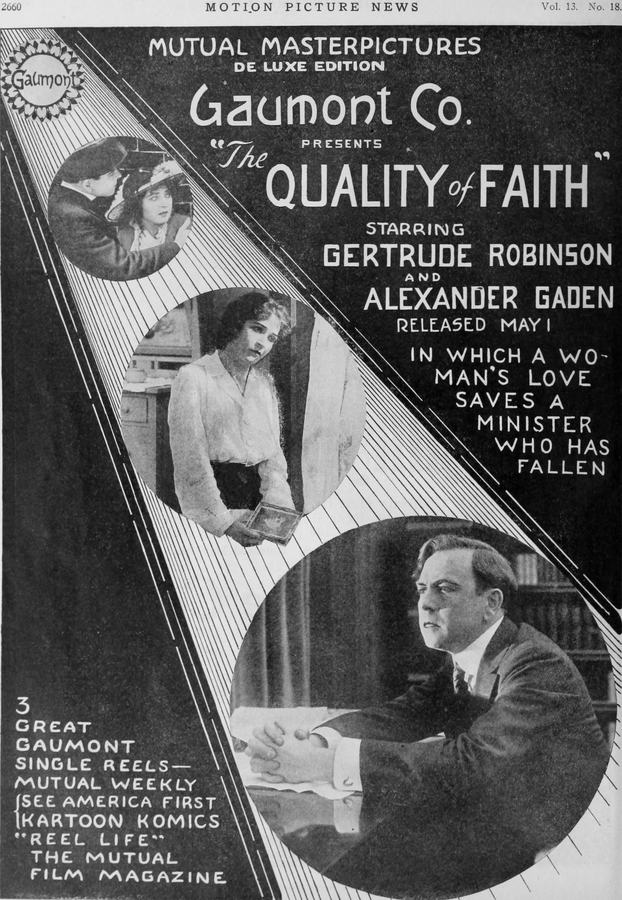
The Quality of Faith Synopsis
Albert Richards, the young pastor of a fashionable and wealthy church, woos Louise Alford and wins her promise to become his wife. She is the daughter of a wealthy mill-owner, John Alford. Louise is a vain, pleasure-loving girl. Her love for Albert is only a passing fancy. After realizing the monotony of such a life as would be hers as his wife, the finally jilts him for Guy Carlton, a society admirer. In the meantime labor troubles arise in the mill owned by Louise's father. The leader of the mill workers is a home-loving, peaceable fellow, Baker, hard-working and reliable when unmolested, but a man of high temper when aroused. Baker is elected head of the first delegation sent to petition Alford not to increase the hours of their labor, as he proposes doing. The petition is denied. While visiting among the poorer classes of the city, Richard is called to minister to a factory girl who has been horribly hurt in Alford's plant. The dramatic story of conditions that exist in the factory told the minister by the grief-stricken father arouses in him the desire to investigate for himself. Later, the tragic squalor and privation of the working people is further revealed to the minister. These scenes confirm his resolve to make an effort in behalf of these unfortunates. On his way home after one of these visits Richards encounters a girl and man in combat, the bully beating the woman unmercifully. He goes to her rescue and assists the girl to her nearby home. The pastor learns that she is Marna, a woman of ill-repute. Struck by her apparent unhappiness and unrest, the minister succeeds in getting her to tell the story of her present life. Ill-health has incapacitated her for work in the factory, where there is no sympathy and had led her to a life of shame for a bare livelihood. Cheered by Richards' words of encouragement, Marna grasps eagerly at his offer to help her and later finds a haven through his efforts in the Salvation Army home. With the gathering of clouds on the factory horizon, Richards takes active interest in the cause of the workmen. His final break with the Alford family comes over his position in the matter. In a riot of the striking workmen, Baker is arrested for inciting it and is given two years in prison. Richards is dismissed from his church and comes under the influence of an atheist. He falls into debauchery, where the love and faith of Marna are the two abiding lights. His literary work also fails of success at the same time. Louise has married Carlton. But the bottom of the pit is finally touched by Richards, and success as a writer at last comes to the erstwhile minister. With renewed popularity, Louise, who has wearied of her husband, sets a trap to again catch Richards with her wiles, but he proves himself strong, and is rewarded by the love and devotion of Marna. Alford, the factory owner, succumbs to heart failure just before Baker comes from prison to kill him because he was the cause of the strife and tragedy at the mill.
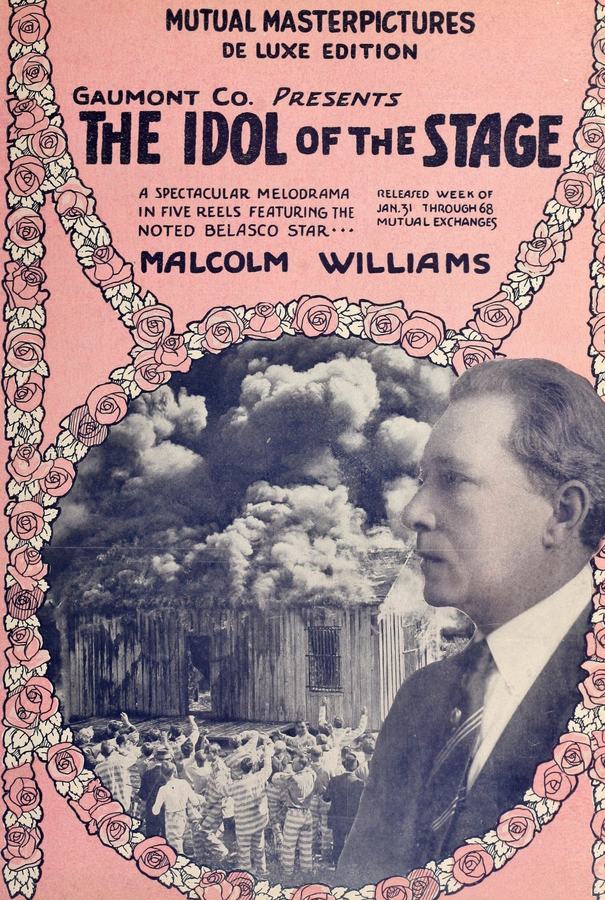
The Idol of the Stage Synopsis
Proud of his Knickerbocker descent, the Elder Van Kortland is ashamed of his son, Philip, for having adopted the stage for a profession. Although Philip is famous as a Broadway Star under the name of Edwin Hargrave, his father begs him to give up the stage and marry the daughter of an old friend. Hargrave refuses to give up his life-work or to marry a girl whose name he does not even know, much less a girl whom he has never seen. He departs on a western tour. While playing a week in a western city he meets and falls in love with Doris Morton, not knowing that she is the girl his father hoped he would marry. Her father, not knowing that Hargrave and Van Kortland are one and the same, tells Doris he would rather see her dead than married to an actor. Philip and Doris elope and are married. Philip and his wife go to Chicago, where he is booked to play several weeks. Here she falls ill, and the actor learns that long and careful nursing will he required to restore her health. He watches over her until his own health is wrecked from his stage work and sleepless nights nursing her. While building up his own constitution, he becomes a victim of narcotic drugs. Leaving Doris in charge of a nurse, Philip continues his tour. When this ends he accepts a position as leading man of a southern stock company to get money to pay the expenses of his wife's long illness. Marion, daughter of the manager, falls in love with him, not knowing that he is married. His mind clouded by a drug, Philip wanders into a Chinese Opium den masked as a curio shop. Here Marion follows him. Philip pretends he is buying a bracelet. This he gives her to allay suspicion, but later she finds him smoking in a back room. Trying to get the actor away from the den, she puts her diamond ring on his finger, coquettishly telling him it is in exchange for the bracelet. Finally curiosity overcomes her, and despite Philip's objection she tries opium smoking. Philip's senses are deadened by the drug and he does not know the effect it has on her until he awakens the next morning to find Marion in a nearby bunk. Realizing the situation, Hargrave resigns from the company as soon as he has safely led Marion from the opium den. Marlon sees the note to her father which says Hargrave, as he is known, must rejoin his wife in Chicago. Her love turns to hate. When Philip reaches Chicago Marion has him arrested for stealing her diamond ring. Mentally irresponsible because of his drug habit, Philip cannot make the fight that he should. He weakly pleads guilty, despite his duty to his wife, so that Marion, whom he considered had been kind to him, should not be compromised because of her visit to the opium den in an effort to save him. The convicted man is sent to a convicts' camp. Here Doris visits him. She arouses the passion of Clark Porter, a "Trusty" who secretly supplies Philip with morphine when told that Philip will be free as soon as he is cured of his craving for narcotics. Through trickery Porter gets an account of Doris' visits to the camp into a blackmailing society paper, making it appear that she is coming to see him. Doris is thereafter refused admittance and Porter thinks to win her when his short term expires. Doris disappears and leaves no trace of her whereabouts, her story not having been believed. When her baby son is born she does not communicate with her husband or her family. Because of the story in the society paper, Philip thinks his wife has deserted him. When he leaves prison he goes into business forsaking the stage. Finally he establishes himself in the city where Doris is living, her son now old enough to contribute to her support by selling newspapers. On the night of a benefit performance of "Ingomar," the hero is taken ill. The elder Van Kortland, who is visiting his son, suggests that Philip play the part. He does so on short notice. Doris is in the audience and recognizes him. Already Philip has been drawn to the little newsboy, his own son, and it is through giving the lad tickets that Doris happened to be present at the performance. On the way home from the theater, Doris is recognized by Porter, now a tramp. He follows her and forces his attentions upon her. The boy, seeking help, appeals to Philip and the elder Van Kortland. They rush to aid the boy's mother, and are overcome with surprise to learn that the woman is Doris. Philip forces a confession from the tramp, thus learning of his wife's innocence. The two are reconciled, and Philip's father is so softened that he even agrees that his grandson may follow the stage as a profession without protest.
"The Quality of Faith" holds a slight edge in general audience appreciation, but "The Idol of the Stage" offers its own unique cult appeal.
Suggested Watch:
The Quality of Faith