DbcultAccessing Vault...
Cult Review
Senior Film Conservator
The Silent Architecture of Adolescent Failure
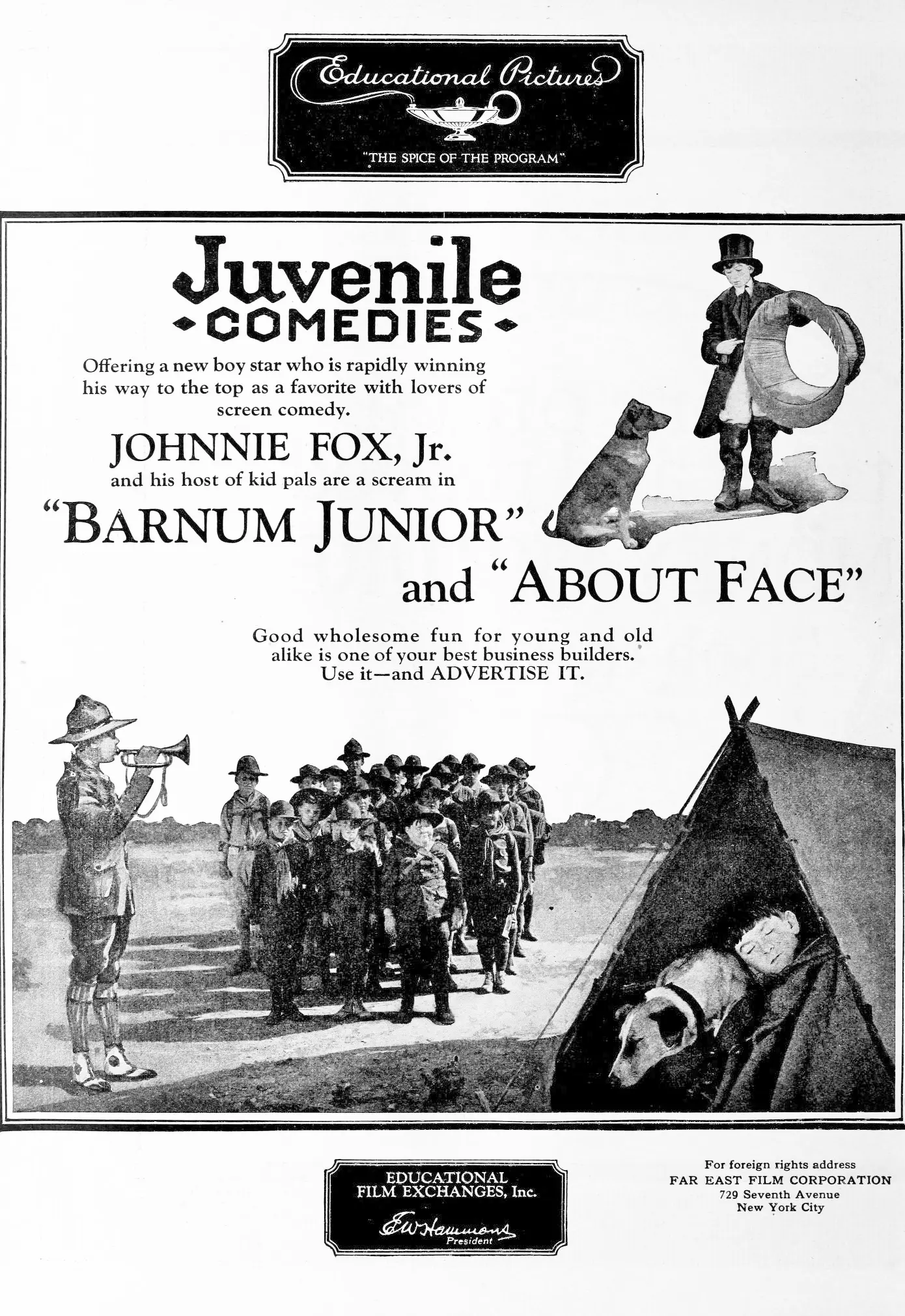
In the pantheon of early silent shorts, few films capture the visceral sting of social ostracization with as much unvarnished sincerity as About Face. The film operates not merely as a narrative, but as a cultural artifact documenting the burgeoning obsession with character-building institutions in the post-Great War era. We are introduced to our protagonist, portrayed with a hauntingly expressive vulnerability by Tommy Hicks, at the very moment of his collapse. He is not a villain, but a casualty of a system that demands a level of asceticism—the Boy Scout discipline—that his youthful spirit cannot yet encompass. This failure is framed not as a minor lapse, but as a foundational crack in his burgeoning manhood.

Unlike the more whimsical domesticity found in Polly Put the Kettle On, About Face leans into the stark reality of the 'outsider.' When Hicks is dismissed from the camp, the camera lingers on the physical space between him and the retreating ranks of his uniformed peers. It is a spatial representation of shame. The direction utilizes the naturalistic lighting of the outdoors to contrast the 'enlightened' space of the camp with the murky, uncertain world of the individual who has lost his way.
The transition from the structured wilderness back to the domestic sphere is handled with a jarring cinematic rhythm. Home, typically a sanctuary, becomes a theater of escalating difficulties. Here, Johnny Fox provides a counterpoint that enriches the film's texture. The 'all sorts of difficulties' mentioned in the plot are not merely comedic slapstick; they are manifestations of a psyche in revolt. Without the external scaffolding of the Scout code, the youth's energy turns inward and outward in destructive bursts. It is a theme we see echoed in the more tragic dimensions of Moral Suicide, though About Face maintains a thread of optimism that prevents it from descending into nihilism.
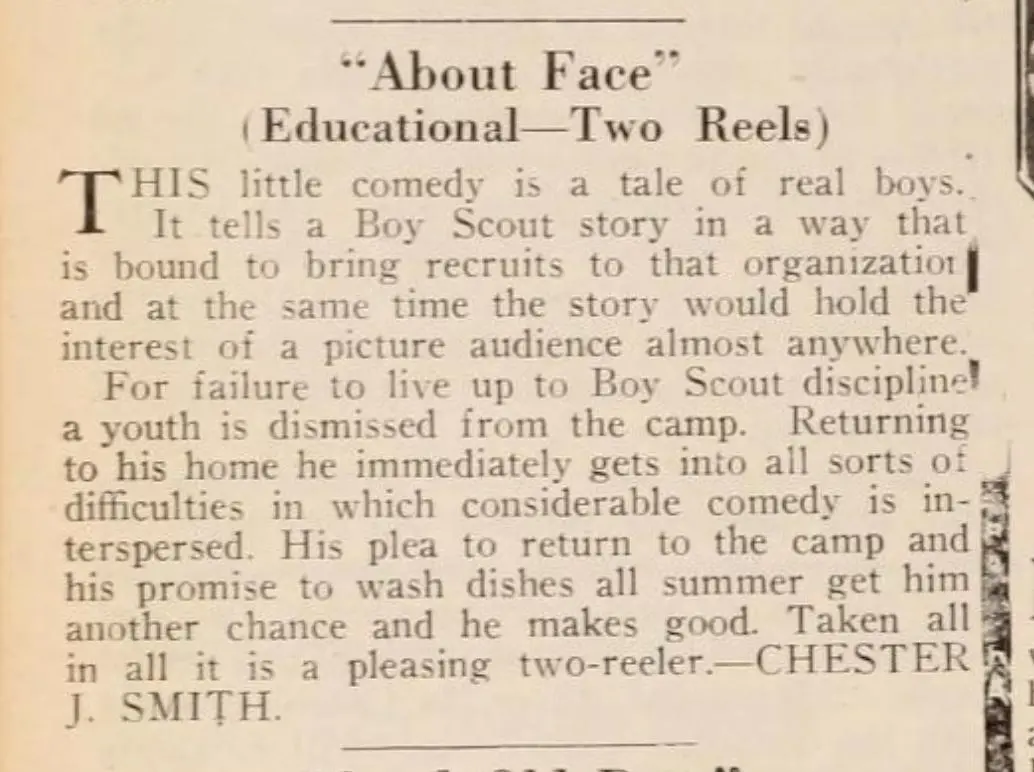
The climax of the film—the plea to return and the promise to wash dishes—is perhaps one of the most poignant depictions of 'labor as liturgy' in silent cinema. By choosing the most menial, repetitive, and invisible task available, the protagonist signals a profound ego-death. He is no longer seeking the glory of the merit badge; he is seeking the humility of service. This transition from the ego-driven failures of his first stint to the service-oriented commitment of his second is a masterclass in character development within a limited runtime.
When analyzing the visual grammar of About Face, one cannot help but compare its rugged aesthetic to the frontier stoicism of Channing of the Northwest. However, while Channing focuses on the external conquest of the wild, About Face is concerned with the internal conquest of the self. The youth's struggle is not against the elements, but against his own lack of focus. This internal struggle is a precursor to the more complex character studies we would see in later decades, yet it is presented here with a purity of form that is often lost in modern talkies.
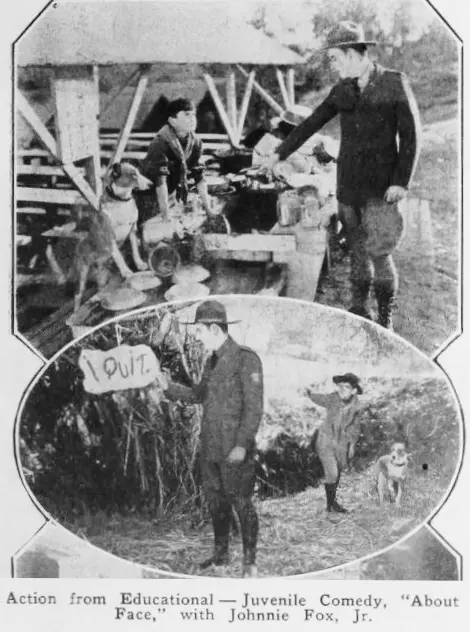
Furthermore, the film’s pacing shares a certain DNA with A Champion Loser, where the narrative relies heavily on the protagonist's ability to garner empathy through failure. Tommy Hicks possesses a face that is a map of adolescent anxiety; every twitch of his mouth conveys a volume of dialogue that title cards could never fully capture. It is this performative sincerity that elevates the film above mere propaganda for the Scouting movement.
"In the washing of a single plate, the protagonist finds a clarity that the entire handbook of discipline could not provide. It is the zen of the mundane, a silent prayer for a second chance."
The cinematography, though limited by the technology of the early 20s, exhibits a surprising sophistication in its use of depth. Deep focus shots are utilized during the camp scenes to show the protagonist's isolation from the group, while close-ups in the home sequences emphasize his claustrophobia. The 'difficulties' he encounters are shot with a frantic, handheld-like energy that predates the French New Wave’s obsession with urban chaos. This stylistic choice mirrors the protagonist's internal state—unsettled, erratic, and desperate for the anchor of discipline he once rejected.
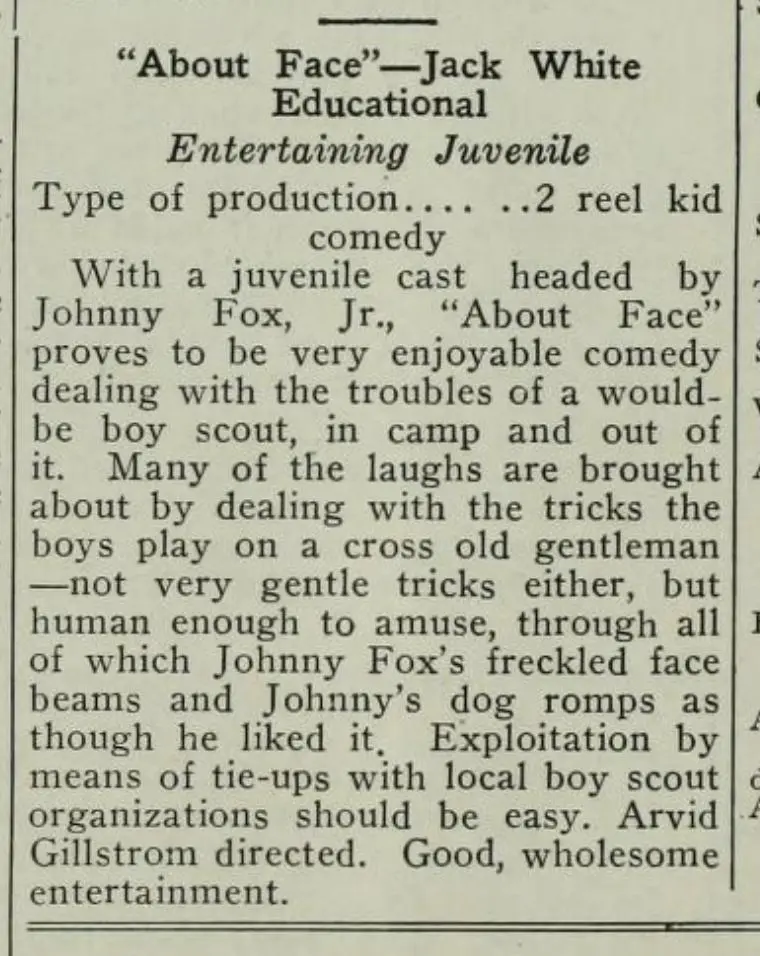
In contrast to the historical grandiosity of Fridericus Rex - 1. Teil: Sturm und Drang, About Face is a small, intimate portrait. Yet, it carries a similar weight of 'sturm und drang' (storm and stress) within its adolescent framework. The stakes are not the fate of a nation, but the fate of a soul. The film understands that for a young boy, the expulsion from his social circle is an existential threat equivalent to the loss of a kingdom.
The chemistry between Hicks and Fox is the film's secret weapon. While Hicks carries the emotional burden, Fox provides the necessary friction that drives the plot forward. Their interactions are devoid of the theatrical overacting common in the era; instead, they opt for a grounded, almost mumblecore-esque realism. This realism makes the protagonist's eventual 'making good' feel earned rather than orchestrated. It isn't a magical transformation but a slow, arduous process of dish by dish, day by day.
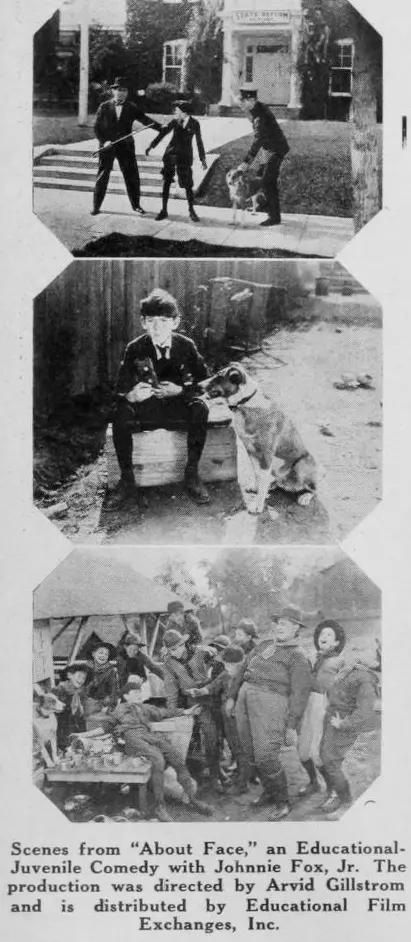
We see echoes of this grounded performance style in Ragged Robin, but About Face strips away the romanticism to focus on the grit. The final scenes, showing the youth back in camp, are not celebratory. There are no parades. Instead, there is the quiet dignity of a boy who has learned that the hardest face to face is the one in the mirror.
About Face is a testament to the power of the short form. In its brief runtime, it manages to dissect the American obsession with discipline, the pain of adolescence, and the beauty of a second chance. It avoids the melodramatic pitfalls of films like A Sister to Salome or the vanity explored in Vanity's Price, opting instead for a narrative of pure, unadulterated growth.
For the modern viewer, the film serves as a reminder that the themes of redemption and self-improvement are timeless. The 'dishwashing' resolution remains a powerful metaphor for the work required to rebuild a shattered reputation. It is a film that demands to be watched not as a relic, but as a living piece of moral philosophy. The youth's journey from the 'failure' of the first act to the 'making good' of the third is a universal map for anyone who has ever felt the sting of rejection and the burning desire to return home.
While it may lack the epic scale of Famous Battles of Napoleon, its emotional battles are no less significant. About Face is a quiet triumph of the human spirit, captured in the silver halides of a bygone age, yet speaking with a voice that remains remarkably clear today.

IMDb —
1923
Community
Log in to comment.