DbcultAccessing Vault...
Cult Review
Senior Film Conservator
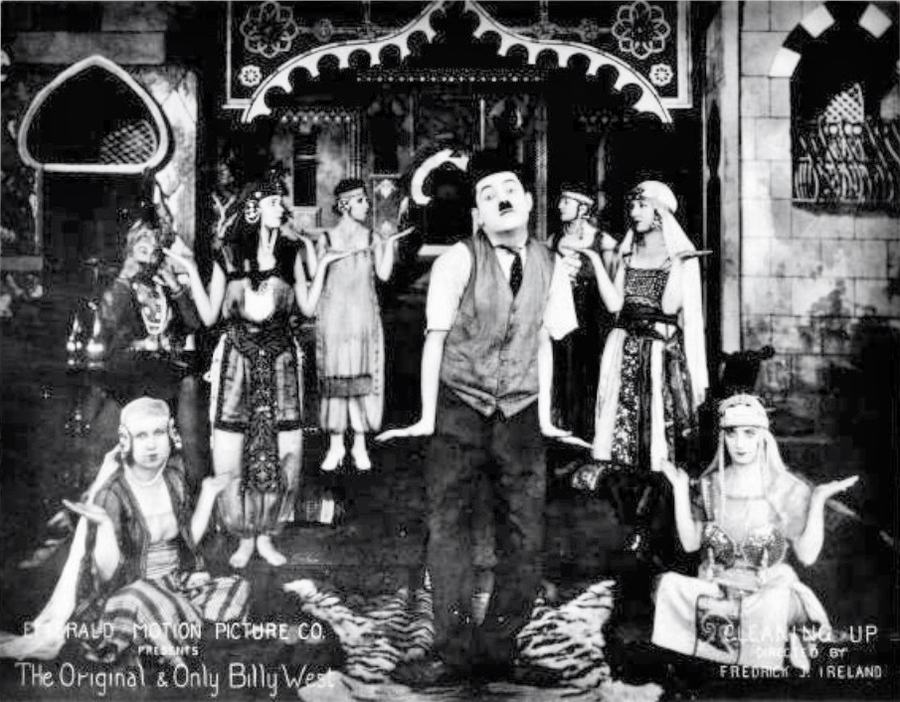
Imagine Charlie Chaplin’s janitor from The Bank wandered into the labyrinth of The Cabinet of Dr. Caligari, traded his bowler for existential dread, and decided the only way to disinfect the world was to erase the filmstrip itself. That jittery alchemy is Cleaning Up, a 1920 one-reel marvel that most historians file under “comedy” because the alternate shelves—“metaphysical horror,” “urban ghost story,” “avant-garde confessional”—simply didn’t exist yet. Billy West, often dismissed as a Chaplin impersonator, here weaponizes that resemblance: the familiar tramp silhouette becomes a fun-house mirror, forcing us to confront how easily identity dissolves under neon guilt.
A Lobby that Breathes Malice
The set itself is the film’s second protagonist: a cavernous hotel foyer dripping with gilt serpents, checkerboard marble, and enough brass to forge a trumpet army. Directors Fred C. Newmeyer and Sam Taylor (borrowing visual grammar they’d soon refine in Safety Last!) shoot the space like a cathedral inverted—every upward tilt of the camera exposes frescoes of rot, every downward glance reveals drains hungrily gulping soapy evidence. The janitor’s bucket, painted with a faded American eagle, sloshes in rhythmic counterpoint to the ticking grandfather clock; together they form a metronome counting down not to lunch break but to moral implosion.
Time Loops & Celluloid Ghosts
Halfway through, the narrative fractures into a loop worthy of The Ouiija Board’s séance gimmick. A lipstick-stained handkerchief falls from a mezzanine, flutters like a wounded dove, lands in the mop bucket—then reappears dry and pristine on the marble, initiating the cycle anew. Critics often mistake this for sloppy continuity, yet each repetition nudges the prop closer to the camera until the fabric fills the frame, transforming into a crimson sail that obliterates the lens. The implied message: memory, especially guilt, cannot be dumped down a drain; it merely reshoots itself on the next roll.
Billy West’s Micro-Acting Masterclass
West’s performance is a study in millimeters: the left eyebrow contracts 2 mm when he spots the recurring handkerchief, the right corner of his mouth rises 1 mm into what might be a smirk or a snarl. Silent-era acting is often accused of pantomime excess, yet West anticipates Bressonian minimalism—every restrained twitch feels like a scream wrapped in asbestos. Compare this to Blind Man’s Holiday, where emotive generosity borders on opera; West instead internalizes until the screen itself seems ready to buckle from suppressed pressure.
Sound of Silence, Smell of Bleach
Although sonically mute, the film weaponizes sensory contradiction. Intertitles reek of ammonia: “Sanitation is the last refuge of the scoundrel,” declares one card, letters scrubbed so aggressively the ink appears to erode the paper. Another intertitle arrives smeared with soap bubbles that seem to drip off the screen. Viewers in 1920 reported catching whiffs of carbolic acid in poorly ventilated nickelodeons; whether olfactory hallucination or clever marketing (ushers reportedly sprinkled disinfectant during reel changes) the legend persists, underscoring the picture’s commitment to make spectators complicit in the cleansing.
Comparative Labyrinth
Where Beneath the Czar externalizes tyranny through snow-drowned gallows, Cleaning Up burrows into the janitor’s cortex, discovering despotism brewed from ammonia and shame. The film’s DNA also echoes The Hand of Peril, yet where that thriller stages a citywide man-hunt, here the hunt is for metaphysical stains no lye can dissolve. Even Dollars and Sense shares the era’s obsession with transactional morality, but Cleaning Up refuses fiscal resolution; the only currency here is culpability, and inflation is infinite.
Visual Rhymes & Architectural Irony
Note the rhyming geometries: the janitor’s triangular mop head echoes the hotel’s art-deco fan motifs; the circular bucket rhymes with the rotunda’s dome, implying the lowliest tool is cosmologically paired with the skyline’s crown. When the mop handle snaps, its splintered shaft resembles the hotel’s finial—sudden parity between laborer and palace, as if the universe itself mocks class hierarchy by making the workingman’s broom a fractal of the tycoon’s spire.
The Missing Third Act as Aesthetic Coup
Contemporary exhibitors trimmed the final two minutes for regional censorship; what survives ends mid-gesture—janitor poised to jettison the bucket into the river of dawn traffic. Rather than lament the loss, savor the rupture: like a de Kooning canvas deliberately left unfinished, the absent resolution forces us to rehearse multiple denouements in our heads, each loop revealing fresh guilt. The film thus metastasizes beyond its reel, colonizing our private projectors long after curtains close.
Restoration & Availability
Most circulating prints derive from a 16 mm dup negative discovered inside a Staten Island parish safe (the priest had used it as a bulletin board backing for decades). The San Francisco Silent Film Festival commissioned a 4K scan in 2019, coaxing amber and sea-foam hues unseen since the Roosevelt administration. Streaming platforms still peddle muddy 480p bootlegs; cinephiles should instead petition archival labels—rumors swirl of an upcoming Blu-ray paired with Arizona and The Conqueror (1917) for a mind-bending triptych of frontier vs. urban anxiety.
Political Undertow in the Jazz Age
Released months after the Palmer Raids, the film’s obsession with purging visible traces reads like a sly indictment of governmental hygiene campaigns—cleansing radicals, immigrants, and union agitators under the sanitary banner of patriotism. The janitor’s mop becomes truncheon, his bleach becomes propaganda, yet the eternal return of stains mocks such cosmetic morality. In this light, Cleaning Up anticipates Kafka’s The Trial: you scrub, you confess, you disappear, but the corridor lengthens indefinitely.
Gendered Spaces & the Missing Female
Curiously, no female appears in long shot; only fragments—silk-stockinged calves descending staircases, a gloved hand brandishing a cigarette holder—enter the frame before exiting off-screen. Their absence turns the lobby into a liminal men’s club where guilt is both sowed and laundered. Compare this to Madame Récamier, where feminine presence anchors moral discourse; here, the void of women makes the janitor’s confrontation with self all the more desolate, as though half of humanity’s narrative has been bleached out by editorial decree.
Cinematic Offspring
Fast-forward to the ’50s: the bucket reincarnates as the radioactive suitcase in Kiss Me Deadly. Jump to the ’70s: the looping handkerchief becomes the never-ending highway in Vanishing Point. Even Tati’s Playtime borrows the architectural gags, though he substitutes cleansing acid with bureaucratic absurdity. Most recently, Cleaning Up haunts the corridors of The Shining: both films trap caretakers inside cavernous spaces where past crimes seep through floorboards, demanding reciprocation.
Final Projection
So, is Cleaning Up merely an antiquated curio? Hardly. It is a celluloid Rorschach: viewers bring their own moral residue, the film supplies the suds, and together we perform the danse macabre of removing what can never truly disappear. In an era where digital cleanliness—delete history, clear cache, bleach tweets—has become second nature, this 1920 time-capsule whispers a century-old warning: the cloud remembers, the floor reflects, and somewhere a janitor’s shadow still swipes in vain. Watch it at 3 a.m., volume muted, bleach fumes optional, and feel the loop tighten around your own spotless conscience.
Runtime: approx. 12 minutes (surviving print) | Silent with English intertitles | Not rated by MPAA
IMDb 5.9
1936
Community
Log in to comment.