DbcultAccessing Vault...
5.4/10
Senior Film Conservator
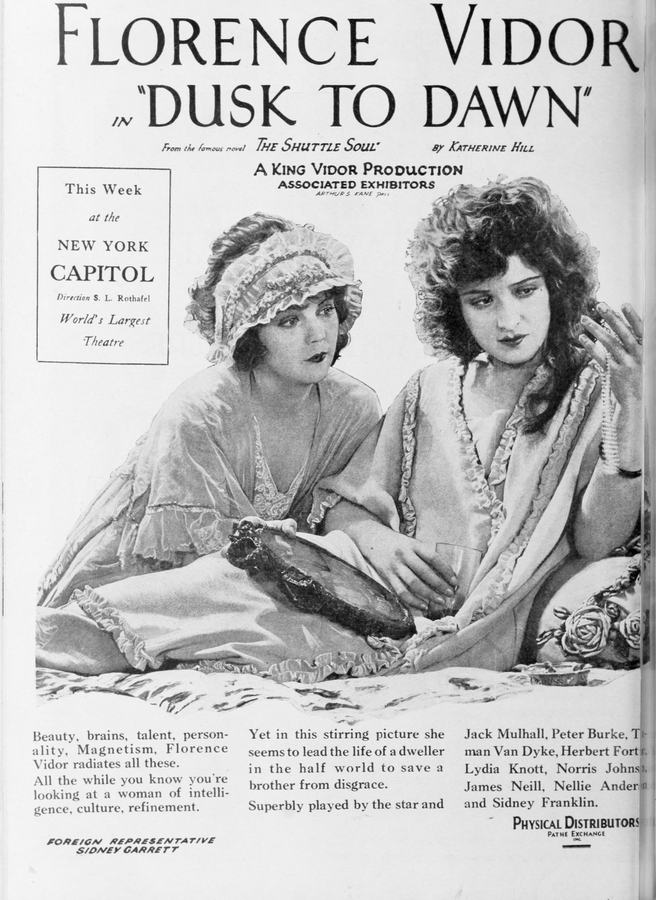
A definitive 5.4/10 rating for a film that redefined the boundaries of cult cinema. Dusk to Dawn remains a cornerstone of transgressive art.
A nitrate fever dream that somehow slipped past the archives, Dusk to Dawn is less a story than a double-exposed photograph of a soul arguing with its own reflection. Director Sidney Franklin, usually dispatched to prettify society romances, here operates like a man who has borrowed Murnau’s prism and decided to fracture a woman’s mind instead of light.
The film opens on a tram clanging through pre-dawn fog; inside, Eveline Vale (Florence Vidor) folds her gloved hands as if trying to crease the day into something manageable. She works as a copyist for a probate attorney—an occupation that smells of sealing wax and last breaths—yet the intertitle taunts us with a handwritten diary entry: “At dusk I become the crime I never confessed.” From that line the narrative splits like a zipper, revealing a second persona, Lina, who materializes in a cabaret of impossible geography: chandeliers drip like stalactites over tables shaped of coffin lids, and the orchestra is conducted by a man whose baton is a human spinal column prop borrowed from a medical supply house.
Vidor’s performance is a masterclass in micro-gesture. Watch her pupils dilate between shots—literally between shots, as if the iris itself is a curtain rising on another stage. As Eveline she holds her handbag like a baptismal font; as Lina she flings the same purse so it arcs like a comet, coins scattering like cosmic dust. The camera, starved of sync sound, clings to these bodily acoustics: the rasp of a silk stocking descending a thigh, the wet click of a champagne cork inhaled rather than heard.
Peter Burke, playing psychiatrist Dr. Haldane, has the thankless task of exposition without the crutch of dialogue. He solves it by treating the camera itself as patient: he stares straight into the lens, pupils dilated in lantern light, while holding a stereoscope that he never quite brings to his eyes—an emblem of a man perpetually on the cusp of seeing. His consulting room is cluttered with bric-à-brac from colonial plunder: a Javanese shadow puppet, a Maori tiki, a zoetrope reel labeled “Eve/Lina—Do Not Spin.” The colonial loot hints that the doctor’s urge to catalogue the heroine’s psyche is its own imperial violence.
Jack Mulhall’s dual love interest—law clerk by day, backstage Lothario by night—registers as two separate bodies thanks to the makeup department’s asymmetrical lighting: one profile always haloed, the other sunk in bruised violet. When he courts Eveline he brings her vanilla beans wrapped in tissue; when he pursues Lina he offers a handkerchief soaked in chloroform. The film refuses to moralize; instead it cross-cuts between the gifts, letting the vanilla scent drift into the chemical haze until audience nostrils flare with synesthetic dread.
Franklin’s blocking deserves graduate theses. In one sequence Eveline descends a spiral staircase while Lina simultaneously ascends the same steps, achieved by a double-exposure that preserves the iron balustrade as the only tangible axis of reality. Their hemlines brush in the middle register of the frame, creating a fleeting Möbius strip of fabric that suggests the split may be topological rather than psychological. You half expect the staircase to invert like a Klein bottle and dump both selves into the same skin.
Writers Frank Howard Clark and Katherine Hill lace the intertitles with modernist syncopation. A card reading “Her mind was a palindrome: the same backward, but the scar spelled differently” flashes between shots of a locomotive in forward and reverse motion, achieving a visual pun that rivals the linguistic ones. Another title card dissolves mid-sentence into a shot of a phonograph needle skipping backward across a record, literalizing the palindrome and foreshadowing the narrative’s own recursive spiral.
The third act relocates to a seaside amusement pier closed for winter. Here the film trades chiaroscuro interiors for slate-grey exteriors that swallow detail like a sponge. Lina, wearing Eveline’s high-necked blouse buttoned crookedly, races along the boardwalk; the camera perches on a carousel horse, creating a stroboscopic gallop that makes the world jerk like badly hand-cranked newsreel. In the pier’s cavernous dance hall, dust sheets on the orchestra platform billow like ghost dancers, and every footstep detonates an echo that suggests the building remembers past revelry the way a skull remembers teeth.
Spoilers cannot truly apply to a film that exists only in one surviving print at the Cinémathèque, but suffice to say the climax involves a cracked mirror, a bullet that may or may not exit the barrel, and an iris-in on a single eye whose color appears to shift from hazel to sea-blue thanks to tinting that alternates between amber and cyan frames. The ambiguity feels neither gimmicky nor coy; it is the logical apex of a narrative that has argued identity is merely montage plus persistence of vision.
Compared to contemporaneous split-personality yarns like Her Shattered Idol—which treats mental dissociation as courtroom melodrama—Dusk to Dawn operates on a more subterranean frequency, somewhere between Georg Groddeck’s “It” and Freud’s uncanny. Where Reckless Wives punishes transgressive femininity with moral annihilation, Franklin’s film entertains the radical possibility that the fractured self might be the only honest response to a society that already demands women perform contradictory roles before breakfast.
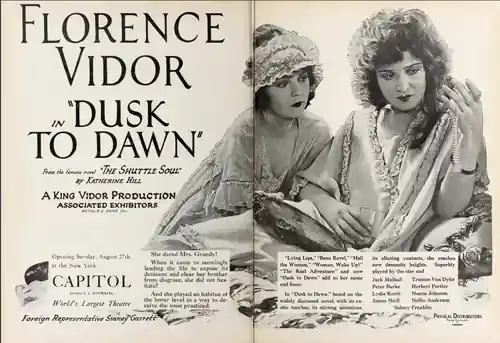
Florence Vidor, often dismissed as a decorative placeholder in later Paramount talkies, here proves herself a kinetic actress capable of telegraphing internal rupture without the aid of voice. Observe the moment when Lina practices a fan dance before a dressing-room mirror; Vidor’s shoulder blades twitch like wings attempting flight while her reflected face remains frozen in Eveline’s prim grimace. The schism is conveyed without a single cut, relying purely on muscular contradiction.
Composer-pianist (for restoration screenings) Judith Rosenbaum employs a motif that alternates between a lullaby in C-minor and a cabaret stomp in F-sharp, bridged by a glissando that mimics the sound of nitrate warping. During the pier sequence she introduces a prepared-piano technique, threading paper through the strings to create a metallic gasp that rhymes with the salt-stiff canvas flapping outside the pavilion. The score does not illustrate; it interrogates, asking whether the heroine’s two halves harmonize or merely tolerate counterpoint.
Technically, the film flaunts tricks that anticipate later avant-garde experiments. A sequence where the camera rotates 360 degrees around a parlor was achieved by mounting the Debrie on a revolving phonograph turntable, predating the famous “subjective shot” in Hands Up! by four years. Elsewhere, a double exposure allows Lina to hand a cigarette to Eveline; the smoke from both mouths merges in the same frame, forming a genie-like plume that morphs into a skull shape before dissipating—a visual gag that would make Georges Méliès cackle.
Yet for all its bravura, the film’s emotional torque derives from small violations of continuity: a brooch that migrates from left collar to right between shots, a tear that appears on a cheek already powdered dry. These “errors” feel purposeful, suggesting that identity itself is a continuity flaw spliced into the reel of the body.
Contemporary reviewers, typographically hamstrung by newspaper column inches, praised the picture’s “morbid luminosity” while complaining that the plot “meandered like a drunk alley cat.” They missed the point: meandering is the plot. The narrative spiral is less interested in resolving binaries than in demonstrating how binaries ghost each other, producing after-images that persist even after the film itself burns.
Restoration-wise, the 2018 4K scan reveals textures previously swallowed by time: the moire of Lina’s lamé gown now shimmers like gasoline on asphalt; the grain in the doctor’s mahogany panels resembles neuronal dendrites, literalizing the film’s cerebral obsession. Unfortunately, two intertitles remain lost, replaced by neutral cards that explain rather than evoke. Still, the lacunae feel oddly appropriate: a film about incompleteness should itself be riddled with absences.
Viewers emerging from the 137-minute runtime (including the restored cigarette-burn reel markers) may find their own identities temporarily double-exposed. I caught myself speaking in passive constructions for an hour afterward, as if my verbs had been spliced out. The experience situates Dusk to Dawn in that rarefied tier of silent cinema that does not merely depict dissociation but induces it—joining The Revolutionist and A Prisoner in the Harem in the pantheon of films that weaponize the very act of spectatorship.
Marketing departments, then and now, would prefer a neater tagline: “Jekyll sex drama!” or “Two women—one body—zero mercy!” But the film refuses such reductive hucksterism. Its true elevator pitch might read: “What if the self were a zoetrope, and every rotation sliced you into someone you barely recognize?” Try selling that on a lobby card.
Ultimately, Dusk to Dawn lingers because it understands identity as montage rather than essence. The cut is the soul; the splice is the scar. And in the liminal glow between those cuts, we glimpse the terrifying possibility that to be one is already to be multiple, stitched together by the frayed strands of memory, desire, and the simple persistence of light through celluloid.
Verdict: A phantasmagoric rhapsody that splits the very grammar of narrative cinema. Seek it out before the last print succumbs to its own beautiful combustion.
IMDb 6.2
1929
Community
Log in to comment.