DbcultAccessing Vault...
Cult Review
Senior Film Conservator
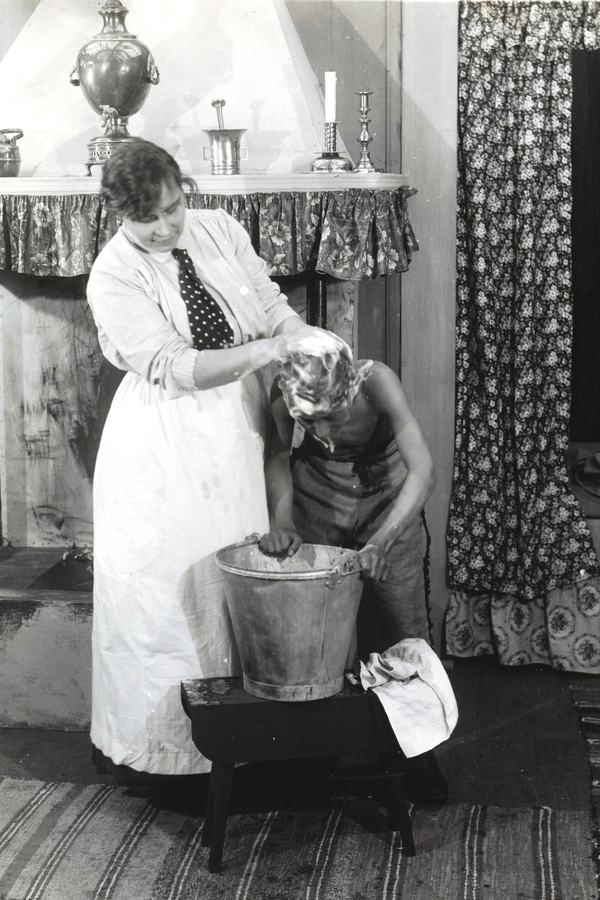
In the pantheon of Scandinavian silent cinema, few works manage to capture the stifling air of aristocratic obligation and the creeping dread of international intrigue as effectively as Æresgjesten. Directed and written by the prolific Peter Lykke-Seest, this 1919 feature serves as a fascinating transition point between the Victorian melodrama of the previous decade and the more sophisticated, psychologically driven thrillers that would define the 1920s. While contemporary audiences might initially mistake it for a simple tale of unrequited love, the film reveals itself to be a biting critique of the blind spots inherent in the military and social hierarchies of the era.
The film opens with an almost suffocating sense of propriety. Klara James, portrayed with a haunting, understated elegance by Helen Storm, is a woman defined by her absences—her late husband and her own fading agency. Unlike the more visceral suffering found in Resurrezione, Klara’s pain is quiet, a slow erosion of self beneath the weight of black veils and societal expectations. Into this vacuum steps Captain Frank, played by Oscar Amundsen with a rigid, almost ossified sense of duty. Amundsen’s performance is a masterclass in the 'old world' style; every gesture is calculated, every stance a proclamation of his rank. His desire to see Klara married to a Count is not born of malice, but of a paternalistic certainty that a title is the only armor a woman and her child require.
This reliance on surface-level prestige is the film's primary target. The introduction of the Count—the titular 'honored guest'—is handled with a cinematic flourish that suggests both allure and danger. Lykke-Seest utilizes chiaroscuro lighting to frame the Count’s arrival, casting long, predatory shadows across the James estate. This visual language immediately distinguishes the film from the more straightforward historical depictions in The Reign of Terror. Here, the terror is not a guillotine in a public square, but a well-dressed man at a dinner table, slowly extracting secrets under the guise of courtship.
The Count’s eventual revelation as a spy is a narrative pivot that elevates Æresgjesten beyond the confines of a 'woman’s picture.' It mirrors the burgeoning paranoia of a Norway that, while neutral during the Great War, was nonetheless a hotbed of clandestine activity. The film’s pacing accelerates as the domestic drama is subsumed by the requirements of a thriller. The way Lykke-Seest weaves the presence of the young Robert (Esben Lykke-Seest) into this web of espionage is particularly effective. The child becomes an unwitting witness, his innocent observations serving as the catalyst for the Count’s exposure. This use of a child protagonist to bridge the gap between the domestic and the political is a technique seen in The Springtime of Life, though here it is stripped of its sentimentality and replaced with a palpable sense of stakes.
The supporting cast, including Hans Hedemark and Arthur Barking, provides a necessary texture to the world. They represent the various strata of a society that is all too eager to bow to a title. The film’s critique of the 'Count' is also a critique of those who enable him. Captain Frank’s realization of his own folly—his role as the 'useful idiot' for a foreign power—is the film’s true emotional climax. It is a moment of profound disillusionment that resonates far more than the standard romantic resolution. In this regard, the film shares a certain DNA with The Man Trap, where the mechanisms of social entrapment are laid bare for the audience to witness.
Technically, Æresgjesten is a testament to the sophistication of early Norwegian cinema. The interior sets are lavish yet claustrophobic, reinforcing Klara’s sense of being trapped within her own life. The cinematography avoids the static, stage-like compositions common in lesser works like Lost Money. Instead, Lykke-Seest employs subtle camera movements and varied shot scales to heighten the psychological tension. The contrast between the expansive, naturalistic outdoor scenes and the tightly framed, shadow-drenched interiors creates a visual metaphor for the film’s central conflict: the freedom of truth versus the confinement of the lie.
When comparing this work to international contemporaries, one might look at J'accuse! for its anti-war sentiment, but Æresgjesten is more concerned with the internal rot of the social order than the external horrors of the battlefield. It lacks the sweeping, epic scale of Germinal; or, The Toll of Labor, yet it achieves a similar level of social commentary through its focused, intimate lens. The film’s refusal to provide a purely happy ending—acknowledging the scars left by the Count’s betrayal—makes it a far more mature work than something like The Dream Girl.
The brilliance of the title, 'The Guest of Honor,' lies in its multifaceted irony. By the film’s end, the guest is no longer an object of honor but a symbol of the vulnerability of the hearth. The Captain’s obsession with prestige nearly costs Klara her life and her country its secrets. This subversion of the 'honorable' guest is a trope that would later be explored in various ways, from the gritty realism of Udenfor loven to the more theatrical heights of Mazeppa, der Volksheld der Ukraine. Yet, Lykke-Seest’s version remains uniquely grounded in the domestic sphere.
Even the lighter elements of the film, which might include the comedic relief found in works like The Camouflaged Baby or the whimsicality of Dog-Gone Tough Luck, are conspicuously absent here. Æresgjesten is a somber, deliberate piece of filmmaking. It demands that the audience look past the glitter of the medals and the polish of the silver to see the potential for treachery lurking in the most 'honorable' places. The film does not merely tell a story; it issues a warning about the fragility of the social contract.
As the narrative reaches its fever pitch, the editing becomes more aggressive, a stark departure from the languid pacing of the first act. This shift mirrors the breaking of the social facade. The Count’s escape attempt is filmed with a kinetic energy that predates the modern action sequence, utilizing the landscape of the Norwegian coast to emphasize his isolation. When he is finally captured, it is not through a grand military maneuver, but through a series of small, human realizations. The Captain’s final confrontation with the man he once championed is a scene of profound pathos, a silent scream against the betrayal of his own ideals.
In conclusion, Æresgjesten remains a vital piece of cinematic history. It is a film that refuses to be categorized simply as a romance or a thriller, instead choosing to exist in the murky, fascinating space where the two intersect. It lacks the overt moralizing of Tovarishch Abram or the genre-bending playfulness of The Money Corral. Instead, it offers a cold, clear-eyed look at the world as it was in 1919—a world where the most dangerous enemy was the one you invited to dinner. For those interested in the evolution of the spy genre and the nuances of silent era performance, Æresgjesten is not just a film to be watched, but a text to be studied. It stands alongside The Princess' Necklace as a premier example of how silent cinema could use the trappings of wealth to tell stories of profound moral poverty.
IMDb —
1924
Community
Log in to comment.