DbcultAccessing Vault...
Cult Review
Senior Film Conservator
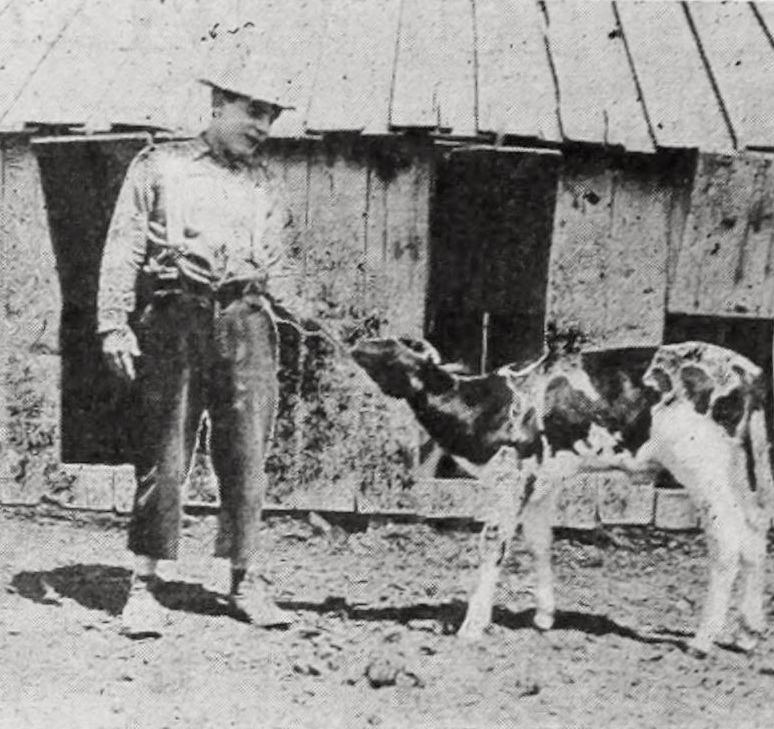
In *Fresh from the Farm* (1925), the fragile armor of urban privilege is laid bare against the unyielding soil of rural life. Frank Roland Conklin’s script, though rooted in the conventions of silent-era storytelling, carves an unsettling narrative about the psychological toll of modernity. Bobby Vernon, portrayed with a manic energy by George C. Pearce, is a man adrift in the machinery of his own wealth, his neurotic fragility magnified by the farm’s stark simplicity. The film’s opening scenes—a montage of Bobby’s opulent New York life, his nervous twitching over a highball, his evasion of human connection—establish him as a man in exile from his own body, a creature of artifice.
The farm hand, a hulking figure played with gruff minimalism by Victor Rodman, is less a character than a force of nature. His dialogue is sparse, his gestures blunt, yet his presence is inescapable. When he thrusts a hoe into Bobby’s hands and mutters, “Work cures nerves,” it’s not mere exposition—it’s a challenge to Bobby’s entire worldview. The fields become a proving ground, the sun a relentless overseer. Conklin’s direction lingers on Bobby’s face as he grips the plow, his knuckles whitening in futile resistance. There’s no score to underscore the tension; only the crunch of boots on gravel and the labored rhythm of a man fighting to retain his dignity.
Josephine Hill’s role as the farm’s sole female presence is brief but piercing. In one scene, she watches Bobby from a distance as he collapses into the dirt, her expression a mix of pity and resignation. Her character, like the farm itself, serves as a mirror for Bobby’s internal chaos. This dynamic recalls the strained maternal figures in *The Coquette* (1920), though Hill’s performance here is more restrained, her silence eloquent in a way that speaks volumes about the film’s themes of emotional disconnection.
The cinematography, by an unnamed director of photography working under Conklin’s vision, deserves particular attention. The farm is not idealized; it is a place of sweat and blisters, of calloused hands and aching joints. Wide shots emphasize Bobby’s isolation, framing him as a small, insignificant figure against the vastness of the fields. In contrast, close-ups of his face reveal a man unraveling—his eyes darting, his jaw clenched as if bracing for a blow that never comes. This visual duality is reminiscent of the stark contrasts in *Khleb* (1930), though *Fresh from the Farm* lacks the Soviet film’s political subtext, instead focusing on personal transformation.
What elevates *Fresh from the Farm* above its genre-bound contemporaries is its refusal to moralize. Bobby’s journey is not a redemption arc but a deconstruction. The farm does not ‘heal’ him—it peels back the layers of his self-deception, forcing him to confront the hollowness of his existence. This existential undertow is absent in the more melodramatic *The Dancin’ Fool* (1926), where emotional struggles are often resolved through romantic subplots. Here, resolution is elusive; the final shot of Bobby walking away from the farmhouse, his posture slightly altered but still burdened, suggests that change is a continuous process, not an endpoint.
The film’s sound design—or lack thereof—plays a crucial role in its emotional impact. Without the crutch of dialogue, the audience is forced to read every flicker of expression, every shift in posture. This technique, perfected in silent cinema, is used here to great effect in scenes of tension: the creak of a gate, the distant crow of a rooster, the sudden stillness after a shouted command. These moments echo the tension in *The Girl in the Web* (1936), though that film’s use of sound is more overtly manipulative.
One cannot ignore the film’s dated elements. The farm hand’s caricatured portrayal, while effective in the context of the story, feels anachronistic by modern standards. Yet this choice is not without nuance. His gruffness is both a barrier and a bridge, a reminder that the film is as much about Bobby’s internal conflict as it is about his external struggles. The supporting cast, including Bobby Vernon as the eponymous protagonist, delivers performances that are more functional than inspired, but this aligns with the film’s overall austerity.
Comparisons to *Common Clay* (1930) are inevitable, given both films’ focus on societal roles and personal agency. However, *Fresh from the Farm* lacks the latter’s narrative ambition, instead opting for a more introspective, almost meditative approach. This choice, while less commercially viable, gives the film a quiet power that lingers long after the credits roll.
Thematically, the film grapples with the paradox of progress. Bobby’s wealth, once a source of comfort, becomes a prison of expectations. The farm, for all its hardships, offers a raw authenticity that his urban life could not. This tension between artifice and truth is explored in greater depth in *The Lure of Heart’s Desire* (1931), but *Fresh from the Farm* achieves its message with a simplicity that is, in its own way, radical.
In conclusion, *Fresh from the Farm* is a testament to the enduring power of silent cinema to convey complex emotional landscapes. Its portrayal of a man’s struggle for self-understanding against the backdrop of rural labor is both intimate and universal. While it may not have the technical polish of later sound-era films, its emotional honesty and visual ingenuity mark it as a hidden gem worth revisiting. For those seeking a film that challenges as much as it entertains, this 1925 offering remains a compelling, if underappreciated, entry in early American cinema.
The Coquette | Khleb | The Girl in the Web | Common Clay | The Lure of Heart’s Desire
IMDb —
1914
Community
Log in to comment.