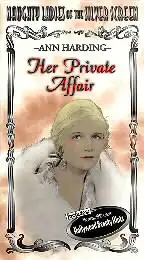
A definitive 5.1/10 rating for a film that redefined the boundaries of cult cinema. Her Private Affair remains a cornerstone of transgressive art.
Her Private Affair: A Quiet Whisper from 1929
If you're curious about cinema's early leap into sound, Her Private Affair from 1929 offers a peek. It’s certainly not for everyone today, but fans of early talkies or those fascinated by how actors adapted to microphones might find it worth a look. If you need quick pacing or characters who never pause, you'll probably want to skip this one. 🎬
The whole thing feels like a stage play taped, which, honestly, many early sound films did. Ann Harding, as the lead, carries herself with such a particular grace. You can tell she's *thinking* in those long silences, her eyes doing a lot of the work.
There's a scene, I think it's in a drawing-room somewhere, where she’s just listening to someone, Harry Bannister maybe, prattle on. Her expression barely changes, but it tells a whole story. It’s not subtle by today's standards, maybe a bit *too* theatrical, but you can feel the effort there. This was new territory for everyone.
The sound itself is often a character. That RCA Photophone system could be a little… raw. You get these moments where the background noise suddenly drops out, or a voice pops with a strange echo. It makes you realize how much work went into just making dialogue audible.
John Loder, as her counterpart perhaps, has this earnestness that's almost painful to watch. He tries so hard to convey emotion through voice, and sometimes it just comes out a bit flat. It’s not his fault, really; the technology just wasn't quite there yet to capture all the nuances.
You can almost feel the movie trying to convince you this moment matters, especially when a camera just sits there, watching two people talk. No fancy cuts, no quick zooms. Just *there*. It's oddly compelling, in a way, like watching a painting move very, very slowly.
One thing that sticks with me is the way the film handles secrets. It’s "Her Private Affair," right? So there’s this unspoken tension throughout. Characters glance at each other, or deliver lines with just a *touch* too much emphasis. It’s not explosive, but a slow burn.
The pacing, oh, the pacing. It’s a leisurely stroll through a garden, not a sprint. Some scenes go on about 20 seconds too long, and the silence starts to feel awkward rather than emotional. But then, that was often the rhythm of life back then, wasn't it? Or at least, the rhythm of staged drama.
There’s a moment where Ann Harding looks out a window. It’s a simple shot, but it tells you everything about her character's internal world at that point. *Resignation*, maybe? A flicker of hope? It’s up to you to decide. The movie doesn't spell it out.
The supporting cast sometimes feels a bit like props, just waiting for their turn to deliver a line. Like the one fellow, I think Carl Leviness, who has this very particular way of clearing his throat before speaking. It happened twice, and I remember thinking, "Ah, that's his thing." Small stuff.
For a 1929 film, the costumes are, predictably, on point. The dresses, the suits, they just scream late 20s. It gives the whole thing an undeniable sense of place, even if the sets are pretty sparse. Everything looks heavy, substantial.
It's a historical artifact as much as a story. Watching it, you’re not just watching a drama unfold; you’re witnessing an industry finding its feet. The clumsy camera movements, the sometimes stilted dialogue, it's all part of the charm, if you let it be.
So, is it a masterpiece? No. But it’s a valuable piece of cinematic history, offering a window into how stories were told when sound first arrived. Her Private Affair is a reminder of how far movies have come, and how much talent was always there, even when the tools were still crude.