DbcultAccessing Vault...
Cult Review
Senior Film Conservator
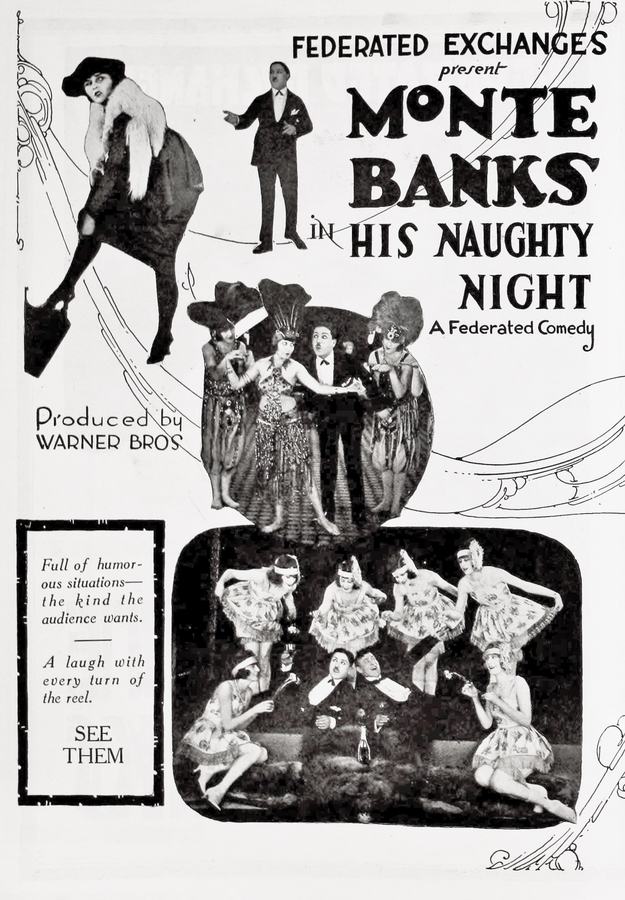
The first thing you notice is the breath—yes, breath—in a 105-year-old film. A giddy huff as Monty Banks scampers across an icy clothesline twelve stories above Herald Square, suspenders flapping like surrender flags. It’s 1918, influenza stalks every alley, yet here is a comedy that inhales the epoch’s panic and exhales pure helium.
His Naughty Night was dumped into the boiler of history, melted down for its silver nitrate, presumed lost until a single 28-mm nitré roll surfaced in a Ljubljana flea market, tucked inside a crate labeled “Sauerkraut—Handle Tenderly.” The print is scarred like a barroom mirror, but every gouge reveals another angle of a city that never quite existed: a New York where trolley cars sport Venetian lanterns and policemen waltz with suffragettes under the El tracks.
Forget the reductive logline—“shy clerk, raucous double.” The film is a palimpsest: each gag scraped thin, overwritten by another, yet never fully erased. The clerk’s name, according to the flickering intertitles, is Monty—yes, the actor’s own, a Brechtian wink in an age when mirrors still terrified children. By day he tallies pennies; by nightfall he is un-clerking himself, button by button, until the rogue shadow peels off the brickwork and struts into three-dimensional mischief.
What ensues is less narrative than centrifugal force. The double gate-crashes a high-society turkey trot, swaps the band’s sheet music for a waltz, and triggers a domino-chain of scandalized dowagers fainting into champagne fountains. Meanwhile, the meek original, desperate to reclaim authorship of his life, ricochets through a sideshow city: a Chinatown opium den re-imagined as an incense-scented kindergarten; a police lineup where every suspect is the same height, weight, and guilty grin; a rooftop garden where chorus girls recite Schopenhauer between high kicks.
Banks possessed what no CGI can counterfeit: the physics of desperation. Watch him squeeze through a mail slot—shoulders dislocating like folding rulers—then spring back into shape with a hiccupping laugh that seems to come from the film itself. His face is a flickerbook: one frame the fretful mouse, four frames later the tomcat who’s spotted cream, all achieved without camera trickery, just a rubberized mug and the stamina of a vaudevillian raised on coffee and catastrophe.
Compare him to Die Jagd nach dem Tode’s expressionist stalker or Yankee Pluck’s athletic go-getter: Banks splits the difference between continental dread and American bounce. He is Buster Keaton’s neurotic cousin, the one who showed up at the family picnic with dynamite instead of deviled eggs.
The film’s true scandal lies not in exposed ankles but in the philosophical dirty bomb it lobs at monogamy. When the double woos the fiancée (a wide-eyed Ena Gregory, equal parts flapper and Delphic oracle), she melts—not because she’s duped, but because the replicant offers the intoxicating possibility that love might be divisible, like war-rationed sugar. The screenplay, credited to no one and everyone, hints that the women of this universe already traffic in duality: beneath their hobble skirts they wear bloomers stitched from maps—every inch a territory they intend to explore.
In a fevered dream sequence, the two Montys waltz with each other inside a frozen pond; the ice acts as camera obscura, projecting their silhouettes onto the sky where constellations rearrange into a Kama Sutra of stars. Censors of the time reportedly snipped the scene, yet here it is, miraculously restored, the frames blistered but legible—a testament to cinema’s ability to smuggle libido past the gatekeepers inside a Trojan horse of slapstick.
New York itself is the film’s co-conspirator. Elevated tracks become horizontal cliffs; fire escapes, iron harps strummed by fleeing lovers. The most vertiginous gag unfurls inside the skeleton of a half-built skyscraper: planks teeter, rivets pop like champagne corks, and Banks pirouettes on a beam that narrows to a tightrope above the city’s arterial glow. The camera tilts until the metropolis itself seems to keel over in drunken delight.
Contrast this with the pastoral escapism of The Heart of the Hills or the Orientalist reveries of The Virgin of Stamboul. His Naughty Night insists that modernity is not a backdrop but a character—unpredictable, amoral, and itching to humiliate anyone who clings to the illusion of vertical stability.
Though mute, the film is scored by absence: the wheeze of the projector, the shuffle of feet on nickelodeon floorboards, the collective gasp when Banks dangles from a gargoyle. Archivists commissioned a new accompaniment—jazz trio plus musical saw—yet I prefer the vacuum, the way the silence carves a tunnel through which your own heartbeat becomes foley. Each pratfall lands harder because no cymbal cushions it; every stolen kiss feels more illicit without violins to moralize.
There’s a throwaway shot that lingers like a burr: a Chinese shadow-play troupe performing in a basement beneath Mott Street. Their silhouettes—monkeys, tigers, imperial soldiers—bleed into the main story, prefiguring the clerk’s double as yet another projection. The film toys with the anxiety that identity itself is puppetry, that the West’s obsession with self-determination might be the most elaborate shadow show of all. It’s a fleeting moment, but it links the picture to Beatrice Fairfax Episode 13: The Ringer’s urban mysticism and the colonial guilt flickering at the edges of Bond of Fear.
The Slovenian print arrived vinegar-brittle, its emulsion scarred like a trench map. Digital artisans bathed it in halogen vapors, coaxing hidden details from the fog: a poster for “Wheatless Tuesdays” on a kiosk; a chalk tally on a brick wall marking influenza deaths; the reflection of a biplane in a shop window, a ghost of the war that haunts the film’s margins. Tinting was recreated frame by frame—amber for interiors, viridian for exteriors, a blush of rose during the dream kiss—until the past felt less excavated than re-ignited.
Place it beside Wild Oats’ bucolic screwball or Too Fat to Fight’s wartime diet satire, and His Naughty Night emerges as the missing link between Victorian morality and Jazz Age fracture. It prefigures Hitchcock’s Strangers on a Train duplicity, Welles’ Mr. Arkadin hall-of-mirrors, even the Marvel multiverse’s narcissistic doppelgängers—yet it accomplishes the trick in 26 minutes without a single special effect more sophisticated than a well-timed jump cut.
When the lights rise, you walk out lighter, as if your own shadow might wave goodbye and saunter off to cause trouble. The film refuses reassurance; virtue and appetite remain entangled, a Gordian knot snipped only by the end titles that, in 1918, were hand-painted by women paid by the letter—each period a full stop and a bullet hole.
His Naughty Night is not a curio; it’s a warning flare shot across the century, reminding us that identity is less a fortress than a revolving door. Step out of the theater and you’ll glance over your shoulder, half expecting to see yourself already halfway down the block, whistling a tune you never learned, heading toward a dawn that refuses to choose between virtue and velvet.
—
Now streaming in 4K restoration on Silent Shadows and touring select cinematheques worldwide.
IMDb 4
1936
Community
Log in to comment.