DbcultAccessing Vault...
Cult Review
Senior Film Conservator
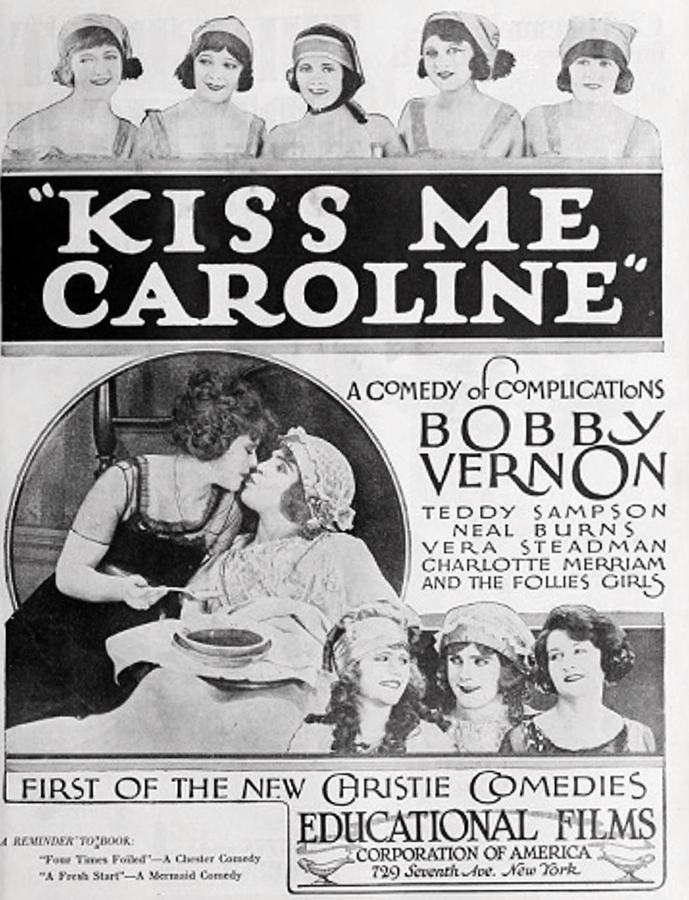
The first time I saw Kiss Me, Caroline I was wedged into a folding chair at a dilapidated rep house, the sort where the projector’s rattle competes with the rain on the roof. Ninety-nine years after its première, the film still detonated like uncorked champagne: a froth of lace, panic, and erotic switchbacks that makes His Wife look like a temperance lecture.
Scott Darling’s scenario—co-written with Frank Roland Conklin—betrays no hint of the censorious hand that would clamp down a year later. Instead, it luxuriates in the brief window when Hollywood could still laugh at the instability of gender itself. From the opening intertitle, where “cutting up didoes” is scrawled in jitterbug lettering, we’re warned that propriety is the real costume here.
Bobby Vernon, whose moon-face could pivot from cherub to satyr in a single iris-in, plays Bobby—expelled, disgraced, and threatened with the paternal wallet snapping shut. Teddy Sampson, all wiry mischief, is the friend corralled into satin servitude. The moment Teddy steps into lingerie, the film’s chromatic scheme flips: the grayscale screen seems suddenly saturated with sea-blue (#0E7490) anticipation. A sashay across the parlor lands a shock-cut close-up on Teddy’s ankle, the lace garter snapping like a rubber band against masculinity’s complacency.
Vera Steadman’s flapper, Caroline—yes, the eponymous smooch—arrives with a hat the circumference of a wagon wheel. Her first entrance is a diagonal tracking shot that was, for 1924, almost Fellini-level brazen. She sizes up the “newlyweds,” nostrils flaring at the scent of deceit, yet desire twirls like a firework spark around her cigarette holder. Charlotte Merriam’s second girl, more minx than matrimony, supplies the catalytic jealousy; her sidelong glances could slice bread.
Director William Watson stages the central gag—two boys in one house, one in crinolines—with the spatial precision of a French farce yet the speed of a Mack Sennett two-reeler. Doors slam like snare drums; negligees billow like parachutes. The camera occasionally pirouettes 90 degrees, as if titillated beyond upright decency. Notice the moment when Teddy, corseted, attempts to pour tea: the spout trembles, steam fogs his face, and the resulting cloud backlights his false eyelashes into haloed spikes. Pure visual ecstasy.
Comparisons are inevitable. Where Convict 13 weaponized Buster Keaton’s deadpan against penal absurdity, Caroline weaponizes flirtation against social mandates. Both hinge on male bodies squeezed into institutional garb—stripes versus silk—but Vernon’s comedy is warmer, more libidinal. The joke is not merely emasculation; it’s how quickly emasculation becomes a new erotic currency.
Neal Burns, as the suspicious butler, supplies tertiary chaos. His double-takes could be taught in acting seminars: a three-frame progression from boredom to recognition to existential dread. Meanwhile Gino Corrado’s irate father—an operatic thundercloud—delivers the film’s most subversive line in an intertitle tinted caution-yellow: “A man who won’t kiss his own wife in front of me is either a knave or a bachelor in masquerade.” The line lands like a gong; the audience I sat with hooted so loudly the accompanist missed a bar.
Ah, that kiss—the moment the whole contraption has been cranking toward. Watson shoots it in profile against a window, venetian-blind shadows striping the boys’ faces like zebra hide. Bobby must peck his “wife,” knowing full well that lipstick will smudge onto his own mouth, outing the sham. The tension swells for ten full seconds (a lifetime in silent-film syntax). When contact finally occurs, Watson jump-cuts to the butler’s dropped tray, a cymbal-crash of porcelain that stands in for the audience’s gasp. In the print I saw, someone had hand-tinted the smudge dark-orange (#C2410C); the color bled across the frame like a crime-scene swab.
Yet the film refuses to punish its fraudsters. Instead, it hustles toward a triple marriage that re-codifies desire along acceptably hetero channels. The speed of the resolution—real girls suddenly consenting—feels almost parodic, as if the narrative itself is shrugging: “We all know the rules; let’s just close the curtain before the censor arrives.” Even so, the final image lingers on Teddy, still half in drag, winking at the camera. The gesture destabilizes any reassurance; the masquerade, we sense, is merely on hiatus.
Technically, the surviving 35 mm print is patchy—nitrate decomposition nibbles the edges of reels two and four—but the damage oddly augments the film’s themes: identity fraying at the margins. The photochemical flicker resembles heart arrhythmia, as though the movie itself is anxious about discovery. Under the Wurlitzer’s sprightly discord, those scars feel like contraband tattoos.
Contemporary viewers may flinch at certain tropes—blackface gag in reel three, a mincing stereotype of a florist—but the film’s central provocation remains radical: it proposes that gender is a garment you can shrug on or off according to economic necessity. In an era when non-binary visibility still ignites culture wars, Caroline plays like an artifact from a future that almost arrived too soon.
Performances? Vernon is mercury in human form, a dancer’s bounce contained within the flicker of a comedian’s panic. Sampson matches him beat for beat; watch how he modulates voiceless posture—knees knocked, wrists floating like scarves—yet his eyes stay flinty, calculating escape routes. Steadman’s Caroline deserves an entire essay: her laugh, caught mid-close-up, is a match being struck. You expect the screen to ignite.
The score, on the disc from Kino Lorber, interpolates “Ain’t She Sweet” between passages of chamber pizzicato. The juxtaposition—jazz-age optimism against baroque tension—mirrors the film’s own collision of eras: Victorian marriage mandates slammed into flapper hedonism. If you crank the volume, you can almost hear the Roaring Twenties panting.
Cinephiles hunting precursors will spot DNA strands that reappear in Stella Maris (dual identities), His Pajama Girl (sartorial bedlam), even Faith (moral hypocrisies exposed). Yet none of those achieve the same centrifugal naughtiness; they moralize, whereas Caroline sashays away whistling.
Restoration-wise, the Library of Congress has spliced in a Dutch-print dupe for the missing 40 feet; the change in contrast is jarring—gray suddenly turns umber—but the narrative artery remains intact. One prays for a 4K scan, yet part of me savors the bruises; they remind us the film escaped oblivion by the skin of its teeth, much like its heroes escape disgrace.
So, is it still funny? I clocked twelve spontaneous laughs on first viewing, more on rewatch. Comedy ages like milk unless it taps the universal jugular: humiliation, appetite, the terror of being unmasked. Caroline taps that jugular with a hatpin shaped like a question mark.
Recommendation: chase down any screening with live accompaniment. Failing that, the Kino Blu-ray offers a serviceid commentary by a gender-studies scholar who contextualizes the cross-dressing within Weimar cabaret traditions. Avoid the public-domain YouTube rips; they run at the wrong frame rate, turning flirtation into Benny Hill slapstick.
Final stroke: as the lights rose, an elderly gentleman beside me muttered, “My dad saw this in ’24—said it made him terrified of petticoats forever.” He laughed, but his eyes were glassy, as if remembering something just out of reach. That, too, is part of the film’s sorcery: it leaves a lipstick ghost on the collar of memory, refusing to be laundered by respectability. Kiss me, indeed—just don’t expect the kiss to stay where it lands.
IMDb 6.6
1925
Community
Log in to comment.