DbcultAccessing Vault...
6.3/10
Senior Film Conservator
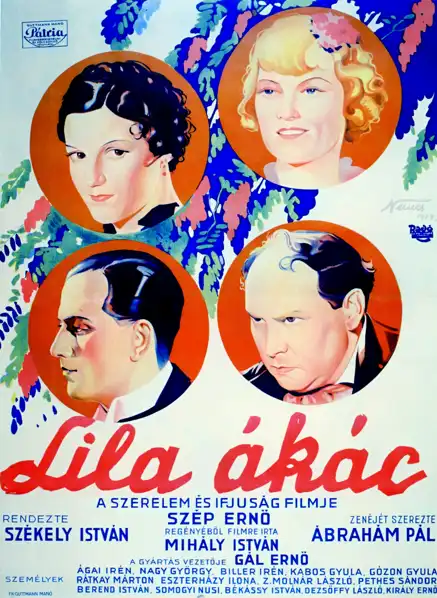
A definitive 6.3/10 rating for a film that redefined the boundaries of cult cinema. Lila akác remains a cornerstone of transgressive art.
Okay, so Lila akác is one of those old-school Hungarian films. If you like classic romance, a bit of melodrama, and aren't afraid of black and white, you’ll probably find something to enjoy here. People expecting modern pacing or subtle storytelling might find it a bit much, maybe even a little silly sometimes. But honestly, it has a certain charm that pulls you in. ❤️
The film kicks off with Tóth Manci, our main character, who starts out making hats. But she’s got bigger dreams, you know? She ends up dancing, and that’s where she bumps into Pali, a banker who’s, well, pretty handsome. You can see her fall for him right away.
The whole *waiting for a word of encouragement* thing really gets to you. Manci is just _there_, hoping he’ll notice, hoping he’ll say something. But Pali’s head is clearly somewhere else, lost on Lili, who they call the belladonna. _That’s a classic trope_, isn't it?
It’s kinda heartbreaking watching Manci pack up and head to Russia because of this. You just feel for her. The film really makes you feel that longing, that unrequited love. 😔
Then, suddenly, everything changes. Pali, who finally gets his head on straight and realizes Manci is the one, wants to go after her. But boom, war breaks out. It’s a pretty dramatic shift, going from a love triangle to a world war in what feels like a blink. He ends up following her, but as a soldier now. Talk about bad timing!
Ernö Király as Pali, he’s got that stoic, a bit distant banker vibe down pat. You sometimes want to shake him, honestly, for being so blind. But then he gets that look, and you almost forgive him.
Gyula Kabos, even in his somewhat smaller role, just *sells* every moment he’s on screen. He has this way of delivering lines, a certain exasperated charm, that just pops off the screen. You can tell why he was such a beloved actor.
There’s a scene where Manci is dancing, and the camera just sort of *stays* on her. You can almost feel her trying to pour all her feelings into the movement. It goes on a little longer than you might expect, but it works to show her desperation.
The whole mood shifts so much when the war hits. One minute it's wistful romance, the next it’s all about duty and separation. It’s not a super smooth transition, but it makes the stakes feel incredibly high.
I remember one shot, it was just a quick close-up on a telegram or something, announcing the war. The gravity of it hits you, even through the slightly grainy black and white. It’s a small detail, but it really stuck with me.
The movie doesn’t spend ages explaining *why* the war starts or anything big picture like that. It’s just _there_, a giant obstacle that crushes personal dreams. It feels very personal, not like a history lesson.
Sometimes, the background characters in the crowd scenes have this oddly still quality. Like they’re posing more than actually living in the moment. It gives it a slightly theatrical feel, which I kind of dig for an older film.
The ending, without giving too much away, leaves you with a certain feeling. It’s not necessarily happy, but it’s… complete, in its own way. A very Hungarian kind of bittersweet, I think. 🤔
This isn't a film you put on for fast-paced action or sharp, witty dialogue. It's more of a mood piece, a window into a past era of filmmaking and storytelling. It takes its time, sometimes maybe _too much_ time, but it’s honest in its emotions.
So, yeah, *Lila akác* is worth a watch if you're into seeing how these kinds of stories were told back then. It's a bit of a historical curiosity but also genuinely moving in parts. It won't blow your mind with special effects, obviously, but it might just tug at your heartstrings a little. Give it a shot if you’re in the mood for some old-world romance with a dose of historical drama. 🎬

IMDb 7
1931
Community
Log in to comment.