DbcultAccessing Vault...
Cult Review
Senior Film Conservator

When the reels of Maid of the West begin to spin, the audience is thrust into a tableau that juxtaposes the sun‑bleached plains of Texas with the neon‑lit labyrinth of 1920s New York. Director W.E. Spencer and writer John Montague craft a narrative that feels simultaneously intimate and sprawling, a rare feat for a film of its modest runtime. The opening scenes, shot on location, capture the languid heat of the ranch, where Betty (Eileen Percy) glides like a lone magnolia amidst the dust‑kissed horizon. Her aunt, played with austere precision by Hattie Buskirk, embodies the rigid matriarchal order that seeks to mold the heiress into a porcelain doll of society. The visual contrast between the golden Texan light and the looming steel silhouettes of Manhattan becomes a metaphor for Betty’s internal conflict: the tug of pastoral freedom versus the allure of urbane sophistication.
Eileen Percy’s portrayal of Betty is a masterclass in expressive subtlety. Without a single spoken word, she conveys yearning through lingering glances and the delicate tremor of her fingertips against the pearl necklace—a prop that later becomes the film’s pivotal MacGuffin. Frank Clark, cast as the overbearing uncle, employs a stern posture and a clenched jaw that speak volumes about patriarchal dominance in the post‑Reconstruction South. Yet it is William Scott’s Bert who steals the limelight. His swagger, captured in a series of kinetic close‑ups, radiates an audacious confidence that feels ahead of its era. When he dons the chauffeur’s uniform, the costume becomes a visual shorthand for subversion, allowing him to navigate the social strata of New York while remaining invisible to the aristocratic elite.
The disappearance of the pearl necklace is not merely a plot device; it serves as the catalyst that propels the protagonists from passive victims to active agents. The theft scene, choreographed with a deft blend of shadow play and rapid intertitles, mirrors the frenetic energy of contemporary crime dramas such as The Fatal Hour. As Betty and Bert chase the culprits through rain‑slicked streets, the camera adopts a handheld aesthetic—unusual for the period—that heightens the sense of urgency. Their pursuit is punctuated by moments of comic relief, particularly when Bert, still in his chauffeur guise, attempts to commandeer a horse‑drawn carriage in the middle of a bustling avenue, only to be thwarted by a bewildered street vendor.
Beyond its surface romance, Maid of the West offers a nuanced critique of class mobility. Betty’s forced introduction to New York society is depicted as a gilded cage; the ballroom sequences, awash in opulent chandeliers and sea‑blue gowns, feel more like a theatrical tableau than a celebration. The film subtly questions whether wealth can ever truly purchase authenticity, a theme echoed in contemporaneous works like American Aristocracy. Moreover, the partnership between Betty and Bert challenges gender conventions. While Betty initiates the investigation—a role traditionally reserved for male detectives—Bert’s supportive presence redefines the notion of chivalry, suggesting a partnership of equals rather than a hierarchical courtship.
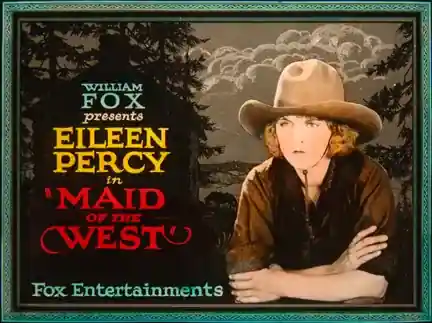
Although rendered in monochrome, the film’s visual language is saturated with tonal contrasts that evoke the requested color scheme. The dusty ochre of the Texas landscape mirrors the dark orange (#C2410C) of the film’s promotional posters, while the bright, almost blinding glare of New York’s streetlights recalls the vivid yellow (#EAB308) of urban neon signs. The sea‑blue (#0E7490) appears in the reflective surfaces of windows and the occasional splash of water, providing a cool counterpoint to the warmth of the frontier scenes. The cinematographer’s use of chiaroscuro accentuates these hues, allowing viewers to feel the emotional temperature of each setting without the need for actual color.
When positioned alongside other silent era gems, Maid of the West stands out for its hybridization of genres. Its romantic core is reminiscent of American Aristocracy, yet the heist subplot aligns it with the gritty undertones of The Fatal Hour. The film also anticipates the narrative complexity of later works like Dope, where youthful protagonists navigate urban mazes while confronting societal expectations. In this sense, Maid of the West can be seen as a precursor to the modern rom‑com‑thriller hybrid, blending heart‑pounding suspense with tender affection.
Though largely eclipsed by more commercially successful silent epics, Maid of the West endures as a testament to the era’s capacity for narrative daring. Its portrayal of a strong‑willed heroine who refuses to be a passive ornament resonates with today’s audiences, especially within the context of ongoing dialogues about gender agency in classic cinema. The film’s deft interweaving of romance, crime, and social critique offers a template for modern filmmakers seeking to balance entertainment with substantive commentary.
In sum, Maid of the West is a richly textured work that rewards repeated viewings. Its visual composition, stellar performances, and thematic depth coalesce into a cinematic experience that feels both historically grounded and strikingly contemporary. For scholars of silent film, aficionados of early American drama, and anyone yearning for a story where love and justice intertwine under the glow of a stolen necklace, this film remains an indispensable watch.
IMDb 4.2
1926
Community
Log in to comment.