DbcultAccessing Vault...
6/10
Senior Film Conservator
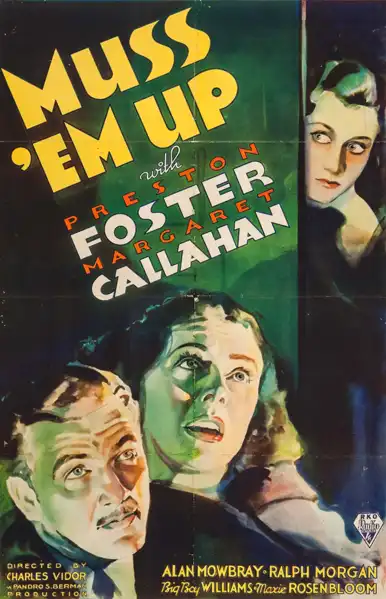
A definitive 6/10 rating for a film that redefined the boundaries of cult cinema. Muss 'em Up remains a cornerstone of transgressive art.
"Muss 'em Up" from 1936? Honestly, this one's mostly for the hardcore classic film fans out there, especially if you're into those quick-fire detective yarns from the era. If you’re just looking for a casual watch, you might find it a bit dusty and *a little bit slow* in spots. But if you dig seeing early careers of folks like Lucille Ball or Preston Foster, it's got some charm. 🕵️♂️
The premise starts kinda goofy: a private eye, played by Preston Foster as detective 'Flash' Casey, gets hired to figure out who shot a dog named "Pooch." The owner, a very distraught woman, wants answers, and that's the whole hook initially. It's a surprisingly *small* stakes start for a crime flick.
Things quickly snowball, naturally. Pooch's owner gets threatened. Then, bam, a kidnapping, then a murder. Casey's just trying to solve a dog shooting, and suddenly he's neck-deep in something much bigger. It's a classic setup, really.
Preston Foster as Casey... he’s got this weary charm. He's not exactly the *sharpest* knife in the drawer sometimes, you know, but he's persistent. You see him kinda stumble into clues more than deduce them. His trench coat, though? Always perfectly draped.
And Lucille Ball! She pops up as a switchboard operator, Ann. She's not on screen a ton, but she's got that *spark* even then, even in a small role. You can feel her trying to make something out of it. There's a scene where she's taking calls, and her exasperation feels very real, not just acted. 📞
Ward Bond is here too, doing his usual tough guy thing. He shows up as 'Red' and, well, he's just *Red*. You know what you're getting with him. He plays it perfectly, the kind of guy who looks like he could break you in half without thinking.
The plot itself is a bit of a tangled mess, to be honest. It moves fast, but sometimes you wonder if everyone involved knew exactly *what* they were doing, or why. Lots of running around, shouting. It’s a lot to keep track of, honestly.
There’s a moment where Casey is interrogating someone, and the camera just *holds* on their face for a beat too long. You almost expect them to break character or something. It feels a bit clunky, but also kinda endearing in a weird way. Like they didn't quite know where to cut.
The dialogue zips along, mostly. It's got that rapid-fire, slightly overlapping feel common in these old pictures. Some lines are genuinely sharp. Others, you just kinda nod and move on.
The villain, when revealed, isn't particularly shocking. But the journey there, through dusty offices and shadowy streets, has its moments. It’s got that old Hollywood studio backlot vibe, no doubt.
Willie Best, always a character, appears as a porter. His scenes are brief. He brings a bit of lightheartedness, but it’s the kind of role that makes you wince a little today. Still, he delivers his lines with a *certain flair*.
One thing that stuck with me was the actual motivation for the dog shooting. It seemed so... *trivial* in the grand scheme of things. Almost an afterthought once the bigger criminal enterprise really gets going. You're left wondering if the dog even mattered to the kidnappers at all. 🐕🦺
The movie feels like a B-picture through and through. Not much budget for anything fancy. The sets are sparse. The lighting is pretty straightforward. *You just kinda get that feeling*.
It's one of those films where everyone smokes constantly. You can practically smell the stale cigarettes through the screen. Just a little detail from the era that stands out. 🚬
The ending wraps up pretty quickly. No lingering questions. Just boom, solved, roll credits. It’s efficient, I guess, but doesn’t leave much to chew on.
IMDb —
1936
Community
Log in to comment.