DbcultAccessing Vault...
Cult Review
Senior Film Conservator
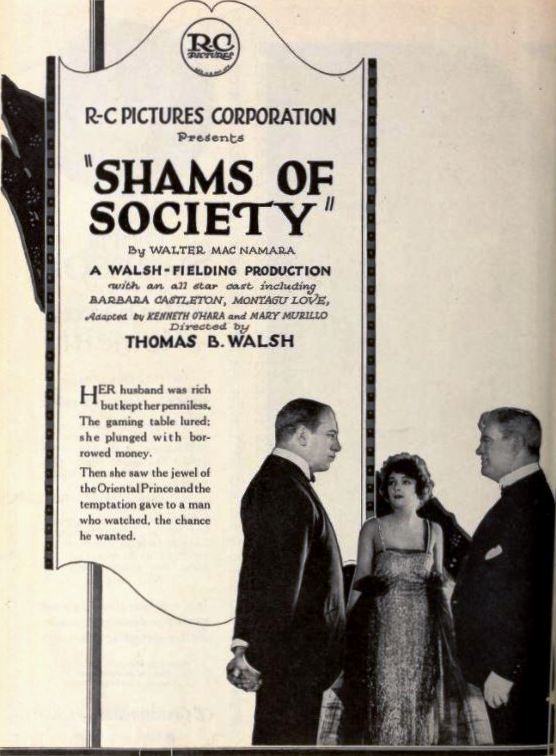
*Shams of Society* (1925) is a film that lingers like a bad debt—unforgiving, precise, and quietly corrosive. Directed with a scalpel’s precision by a trio of scribes who understood the anatomy of societal rot, this silent gem dissects the vulnerabilities of a woman trapped in a gilded cage of wealth and marital neglect. Sally Tysha’s Helen Porter is a character carved from paradoxes: a woman whose financial dependence on her miserly husband (Victor Gilbert) forces her into a world of vice, yet whose moral decay is framed not as a downfall but as a survival tactic. The film’s genius lies in its refusal to vilify Helen; instead, it implicates the society that starves her of autonomy, pushing her toward Howard’s (Montagu Love) web of criminality.
The narrative opens with a masterstroke of visual storytelling: Helen, draped in a gown that screams affluence but swaddles her in constraint, walks through a department store. Her husband’s name may be on the bank statements, but the film’s camera lingers on her trembling hands clutching a meager purse. This is a woman whose identity is parasitic on a man who hoards more than money—his吝啬 extends to affection, respect, and even the basic dignity of financial agency. The gambling den, nestled in a dress shop, becomes a metaphor for this duality. Here, the veneer of femininity (dresses, lace, perfume) collides with the rawness of gambling, where fortunes and ethics are lost with the turn of a card. Helen’s losses are not just financial; they are a shedding of identity, each borrowed dollar a step further from the self she once knew.
Montagu Love’s Milton Howard is the film’s true archvillain, a financier with the charm of a serpent and the moral compass of a compass. His proposition—steal a jewel from a society gala—is not a heist but a psychological operation. Howard understands that Helen’s desperation is her greatest asset; by dangling the promise of financial independence, he weaponizes her desire to break free from her husband’s tyranny. The gala sequence is a masterclass in tension: the glittering chandeliers mirror Helen’s fractured psyche, the champagne a bitter parody of celebration. As she approaches the jewel, the camera circles her in a slow, dizziness-inducing orbit, the music swelling to a dissonant crescendo. This is not a crime of passion but of necessity, a woman’s final act of rebellion against a system that has already robbed her of choice.
The film’s supporting cast—Julia Swayne Gordon as the manipulative friend, Barbara Castleton as a rival socialite—add layers of complexity. Gordon’s character is a cautionary tale in a beaded gown, her laughter hollow as she leads Helen into ruin. Castleton’s presence, meanwhile, embodies the toxic competition of high society, where friendships are transactional and alliances are forged over stolen glances. The ensemble work is seamless, each actor embodying the era’s social archetypes with a nuance that transcends silent film conventions. The writers, particularly Mary Murillo, deserve credit for crafting dialogue that crackles with subtext, delivered through facial expressions and glances that say more than words ever could.
Technically, *Shams of Society* is a marvel. The set design for the gambling den—a labyrinth of velvet curtains and mirrored surfaces—is a visual metaphor for the characters’ entrapment. The use of shadow and light is particularly striking; Helen is often framed in half-light, her face split between clarity and obscurity, a visual echo of her moral ambiguity. The score, a haunting blend of waltzes and dissonant strings, underscores the film’s tension, swelling at moments of decision to mirror the characters’ internal chaos. One cannot overlook the influence of German Expressionism in the film’s angular staging, particularly in the gala scene where the set’s geometric lines create a sense of claustrophobic unease.
Comparisons to contemporaries like *Love’s Protegé* (1927) are inevitable, but *Shams of Society* distinguishes itself through its unflinching focus on female agency. Where *Figaros Hochzeit* (1923) revels in comedic farce, this film is a tragedy of slow burn, its stakes elevated by the societal pressures it critiques. The influence of *The Adventures of Sherlock Holmes* (1922) is evident in the narrative’s puzzle-box structure, but where that film’s solutions are clean and logical, *Shams of Society* leaves its audience with questions. The ending—ambiguous, yet inescapably resonant—refuses to offer catharsis, instead demanding a reckoning with the systems that produced Helen’s plight.
The film’s legacy is as much about its cultural context as its narrative. Released during the Roaring Twenties, a decade of apparent excess but hidden inequality, *Shams of Society* critiques the illusion of opportunity. Helen’s journey mirrors that of women in the era—given a veneer of independence but shackled by financial and social constraints. The film’s unflinching portrayal of a woman’s descent into crime for survival would later echo in works like *The Smart Aleck* (1926), though that film’s comedic tone softens its message. Here, the stakes are visceral; the audience feels every loss, every borrowed dollar, every stolen glance as a step closer to the abyss.
Sally Tysha’s performance is the cornerstone of the film’s success. Her face is a canvas of micro-expressions—disappointment, determination, desperation—all conveyed without the luxury of voice. In one particularly moving scene, she stares into a mirror, the reflection of her husband’s portrait looming in the background. The juxtaposition of her vulnerability against the cold formality of his image is a masterstroke of silent film acting. Tysha’s physicality—her strained posture, the way she clutches her purse as if it were a lifeline—adds layers of subtext to the dialogue.
The film’s technical achievements are equally noteworthy. The use of double exposure in the gambling sequences creates a surreal atmosphere, where the stakes feel both real and dreamlike. The editing, brisk yet deliberate, maintains a tension that never wavers. Even the title card, with its Art Deco font and jagged lines, foreshadows the fractured morality at the film’s heart. These details are not mere flourishes; they are integral to the storytelling, each choice reinforcing the film’s themes of entrapment and illusion.
In the pantheon of silent film, *Shams of Society* holds a unique place. It is neither a pure melodrama nor a strict social realist work, but something in between—a hybrid that uses the form’s strengths to dissect the very real issues of its time. The film’s exploration of financial precarity and gender roles remains startlingly relevant, its questions about autonomy and complicity as urgent today as they were a century ago. For modern audiences, it serves as both a historical artifact and a timeless critique of systems that profit from the vulnerability of the marginalized.
To watch *Shams of Society* is to witness the birth of a narrative style that would later define the noir genre. The shadows, the moral ambiguity, the characters driven to extremes by societal pressures—all prefigure the taut, psychological dramas of the 1940s and beyond. It is a film that demands to be seen not just for its craftsmanship but for its unflinching honesty. In an age where the line between right and wrong is often blurred by circumstance, Helen Porter’s journey is a reminder that survival is rarely a matter of virtue, but of circumstance.
The film’s final act is a masterclass in ambiguity. As Helen stands on the precipice of her decision, the camera pulls back to reveal a society party in full swing, oblivious to the tragedy unfolding. This is the true shaming of the film’s title: the society that enabled Helen’s downfall is not just complicit, but indifferent. The closing moments, with their haunting silence and the flicker of a single chandelier, leave the audience with a lingering unease. It is a ending that refuses to moralize, instead inviting reflection on the structures that create such dilemmas in the first place.
IMDb 5.6
1921
Community
Log in to comment.