DbcultAccessing Vault...
Cult Review
Senior Film Conservator
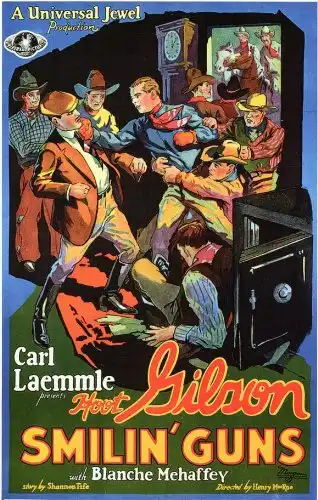
“Smilin' Guns,” a 1932 Hoot Gibson flick, is probably only for a very specific crowd today. If you're really into classic westerns, especially the early talkie kind, or you're a big Hoot Gibson fan, then yeah, you might find some quiet charm here. Everyone else expecting big explosions or complex plots? Probably give this one a wide berth; it'll feel like a slow afternoon nap. 😴
So, the movie opens up, and Hoot Gibson, our hero, rides into town. He's got this grin, you know, hence the title. He plays a guy named 'Smiling' Jim, which feels a bit on the nose, but hey, it's 1932. He's supposed to take over a ranch that's been left to him, but naturally, some bad dudes are trying to muscle in.
It’s very much a case of mistaken identity early on, which felt like a staple for these old films. Someone thinks he’s someone else, and that kicks off a bunch of low-stakes drama.
The film moves along at what I'd call a *leisurely* pace. You really feel every one of those 58 minutes.
There's a scene where Hoot's just riding across the desert, and the camera just *stays* on him for a really long time. It’s like the director just let the camera roll, hoping something exciting would happen. It didn't. 🐎
Hoot Gibson himself is… well, he’s Hoot Gibson. He's got a certain easy-going charisma, though it doesn't always translate into a commanding screen presence by modern standards. His smile is pretty constant, even when he’s supposed to be in a tight spot. Sometimes it feels a little *too* constant.
Walter Brennan pops up in this one, playing a character called 'Cactus.' You can always count on Brennan to bring a little something extra, even in these early roles. He's got this distinct voice and way of moving that just sticks with you. He’s not a huge part, but he definitely stands out when he's on screen, adding a tiny bit of grit.
There’s a saloon girl, played by Blanche Mehaffey, who tries to be tough but ends up just being kinda sweet. She's involved with the bad guys, but you can tell her heart's not really in it. Her big moment involves her trying to warn Hoot, and it's pretty understated.
The bad guys, led by someone just called 'Bart,' are pretty generic. They mostly just stand around looking mean and occasionally riding horses. Their plans aren't exactly masterminded, which makes Hoot's job a little easier.
Being an early talkie, the sound quality is… *of its time*. You often hear this slight hiss, and some of the dialogue sounds a little tinny. It adds to the charm, I guess, but also makes you appreciate modern sound design. 🔊
The sets are what you’d expect: dusty towns, simple saloons, and lots of wide-open spaces. You can tell they weren't spending a fortune on production design here. It's functional.
One of the chase scenes, if you can call it that, involves Hoot and the bad guys riding horses. The editing felt a little jumpy, like they were stitching together whatever footage they had. It doesn’t build much tension, just shows people on horses.
There’s this particular shot of a mountain in the background that shows up a few times. It’s pretty, but it almost feels like a stock image they just kept cutting back to. Like, 'Oh, look, scenery!'
The final showdown isn't really much of a showdown. It's more like a few punches thrown, a quick lasso, and then everyone just kinda gives up. It's all wrapped up very neatly and without much fuss. You almost wish for a bit more chaos.
Is Smilin' Guns a masterpiece? Nope. Is it even particularly memorable beyond being a Hoot Gibson vehicle? Probably not for most folks.
But if you approach it as a glimpse into what early westerns were like, with their simple stories and even simpler production, there’s something oddly endearing about it. It’s not trying to be anything it isn’t.
It’s a movie that feels like it was made on a Tuesday afternoon, everyone did their job, and then they went home. No big statements, just a cowboy and some bad guys. If that sounds like your cup of tea, go for it. If not, there are literally thousands of other movies out there. 😉
IMDb —
1916
Community
Log in to comment.