DbcultAccessing Vault...
6.1/10
Senior Film Conservator
A definitive 6.1/10 rating for a film that redefined the boundaries of cult cinema. Soak the Rich remains a cornerstone of transgressive art.
"Soak the Rich" from 1936? Yeah, it's definitely not for everyone, not today anyway. If you're a serious film historian, or just someone obsessed with how political fear-mongering looked way back when, then sure, dive in. Anyone else looking for laughs or even a coherent plot, you'll probably be pretty bored. It's a curiosity, mostly. 🧐
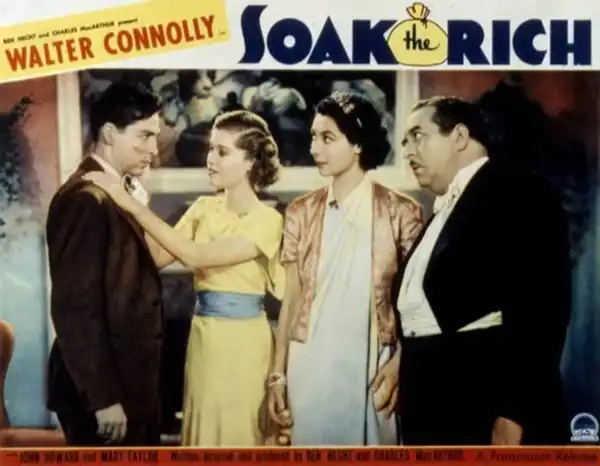
The movie centers on Benjamin K. Babbitt, played by Walter Connolly, who's just terrified of this "soak-the-rich" bill moving through the Senate. His whole world seems to revolve around this. He's got this private "captain" fellow, kind of a spy type, played by Lionel Stander, who keeps him updated on "Communist activities." This captain character, he's a real hoot. Stander's delivery, all gruff and conspiratorial, makes his reports almost the best part. You just wait for him to pop up and deliver some wild news.
There's this one scene where Babbitt calls the President directly. Like, directly. No switchboard, just pick up the phone and chat with the leader of the free world. It's kinda funny how casual it seems compared to now. You can almost feel the movie trying to make this whole situation seem super dire, but Babbitt's flapping and yelling just makes it all feel a bit silly instead.
Ilka Chase, as Babbitt's socialite daughter, provides a nice counterpoint. She's a bit ditzy, but her lines sometimes hit with this unexpected cleverness. Her character doesn't care about politics, really, which feels refreshing amidst all the capitalist panic. The way she try to get her dad to just chill out. Bless her heart.
The main plot gets a bit tangled with a romance between Mary Taylor's character and John Howard's. Honestly, it doesn't quite click. Their scenes often feel like they belong in a different film. You get the sense the writers, Charles MacArthur and Ben Hecht, tried to shoehorn in a more traditional rom-com element. Their dialogue usually zings, but here it often feels a little flat, like they wrote it on a Tuesday afternoon before happy hour.
What sticks with me are the small details. Babbitt's facial expressions when he hears another report about "the reds." Or the way his butler just silently judges everything. There's a moment when someone tries to explain economics, and the camera lingers on Babbitt's utterly confused face for a good ten seconds. It’s not profound, but it made me chuckle.
The conversations, especially when Babbitt is panicking, they're like something out of a play. Ben Hecht and Charles MacArthur, the writers, they knew how to make words dance, even if the plot sometimes stumbled. There’s a certain snap to some of the back-and-forth, even the stuff that feels a bit dated now.
His fear isn't just about money, it’s about this whole idea of society falling apart because of, well, people wanting a bit more. It’s pretty wild to see that kind of panic laid bare, all those years ago. You wonder if folks watching it in 1936 felt the same dread, or if they were laughing right along with me.
The pacing feels a bit off at times, too. Some scenes just drag. Then others rush by and you're left wondering what just happened. The movie is trying to make a point about class and fear, but it gets a bit lost in its own antics. It tries to be a satire, then a romance, then a political thriller, and ends up being just a bit of a mishmash.
The ending, without giving too much away, ties things up a bit too neatly. After all that buildup, all that panic from Babbitt, the resolution feels almost too easy. It’s like the writers just threw up their hands and said, "Alright, let's just finish this." You don't get much of a lasting impresion.
For anyone who studies the pre-Code era, or early political films, there’s some historical gold here. It’s a snapshot of a particular anxiety from the time. But for casual viewing? Probably not. It's more of an academic curiosity then a truly engaging film. 📚

IMDb —
1929
Community
Log in to comment.