DbcultAccessing Vault...
Cult Review
Senior Film Conservator
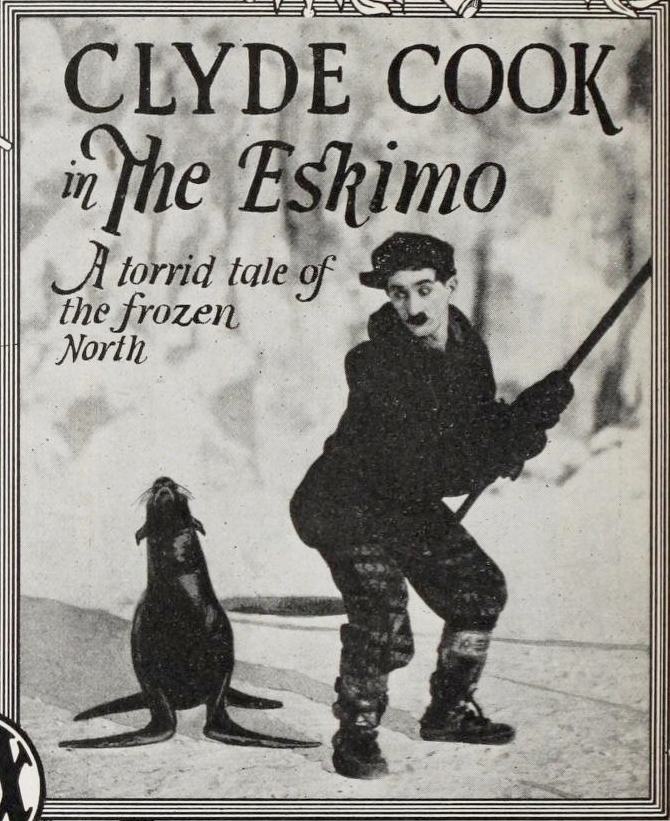
Arctic lampoonery at full glare: Kennedy’s parka-clad boob becomes the era’s funniest snowman.
There is a moment—roughly three minutes in—when Edgar Kennedy attempts to strike a match on a glacier and the flame, obedient to nothing but comic logic, ignites his false beard instead of the cigarette. The camera lingers just long enough for you to glimpse the terror in his eyes, then smash-cuts to Sybil Seely, whose expression of cultivated indifference could freeze gin. In that sliver of celluloid, The Eskimo announces its manifesto: every heroic myth of the Yukon will be flambéed until the frost itself laughs.
Historians who treat silent slapstick as mere custard-pie archaeology miss the subversion pulsing beneath the snow here. The picture opens with a title card that reads—misspelled on purpose—“He wanted to plant his flag where no flag had ever been planted, but forgot his mittens.” Already the grammar of imperial swagger is punctured. Kennedy’s explorer, billed only as ‘The Captain,’ stomps through fake drifts that billow like busted pillows, accompanied by a bear who is visibly a man in a rug. The bear periodically removes its head to sneeze, collapsing any remaining illusion of verisimilitude.
Rather than spoof one single snow epic, the writers layer parody upon palimpsest. You’ll recognise the starving-cabin-fever scenario from The Highest Bid, the man-versus-blizzard braggadocio of Trapped in the Air, even the ethnographic hooey that A Trip to the Wonderland of America peddled. Yet each trope is kneaded until it squeaks. Kennedy’s starvation hallucination isn’t a tragic descent; it’s a Busby Berkeley number where fishsticks dance the Charleston and a chorus of penguins moonlights as flappers.
Sybil Seely, often remembered as the ingenue who could match Buster Keaton’s deadpan, weaponises that same stone-face here. She enters astride a malamute sled, fur coat parted to reveal a drop-waist dress better suited to a Manhattan speakeasy. When the Captain pontificates about ‘taming the savage wilderness,’ she yawns, files her nails with a walrus tusk, and quips via intertitle, “I’ve seen tamer bachelor parties in Jersey.” The line, risqué for 1920s tastes, detonates like a firecracker under the seats.
Then there’s Clyde Cook, Australia’s gift to kinetic comedy. His character, ‘Salty’ O’Toole, allegedly spent seven years inside a whale—an absurdity the film neither confirms nor denies. Cook moves as though his bones are made of elastic; he skis backwards, collides with his own shadow, and in the film’s most surreal flourish, arm-wrestles a polar bear for custody of a herring. The bear wins but graciously offers half the fish, sealing the moment with a handshake that lasts three frames too long, turning the gag from mere slapstick into absurdist diplomacy.
Director—name lost to a filing-cabinet avalanche—relies on under-cranking, reverse photography, and double exposure rather than the costly location work that bankrupted studios churning out Salvation Nell or The Count of Monte Cristo. The result feels closer to the animated anarchy of a Max Fleischer Out of the Inkwell short than to any live-action expedition. Yet the phony matte paintings, all cotton snow and silver-paint ice, achieve their own Brechtian honesty: we are always reminded we’re watching artifice, and that reminder is the joke.
Where contemporaries such as Morals punished flapper independence with moral ruin, The Eskimo lets Seely own the narrative. She rescues the men not with brawn but with brains: bartering a crate of booze for safe passage past imaginary Inuit, seducing a corrupt Mountie to lift an embargo, and finally commandeering the dogsled while the boys cling to the runners like frostbitten toddlers. The inversion is so blatant it loops back to farce, yet the film trusts the audience to cheer anyway.
Race depictions, inevitably, carry the era’s baggage. Eskimo extras wear sealskin coats over plaid shirts, speak in Hollywood gibberish, and are placated by jazz records played on a portable gramophone. It’s offensive, yes, but the film also makes them the only competent characters: they build real igloos, navigate by starlight, and ultimately filch the explorers’ whiskey to stage their own off-screen party. The satire lands less on indigenous people than on the white lens that never bothered to learn their names. Still, a modern viewer will wince, and rightly so.
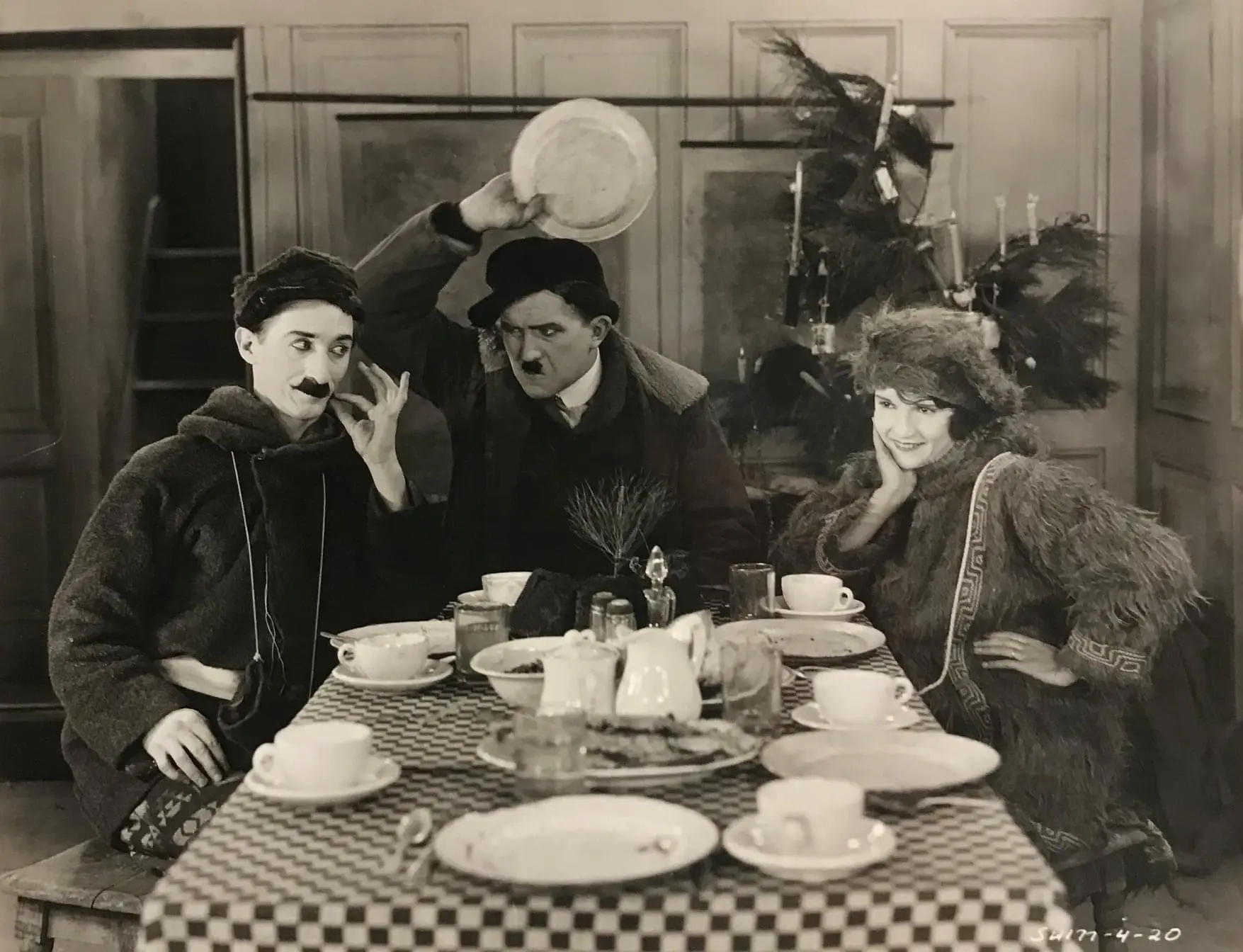
Watch for the background details: a wanted poster for ‘Abominable Snowman—Last Seen Buying Stocks,’ or a sled branded ‘Property of Santa Claus—Return to North Pole.’ My favourite Easter egg appears when the Captain unfolds a parchment map; for a single frame the cartographer is listed as ‘J. Swift & G. Orwell.’ Such blink-and-miss graffiti anticipates the marginal jokes later perfected by Airplane! and The Naked Gun.
The score, reconstructed for recent 2K restorations, pairs ragtime xylophones with Inuit-style throat singing—an anachronistic mash-up that somehow gels. During the climactic chase across cracking ice floes, the percussion accelerates to locomotive speed, then drops to silence the instant the heroes plunge into freezing water. The absence of sound becomes its own punchline, a vacuum into which the audience’s gasp rushes like a comic cymbal.
Editing rhythms borrow from Soviet montage: collision, juxtaposition, dialectical thaw. A shot of Seely’s mascara—two sooty commas—dissolves into twin crescent moons, which then tilt to become frostbitten smile lines on Kennedy’s cheek. Intellectual metonymy rendered in greasepaint and moonlight. The payoff arrives seconds later when Kennedy attempts to light a stove with the moon’s reflection, convinced it’s a lantern. Cause, effect, pratfall— Eisenstein would applaud the efficiency, if not the silliness.
Yet for all its formal cleverness, The Eskimo never struts its sophistication; it’s too busy slipping on its own banana peel. The film’s governing philosophy is simple: if clichés are cultural icebergs, melt them with a blow-torch of absurdity and let everyone slide laughing into the sea.
Released in late 1926 as a brisk five-reeler, The Eskimo performed modest winter business, trampled by the prestige snowshoes of The Venturers. Variety dismissed it as ‘a two-reel idea wearing four-reel earmuffs.’ By the sound era it had vanished, misfiled under ‘Educational—Arctic’ in a Kansas storage vault. Rediscovered in 1998 beneath a stack of decomposition-prone nitrates, the print arrived in Rochester’s Eastman archive looking like shattered meringue. Restorers pieced 847 shards into a cohesive reel, tinting night scenes a hypothermic cyan and firelight moments the colour of cognac.
Contemporary festival audiences greet the film with stunned delight; its gag density rivals Winning with Wits yet feels fresher for its very obscurity. Modern critics mine it for evidence that parody did not begin with Zucker-Abrahams-Zucker, that the 1920s possessed its own brand of meta—ink-stained, frost-nipped, and roaring drunk on bathtub gin.
So is The Eskimo merely a footnote in the blizzard of slapstick history? Hardly. It is the missing link between the social-climb comedies of The Suburban and the full-bore spoofs that would crest a century later. It proves that even in an era when polar exploration still killed people, audiences were ready to laugh at the hubris of flag-planters. And it reminds us that satire travels light: no CGI, no Dolby, just greasepaint, a rubber walrus, and a woman who refuses to shiver on command.
Watch it for Kennedy’s slow-burn when his trousers become an impromptu dogsled. Watch it for Seely’s side-eye that could slice seal blubber. Watch it because, at a moment when every blockbuster arrives pre-packaged with its own self-mocking trailer, The Eskimo found the joke first, carved it into the ice, and then set the whole floe drifting toward oblivion—only for us to fish it out, still ticking like a comic time-bomb.
Verdict: a frostbitten jewel of subversive slapstick, worthy of thawing for your next movie night. Just bring whiskey. Lots.
IMDb 7.1
1927
Community
Log in to comment.