DbcultAccessing Vault...
Cult Review
Senior Film Conservator
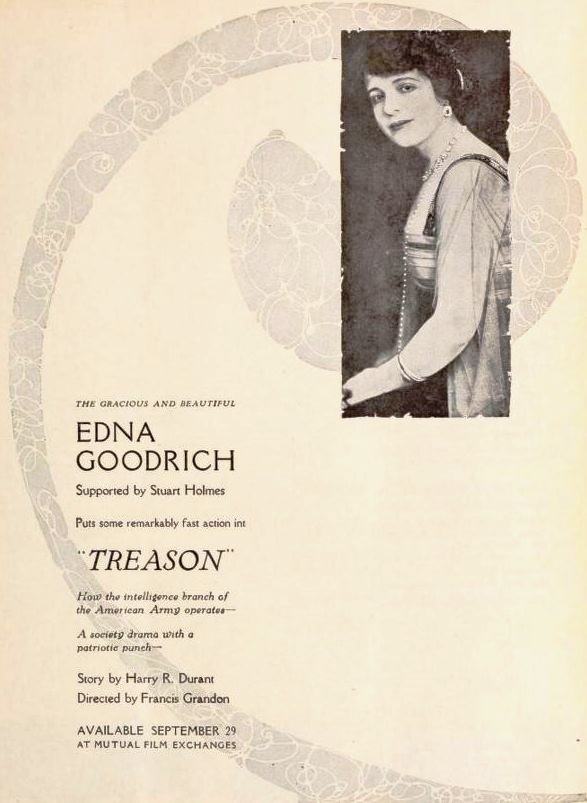
The phrase “silent film” usually conjures fluttering eyelashes and damask fainting couches, yet Treason arrives like nitrate shrapnel—quiet only in decibel. The year is 1918, influenza stalks the streets, and a different contagion—mistrust—seeps through the drawn curtains of a brownstone lab where Clarence Heritage’s obsessive chemist distills annihilation into a thimble. Director Stuart Holmes refuses patriotic pieties; instead he stages espionage as domestic rot, a choice that makes this hour-long curiosity feel eerily predictive of Mr. & Mrs. Smith style psychodramas a century later.
Notice how cinematographer Howard Hall weaponizes shadow: the test tubes glow like votive candles while Edna Goodrich’s neglected wife glides through corridors of Stygian gloom, her negligee a white flag nobody bothers to see. Each fade-out feels less like gentle punctuation than like someone drawing a velvet shroud over a corpse that hasn’t quite died. The effect is noir before the French coined the term.
Where contemporaries such as Whose Wife? mined adultery for slapstick, Treason treats espionage like an extramarital affair the state insists on chaperoning. The unnamed Secret Service agent planted in the parlour is both voyeur and cock-block, his unexplained presence an aphrodisiac for conspiracy. Every time the camera lingers on Mildred Clair’s housemaid—wide eyes reflecting hallway gaslight—you sense she knows the protector’s real brief yet savors the secrecy like absinthe on the tongue.
The screenplay, credited to Harry R. Durant and J. Clarkson Miller, dispenses exposition the way a miser doles out coins. One intertitle reads merely: “She asked no questions—curiosity had been bled from her.” In that ellipsis lives whole volumes of Edwardian marital fatigue. Compare it to the verbose moralizing of Thou Shalt Not Covet and you appreciate the modernist compression at work here.
Aachen—played with oleographic charm by an uncredited Stuart Holmes—doesn’t seduce with promises of silk or champagne. His aphrodisiac is abstraction: the notion that a chemical formula can be transmuted into emotional capital. When he whispers, “Your husband loves his test tubes more than your heartbeat,” the line lands like a surgeon’s scalpel slipping past bone. We have here the birth of techno-thriller logic: data as the true object of libido.
Watch how the theft sequence cross-cuts between the wife’s trembling hand and the bubbling retort, both vessels on the brink of irreversible reaction. The montage predates Hitchcock’s Sabotage by nearly two decades yet already understands that suspense is a question of molecular timing.
Edna Goodrich shoulders the film’s emotional arc with minimal histrionics. In close-up her pupils dilate like ink dropped in water; in long shot she shrinks beneath doorway lintels as though the house itself were accusing her. She embodies what T.S. Eliot would later call the “patient etherised upon a table,” only here the ether is secrecy and the scalpel is Aachen’s rhetoric.
Clarence Heritage, by contrast, plays the husband as a man who has mistaken stoicism for immunity. Watch the instant he discovers the formula gone: his shoulders sag not with fear of national calamity but with the recognition that emotional bankruptcy now has a body count.
A subtext hums beneath the spy-craft: women’s knowledge must be policed lest it contaminate the masculine forge of war. The government’s directive to keep the wife ignorant reads like a wartime version of The Way of a Man with a Maid, only here chastity is replaced by clearance level. When she finally partakes in classified information—albeit through larceny—the punishment is swift, public, and gender-coded: she loses husband, house, and narrative agency in a single reel.
Yet the film also flirts with schadenfreude. The camera lingers on her anguish long enough for us to question whether this “lesson” is just another patriarchal spectacle. The final iris-in closes on her tear-streaked face rather than on the shackled spy, implying that treason, in the end, is less about national security than about wives who dared to look where they were told not to.
Restored prints reveal tinting strategies that turn night scenes into bruise-colored fever dreams: amber for interiors, viridian for labs, a sickly lavender for the wife’s boudoir. These chromatic choices perform narrative work, mapping emotional temperature onto physical space. Compare it to the monochrome moralism of The Awakening and you appreciate how Treason weaponizes pigment for psychological realism.
Notice too the use of negative space in compositions: doorframes bisect the screen, trapping characters in visual purgatory. The explosive formula itself is never shown in detail; instead we see its reflection—a warped amber smear on a glass beaker—suggesting that destruction is always mediated, always interpreted, never grasped in the raw.
Archival records indicate the film toured with a live effects team: a struck anvil for lab explosions, a muted snare for whispered conspiracies. Modern audiences encountering it on Blu-ray with a curated score by the Alloy Orchestra will find the experience paradoxically louder than most talkies. Every tick of the metronome becomes a countdown; every viola scrape feels like a fingernail across patriotism’s conscience.
History has stranded Treason in the limbo between Griffith’s Victorian parables and Lang’s Expressionist labyrinths, yet its DNA proliferates. You can spot its descendants in Notorious’s stolen uranium, in Eye of the Needle’s marital espionage, even in the laconic despair of Tinker Tailor Soldier Spy. The film intuited what the Cold War would later codify: that bedrooms make better war rooms than bunkers.
Meanwhile the star careers dissipated like nitrate fumes. Edna Goodrich retired into private grief; Clarence Heritage died on a 1923 set when a prop revolver misfired—an irony too ghastly for fiction. Their obscurity lends the film an autopsy-like intimacy: we are watching ghosts who never achieved immortality, only transience caught on celluloid.
What lingers longest is the film’s refusal to cathartically punish the male inventor. The state’s wrath lands on the wife and the foreign spy, while the husband’s neglect—arguably the true inciting sin—goes unexamined. In this sense Treason prefigures the moral asymmetry of the Manhattan Project era: scientists revered, wives silenced, history written in isotopes rather than apologies.
Yet perhaps that very asymmetry is why the film feels contemporary. We still live in a world where classified knowledge trumps intimate knowledge, where patents are sexier than promises. The final tableau—a reunited yet shattered marriage standing amid broken beakers—offers no absolution, only the uneasy truce of two people bound by secrecy and scorched by the same fireball.
As of this writing, the only accessible print is a 2K restoration housed at George Eastman House, occasionally streaming on Criterion Channel under the “Shadows of 1918” banner. Seek it out not for nostalgic kitsch but for a masterclass in how silence can detonate louder than TNT. Bring headphones; the lack of synchronized dialogue paradoxically amplifies every creak of your own floorboards, turning living rooms into accomplices.
And when the end credits—white text on black, no scrolling—snap shut like a prison gate, take inventory of your own secrets. Do you hoard passwords the way Heritage hoards molecules? Have you ever weaponized information to teach a lover “a lesson”? If so, congratulations: you are the latest unindicted co-conspirator in a century-old plot that refuses to expire.
Verdict: A brittle, blistering artifact that proves the most volatile compound ever concocted isn’t nitroglycerin but mistrust between people who once pledged permanence. See it, then—quietly—go home and kiss your spouse like the Feds might be watching.
IMDb —
1920
Community
Log in to comment.