DbcultAccessing Vault...
6.5/10
Senior Film Conservator
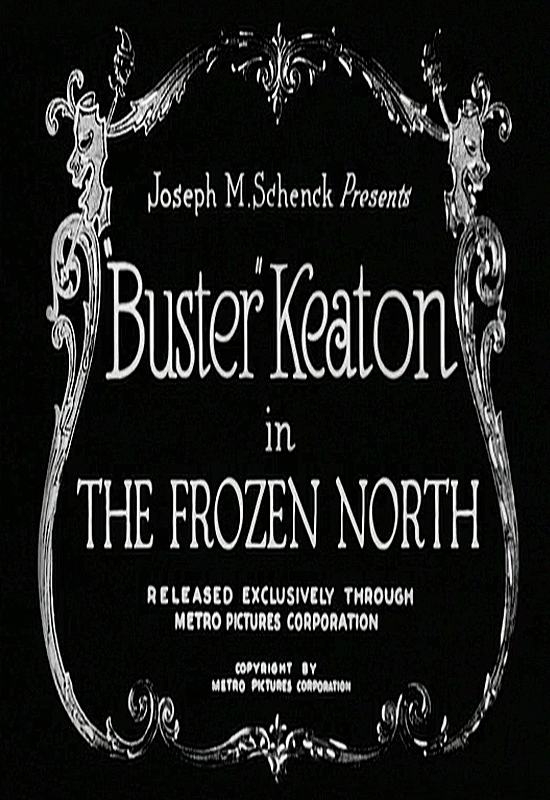
A definitive 6.5/10 rating for a film that redefined the boundaries of cult cinema. The Frozen North remains a cornerstone of transgressive art.
Picture the American frontier as told not by Zane Grey’s ink but by a frost-bitten vaudeville postcard: that is the canvas on which The Frozen North (1922) paints its 17-minute epic of delinquent grandeur. Buster Keaton—stone-faced, rubber-limbed—exits the Pullman carriage and steps straight into a genre he intends to detonate. The film’s first gag arrives before any character can speak: the locomotive exhales, the platform is empty, and suddenly Keaton’s silhouette emerges from inside the plume itself, as though birthed by industrial myth. It is a visual overture that whispers, “History is about to be tripped, face-first, into a snowbank.”

Silent-era historians often slot this one-reeler beside The Scarecrow or Life Savers—shorts where Keaton’s acrobatic pessimism ricochets through pastoral sets. Yet The Frozen North deserves colder company: it is Keaton’s sly love-letter to the nickelodeon villain, that cloaked sociopath who once tied maidens to sawmill conveyor belts. Here, the comedian dons a black neckerchief so absurdly ominous it droops like a guilty verdict, adopts a villain’s swagger, and promptly walks into every conceivable rake of comeuppance. The joke is not merely that evil fails; it fails with bureaucratic exactitude.
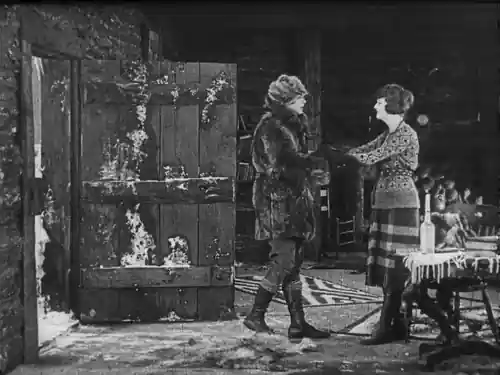
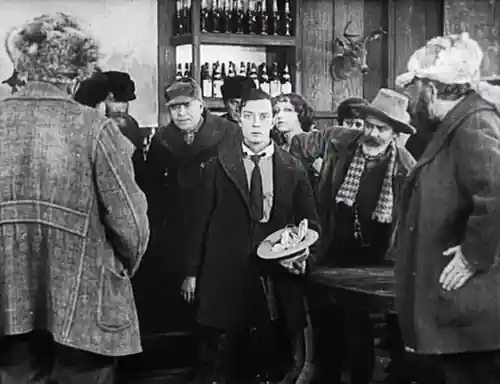
Edward F. Cline, co-writer and frequent Keaton conspirator, structures the picture like a three-act snowball fight with Fate. Act I: arrival and posturing. Our anti-hero swaggers into a dilapidated Yukon cantina, twirls his revolver, and discovers—to his indignation—that the locals greet him with yawns rather than shrieks. In a conventional melodrama, such nonchalance would wound the villain’s mystique; here it forces Keaton to upstage himself, inflating his menace until it pops like a paper bag. Watch how he leans against the bar, elbows angled like a scarecrow attempting nonchalance, while the saloon mirror reflects not his steely gaze but the back of his bobbing hat—a visual pun on the cliché of the “fearsome reflection.”
Act II: courtship and catastrophe. Enter the schoolmarm (Bonnie Hill), lips pursed with prairie rectitude, eyes glinting with dime-novel curiosity. She becomes the unwilling axis around which Keaton’s villainy pirouettes. One extended gag involves an attempted elopement via handcar on a spur line that terminates, literally, in mid-air above a frozen river. The lovers roll onward, oblivious, until the ground runs out. The resulting plummet—undercranked, gravity-defying—turns the damsel-in-distress trope into a physics problem. When they surface through the ice, her pompadour has hardened into an icy helmet; Keaton’s moustache droops like a defeated ferret. No intertitle is needed: the image satirizes every perilous rescue ever hatched by When Men Are Tempted or Love’s Penalty.

Where Mack Sennett’s brand of chaos feels solar—explosive, mercurial—Keaton’s comedy is cryogenic. His timing suspends calamity in mid-air, letting us inspect its contours. Consider the sequence that follows the botched robbery: cornered by a lynch mob, Keaton’s villain ducks into a frontier photo studio, dons a fur coat, and re-emerges disguised as… well, still Buster Keaton, but now swaddled like a malfunctioning teddy bear. The mob fails to recognize him, even as his derby trembles atop the ensemble like a guilty semaphore. The gag works because it trusts the audience’s narrative memory; we remember the coat from an earlier shop-window display, and the payoff lands with the satisfaction of a well-plotted mystery. In 1922, such self-referentiality was practically Brechtian.

Silent film is often praised for its universality, yet Keaton weaponizes that universality to mock the very notion of moral legibility. The villain’s revolver, a phallic talisman in The Praise Agent or Der Tunnel, becomes here a malfunctioning water-pistol: when Keaton finally fires, the bullet exits at half-speed, loops, and perforates his own hat brim. The camera lingers—not on the wound (there is none) but on the perfect circle of daylight now punched above his scalp. The image distills the entire ethos of The Frozen North: aggression, once mechanized, circles back to expose its own absurdity.
“I always wanted the audience to know the gag was on me,” Keaton later remarked. “That way they’d forgive the villainy, because the villainy was already confessing.”
Yet confession requires a witness, and the film’s most enduring witness is the landscape itself. Shot partly on a backlot strewn with salt and potato flakes, the Yukon exhales a bleached, lunar pallor. Every footprint Keaton leaves is an autograph on the blank page of settler mythology. When the final reel dissolves into a horizon-wide iris, the whiteout swallows not only the protagonist but the genre that birthed him. The frontier, once a canvas for manifest destiny, becomes a palimpsest where melodrama is overwritten by farce.
Place The Frozen North beside ’Tween Heaven and Earth and the tonal chasm yawns. Both films flirt with divine retribution, yet where the latter sermonizes through candle-lit tableaux, Keaton preaches via pratfall. Likewise, Queen of Spades conjures supernatural comeuppance; Keaton finds the same cosmic justice in a slipping icicle. His genius lies in demonstrating that morality tales need not thunder—they can simply slip on a banana peel frozen beneath fresh powder.

Joe Roberts, perennial heavy, portrays the local sheriff—a man whose moustache alone outweighs most supporting actors. Roberts’ looming frame functions as a moving obelisk against which Keaton’s wiry villainy is measured. Their physical disparity fuels a ballet of pursuit: Roberts strides like a glacier, Keaton skitters like windblown litter. In one undercranked chase, depth planes collapse; Roberts appears to gain an inch per frame, Keaton loses a yard per heartbeat. The effect is both comedic and existential—we are watching time dilate through desire and dread.
Marion Harlan, as the saloon vamp who briefly double-crosses the protagonist, injects a venomous flirtation that anticipates noir femmes. Her kohl-rimmed gaze slices through the masculine braggadocio like a hot wire through frost. When she slaps Keaton—an open-palmed crack that echoes amid the nickelodeon silence—the gesture carries the weight of every silenced ingénue in Should a Wife Forgive? or The Society Bug. The moment is brief, yet it reframes the entire narrative: villainy, already buffoonish, is now revealed as gendered posturing ripe for toppling.
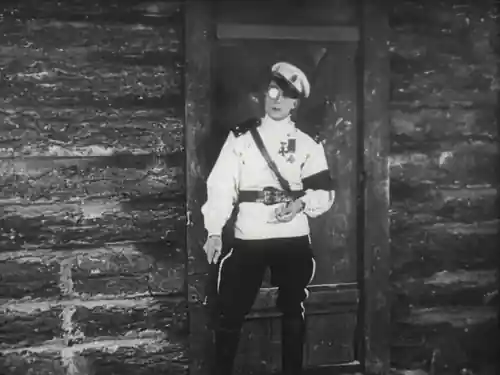

Keaton edited The Frozen North with the precision of a metronome. Average shot length hovers around 3.4 seconds—frenetic even by 1922 standards—yet each cut obeys thermal logic: the faster the montage, the colder the sensation. When the narrative slows, allowing a single tableau to breathe (Keaton alone on the ice plain, derby in hand, surveying the void), the temperature paradoxically rises; we feel the chill only because the film has granted us stillness to shiver.
That calculus reaches apotheosis in the climactic gag: a duel scheduled “at high noon,” which in the Yukon midwinter translates to a sun hovering like a dim coin behind cirrus. Keaton and Roberts stand ten paces apart, revolvers trembling. The camera frames their silhouettes against a whiteness so pure it seems liquid. Then—without a title card—the sun slips behind a cloud, erasing both shadows. The duel dissolves into pantomime; antagonists flail at inaudible bullets while their shadows, missing, refuse to participate. It is a moment at once hilarious and metaphysical: identity itself, like villainy, depends upon illumination.
By the time the end card hits, Keaton’s anti-hero has been shot, dunked, dragged, and, in a coup de grâce, married off to the schoolmarm by a justice whose Bible is frozen shut. The couple exits the frame into a blizzard whose gusts whip the bride’s veil until it flaps like a surrender flag. Cynics might read this as conservative closure: roguish male tamed by domestic yoke. Yet Keaton’s stone-faced resignation, that visage which refuses to smile even as the iris closes, implies a more subversive coda: perhaps the real villainy was civilization itself, lassoing wild impulses into social contracts.
Viewed today, The Frozen North operates as both artifact and prophecy. Its deconstruction of frontier mythology anticipates the revisionist westerns of the ’60s; its gag-driven nihilism foreshadows the anti-humor of contemporary adult cartoons. Film schools cite it as a masterclass in visual economy: no shot exceeds its narrative necessity, no gag overstays its frostbitten welcome. Meanwhile, TikTok comedians unknowingly homage Keaton whenever they allow a stunt to undercut their own bravado—digital pratfalls echoing across a century of snow.
Newcomers to silent comedy often complain of “speed sickness”—the herky-jerky motion bequeathed by incorrect frame rates. Seek restorations projected at 20–22 fps; at that cadence, Keaton’s movements attain balletic gravity. Pair your viewing with a score that favors brushed snare and muted trumpet; brass sections amplify the film’s undercurrent of wistful bravado. Finally, resist the urge to binge. At 17 minutes, The Frozen North begs repertory programming between The Adventures of Felix and a hot mug of something spiked. Let the salt-and-potato snow settle on your retinas; let the bowler hat linger in your peripheral vision. Only then will you feel the chill that Keaton intended—not merely of weather, but of a universe that answers ambition with slapstick.

There, in the swirling white, the American villain is neither defeated nor redeemed. He is simply given the slip—by his own shadow, by the train of narrative convention, by the audience’s stifled guffaw. And as the screen fades to black, one senses that Keaton tips his derby not to us, but to the void beyond the rectangle of light, where every melodrama must eventually freeze solid and shatter.
IMDb 6.1
1926
Community
Log in to comment.