DbcultAccessing Vault...
Cult Review
Senior Film Conservator
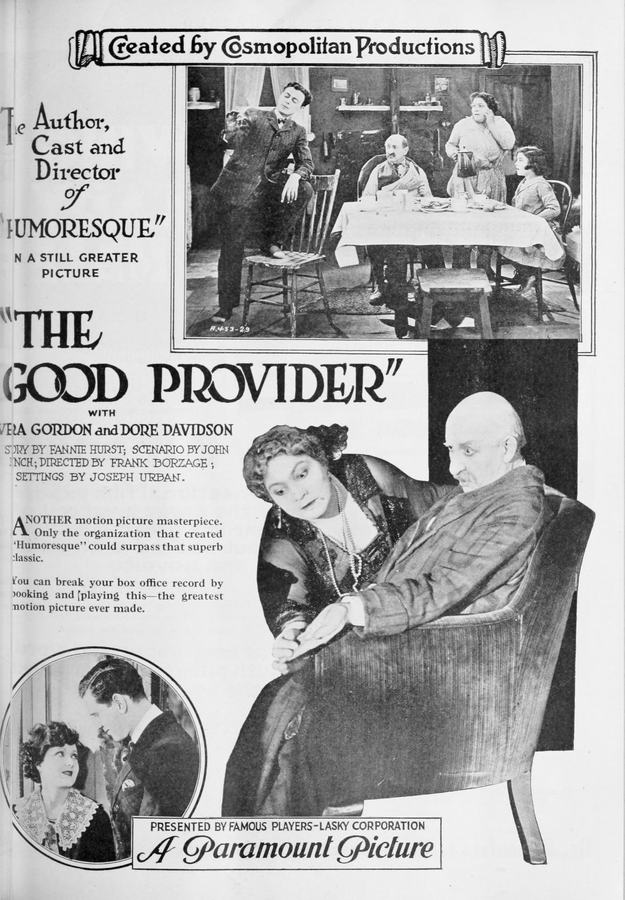
In the chiaroscuro universe of early-1920s cinema, where every intertitle is a stanza and every iris-in a gasp, The Good Provider arrives like a weathered valise unpacked under kerosene lamplight: corners scuffed, hinges protesting, yet exhaling the camphor of lived experience. Director John Lynch—working from a scenario by the indefatigable Fannie Hurst—refuses to let immigrant striving calcify into statuary myth. Instead, he lets it breathe, belch, stumble, and ultimately re-constitute itself inside the gaudy, jangling boom of post-WWI prosperity.
Julius Binswanger, incarnated with stooped majesty by Dore Davidson, is no wide-eyed naïf gaping at Lady Liberty. From frame one he is a man who already hears the freight-train whistle of American capitalism, who knows that to peddle is to pray, to haggle is to chant. The opening montage—New York tenements stacked like cracked honeycombs—cuts to a ferry’s wake bisecting the Hudson, water rendered in slate grays that anticipate the storm inside every subsequent reel. Lynch overlays these shots with a superimposed ledger page, its red-ink totals bleeding away, a visual motif that whispers: every mile traveled is also a debt incurred.
Newton, when we reach it, exists in a honeyed glow that could lull any viewer into pastoral complacency. Yet the director seeds disquiet: a telegraph wire hums like an angry cicada; a Model T backfires, scattering hens that once merely side-stepped horses. In this cradle of future displacement, Julius erects a modest empire—lace curtains, a pot-bellied stove, the first cash register anyone in town has ever touched. His success feels both heroic and vaguely predatory, as though prosperity itself were a traveling circus that might fold its tents overnight.
The film’s boldest gambit is a fifteen-year ellipsis rendered in a single, luminous match-cut: a teenage Pearl (Margaret Severn) twirls in a field of daisies, dissolving into the same field now bulldozed into a dirt lot where billboards hawk Sanitized Overalls. The cut lands like a slap, reminding us that progress in America is rarely additive; it is substitutive, voracious. When the adult Pearl re-enters, her gait is all flapper angles, eyes glittering with Manhattan hunger. Severn plays her like a violin that has swapped lullabies for foxtrots—every glance toward Max (Eddie Phillips) is a dare, every smile a promissory note.
Max arrives in Newton wearing a camel-hair coat so sumptuous it might have been tailored from sunset. Phillips, blessed with a profile that could sell cologne to a hermit, lets the actorly gloss crack just enough to reveal the outsider’s panic beneath. His courtship of Pearl is staged on a porch swing whose chains squeak a syncopated anxiety, as though the very furniture fears the city will steal its innocence. Their first kiss—captured in profile against firefly dusk—feels less romantic than conspiratorial, a pact to abandon the world that nurtured them.
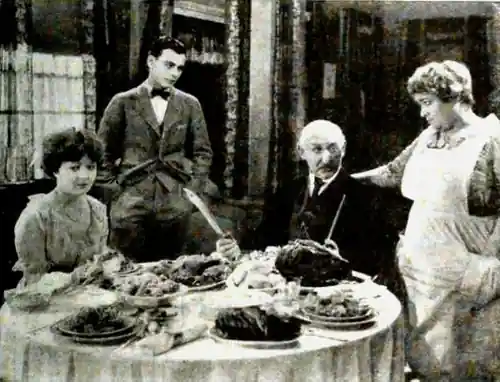
Meanwhile, Julius’s paternal anguish festers. Davidson, using the subtle vocabulary of shoulders—their slump, their twitch—shows us a man realizing that his American dream has incubated a generation allergic to the scent of his sweat. The dinner-table scene, lit by a single overhead bulb that carves the family into chiaroscuro islands, crackles with subtext. Izzy (William Collier Jr.) proposes buying into a chain of five-and-dime emporiums; Julius counters with the sanctity of personal credit, face-to-face barter, the old-world handshake as covenant. The generational clash is staged not as thesis-antithesis but as two orchestras tuning in different keys, each convinced the other is noise.
Becky (Vera Gordon), often relegated to the stereotype of long-suffering wife, emerges here as the narrative’s quiet cartographer. Gordon, a Yiddish-theater veteran, imbues Becky with a sly humor: she weighs each child’s restlessness on invisible scales, bargains with destiny as shrewdly as her husband once haggled over crockery. It is she who suggests the return to New York, couching the seismic decision in maternal pragmatism—better a wolf you know than a wolf you don’t. The family’s exodus is filmed from the rear platform of a train, smoke billowing like regret across the lens, Newton’s water tower receding into a postage stamp of memory.
At the Wellington Hotel, Art Deco mirrors multiply the Binswangers into infinity, a visual echo of the capitalist multiplication table Julius cannot master. Lunch is a choreographed spectacle—oysters, Charleston, champagne sabered open like a Roman triumph. Julius, seated beneath a fresco of nymphs that might have scandalized his shtetl father, looks as though he has swallowed a mouthful of pennies. Davidson’s comic timing shines: he tries to tip a waiter with the gravitas of a rabbi bestowing a blessing, only to discover service is already included. The pathos is subtle—an old-world soul drowning in the very liquidity his offspring crave.
Business reversals arrive like a string of firecrackers—each pop smaller yet more disorienting than the last. Lynch overlays ledgers with spinning newspaper headlines: CHAIN STORES DEVOUR INDEPENDENTS, CREDIT CRUNCH BITES SMALL MERCHANTS. The montage is brisk but never glib; every cut lands like a guillotine in Julius’s gut. When Izzy, desperate, proposes a merger with Max, the father’s refusal is less stubbornness than existential terror: to incorporate is to dissolve the self he has soldered together out of exile and accent. Collier Jr. plays Izzy with jittery hands, a cigarette that trembles like a seismograph needle; we sense that filial rebellion has its own immigrant narrative—one that simply crossed a different ocean.
The film’s hinge scene arrives at 3 a.m. in the Wellington’s linen closet, of all places. Julius, pockets rattling with vials, confesses insolvency to the dim bulb as though it were a confessor who charges no interest. Davidson lets his voice fracture—no histrionics, just the rasp of a man who has outlived his own biography. He plans an overdose of sleeping powder, the most American of self-annihilations: to purchase extinction at a pharmacy. Yet even here, Hurst’s script resists melodrama; suicide is framed as a negotiation with failure, a final transaction where the currency is silence.
Enter Max, white silk scarf trailing like a comet, to invert the trajectory. Phillips delivers a monologue—part proposal, part business prospectus—that should feel mercenary yet lands as tender. He wants no dowry, only the old man’s head for numbers, his nose for the human hunger beneath mere need. The camera dollies in until Max’s eyes fill the iris, two pools in which Julius might finally rinse the dust of obsolescence. It is a credit to both actors that the moment feels less like rescue than recognition: the younger man sees in Julius not relic but root system, something to graft the future onto.
The final reel risks sugar, yet Lynch steers it toward complexity. Pearl and Max wed beneath a chuppah improvised from Newton apple-blossom boughs, but the town that gathers is already half-strange to us—gasoline pumps where lilacs once nodded. Severn’s bridal smile quivers with the knowledge that love’s geography is never the map she once colored in school. The family boards the train again, this time in reverse, track-side junkyards giving way to orchard smoke. Closure, the film insists, is just another commodity whose value fluctuates daily.
What lingers is not the assurance of prosperity but the aftertaste of motion itself. Hurst, ever the sentimental realist, lets the camera drift skyward as the train recedes, holding on clouds that look like unwritten ledgers. The implication: every generation will renegotiate the terms of arrival, failure, and return; every patriarch will one day discover his children speak a language he can conjugate but not dream in.
Among the supporting cast, Miriam Battista shines as young Rosie, Pearl’s kid sister whose eyes absorb adult desperation like blotting paper. In a wordless scene, she drags a stick along a picket fence, each clack marking a year of her father’s waning strength. James Devine provides sardonic ballast as the town banker, his pince-nez flashing like a traffic signal that only ever reads STOP. And Blanche Craig, playing the Wellington’s concierge, imparts aristocratic frost with a single glance that could freeze consommé.
Cinematographer George W. Lane (uncredited in most archives) bathes interiors in pools of carbon-arc light that sculpt cheekbones into mountain ranges. Note the sequence where Julius wanders a Lower East Side alley at dawn: shadows stretch like tefillin straps, and a scrap of newspaper—STOCKS SOAR—flutters against his boot, prophecy masquerading as trash.
Placed beside contemporaneous immigrant sagas such as Moderne Sklaven or Fedora (1916), The Good Provider feels less didactic, more willing to let capitalism’s victories taste of ash. Its narrative DNA also rhymes with Stay Down East, where rural nostalgia collides with urban centrifuge. Yet Lynch’s film is flecked with specifically Jewish nuance—Hebrew prayers murmured behind store counters, the machatunim politics of dowry—that prefigure Hurst’s own later Imitation of Life without that film’s racial dynamics.
A century on, as gig-economy parents watch their TikTok offspring hawk NFTs, the film’s generational chafing feels freshly pierced. Julius’s horror at chain stores is our horror at algorithmic marketplaces; his dread of sleeping powder anticipates the opioid toll beneath modern prosperity. The movie whispers that to be American is to inherit a roulette wheel disguised as a promise, and that love—when it arrives—may wear the unflattering attire of a business partnership.
Restoration efforts by the George Eastman Museum have salvaged intertitles whose Yiddish transliterations were once thought lost. The 4K scan reveals texture: the herringbone of Julius’s coat, the cracked veneer on Pearl’s vanity where lipstick stubs stand like spent bullets. Available now on Blu-ray paired with a scholarly commentary, the disc lets viewers toggle between a vintage theater organ score and a klezmer-infused arrangement that makes every emotional beat vibrate like violins in a dimly lit cellar.
Few silent films manage to feel both intimate and epic without toppling into the sentiment they scrutinize. The Good Provider achieves that equipoise, largely thanks to Davidson’s weary iridescence and Severn’s mercurial glow. It is a film about the cost of providing, the elasticity of identity, and the bittersweet recognition that every homeland—old or new—eventually becomes a way station. Watch it late at night when the city outside your window hums like an unattended cash register; you may find yourself counting not coins, but the versions of you that might have been.
IMDb —
1916
Community
Log in to comment.