DbcultAccessing Vault...
6.5/10
Senior Film Conservator
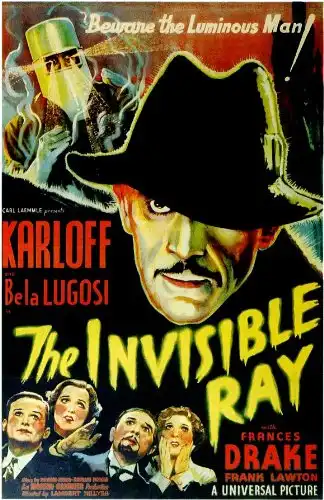
A definitive 6.5/10 rating for a film that redefined the boundaries of cult cinema. The Invisible Ray remains a cornerstone of transgressive art.
Okay, so you're thinking about digging into a 1936 B-movie with Boris Karloff and Bela Lugosi? Good on ya. If you're into that classic Universal monster vibe, the kind of moody, slightly creaky horror that relies on atmosphere more than jump scares, then The Invisible Ray is absolutely worth an hour of your time. This one’s for the folks who appreciate a good old mad scientist story, especially with Karloff really leaning into the crazy. Now, if you need fast pacing, gore, or a totally logical plot, you might find yourself checking your watch. It’s definitely not for anyone who can’t sit through a film from the '30s.
The setup is pure pulp goodness. Karloff plays Dr. Janos Rukh, a genius who finds a new element, Radium X, out in deepest Africa. He’s obsessed with it. Like, really obsessed. He shows off its power to a group of scientists, including Bela Lugosi’s Dr. Benet, and his own wife, Diana. Of course, things go wrong. Rukh gets exposed to the stuff.
He doesn't just die, though. Oh no. Instead, he starts to glow – subtly, at first, then more pronounced. And his touch becomes deadly. It's a neat visual trick for the time, seeing that faint luminescence around his hands. You can almost feel the movie trying to make this feel dangerous.
What really grabs you here is Karloff. He's not just a guy who got zapped. He’s slowly, methodically losing his mind. You see him go from this focused, if a little eccentric, scientist to a truly vindictive man. The way his eyes narrow when someone crosses him, it’s chilling. He doesn't go full screaming madman right away, which makes it more effective. It’s a slow burn, his sanity just chipping away. There's a scene where he's explaining the ray, and you can see this flicker in his eyes. Is it passion? Or the first sign of the radiation taking hold? It’s subtle but unsettling.
Lugosi, as Dr. Benet, is mostly playing the straight man here, trying to figure out what's happening to Rukh and maybe, just maybe, help him. He doesn't get a lot of big, dramatic moments, which is a shame, but his presence grounds the wild science stuff. You expect a lot of scenery-chewing when you get these two together, but Lugosi is surprisingly restrained. It works, though. Someone has to be the voice of reason, or at least, *attempted* reason.
The science in this movie? Oh boy. It's the kind of science that only exists in 1930s horror films. Radium X can make things glow, cure blindness, and kill people. All at once. It’s a bit of a Swiss Army Knife of plot devices. One moment it's saving someone's sight, the next it’s dissolving a skull. You just have to roll with it. The explanation for *why* Rukh glows and kills is pretty vague, honestly. Just... radiation. And madness. That's enough, right? 🤔
The film does drag a bit in the middle. There’s a lot of talking about Radium X, and the plot takes its sweet time getting to the really mad scientist stuff. You can almost feel them stretching out the runtime between the cool glowing hand moments. But when Karloff is on screen, especially when his madness starts to bloom, it’s captivating. He carries the whole thing. He makes those long stretches of exposition bearable, really.
One weird detail: the way they portray the *cure* for Rukh's condition. It's like a special serum or something that keeps the Radium X from making him glow and kill. But he has to take it constantly. And when he misses a dose, boom, back to glowing and being murderous. It's a neat way to build tension, but also makes you wonder why they just don't, you know, lock him up somewhere. The authorities are strangely chill about a glowing killer on the loose.
This isn't a film that tries to be deep. It's a cautionary tale about playing God with science, wrapped in a horror package. It’s less about the profound implications of Radium X and more about watching a master of screen villainy do his thing. And Karloff does it so well. It's a glimpse into an older style of horror, where the terror comes from the slow unraveling of a mind, not just a monster jumping out.
So, if you're settling in on a rainy afternoon, maybe with a cup of tea, and you want to see a genuine horror legend sink his teeth into a truly unhinged character, give The Invisible Ray a shot. It's got its quirks, its slow bits, and some very dated science, but the core performance is pure gold. It’s a solid entry in the old Universal canon, even if it's not as famous as some others. Enjoy the glow! ✨
IMDb —
1935
Community
Log in to comment.