DbcultAccessing Vault...
Cult Review
Senior Film Conservator
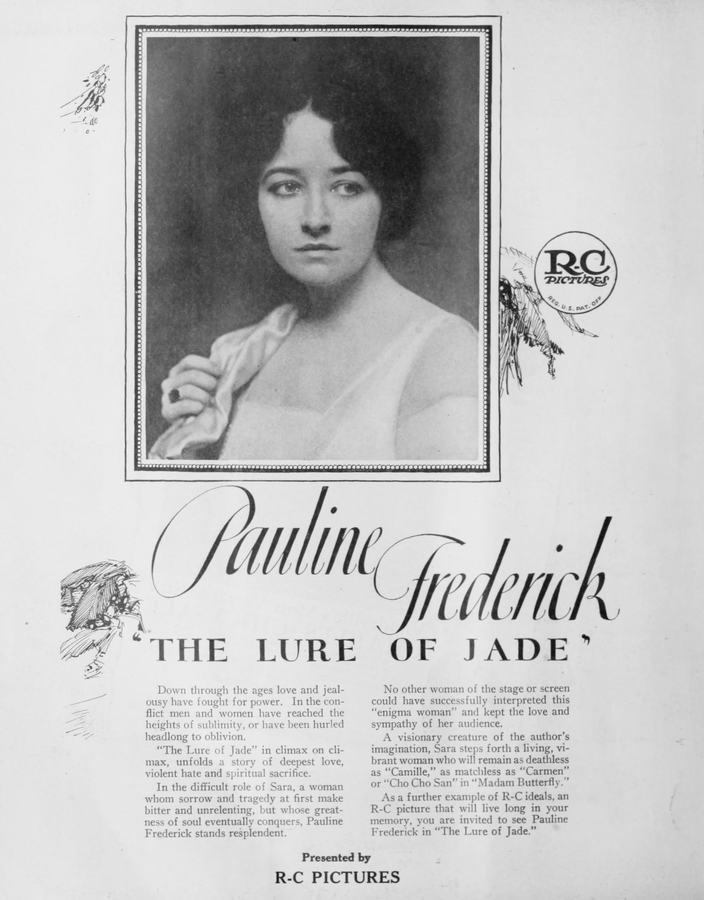
The Lure of Jade
Silents were never silent; they murmured through gauze, through glints of gilt molding, through the flutter of a bead curtain in close-up. Marion Orth’s scenario for The Lure of Jade understands this grammar instinctively: every cigarette case snapped shut is a gunshot, every half-closed door a verdict. Pauline Frederick, regal even when the intertitles merely read “Sara smiled,” gives us a woman who has read Nietszche in translation and believes every syllable about the abyss gazing back. She measures her line readings in millimeters of eyelid, so that when the camera irises in on her face at the admiral’s funeral, the tear she refuses to shed scalds harder than any hysterical collapse.
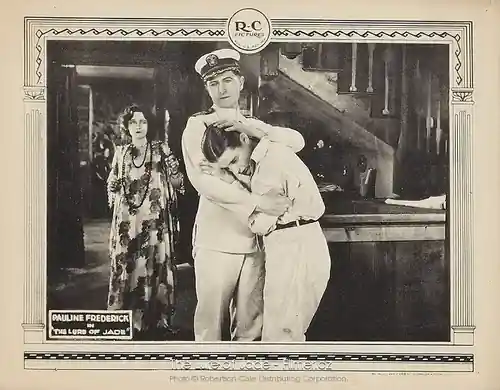
Director Léon Bary, himself once a matinee swashbuckler, shoots the London sequences like a man who remembers how claustrophobic whale-bone corsets feel. He cranes up over the ballroom’s mosaic floor—ivory, lapis, malachite—until the guests resemble moving game-pieces on a board whose rules only the women understand. The jade statuette at the center of the plot is filmed in extreme insert: serpentine veins shimmer, the stone seems to respire, and for a heartbeat the entire colonial project feels condemned by the mineral memory of a civilization that carved jade before Britannia ruled waves.
Lee Shumway’s Corey is all khaki rectitude, the type who buttons his tunic to the throat even while drinking tea. The performance ages cleverly: in reel one he is the emblem of certitude, by reel four the mustache droops, the gait falters, and the man realizes that the moral ledger he kept so piously is written in water. Arthur Rankin, as the gadfly Captain Willing, supplies comic relief that curdles into complicity; his boisterous claim of jade superiority is the pebble that triggers an avalanche. Watch how Rankin’s pupils dart sideways the instant the door locks—jocularity calcifying into panic—an acting choice so subtle it feels modern.
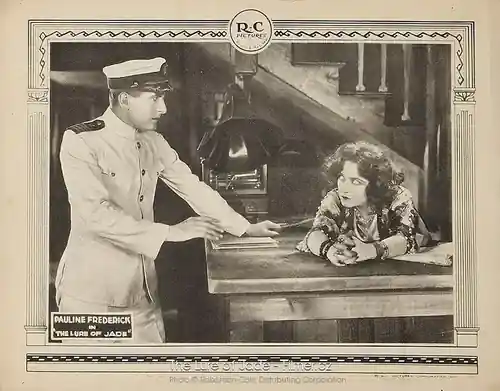
Alida, essayed by Clarissa Selwynne with flapper cheekbones and Medusa resentment, is the film’s secret engine. Hollywood usually flattened the “other woman” into a harridan; Orth’s script grants her the bitterness of someone who suspects she received second-hand love and must pretend it suffices. In a scene trimmed by some provincial censors, Alida toys with her strand of black pearls—each bead clicked against her teeth like a countdown—while watching Sara traverse the garden. No intertitle intrudes; the cut to the pearls hitting the parquet is enough to make the audience gasp.
“The jade is cool,” Sara says in an early card, “but it remembers the hands that warmed it.” The line reverberates across decades, across oceans, across every fade-out.
Once the story relocates to the South Seas, cinematographer Goro Kino swaps gaslight for moonlight. The hotel veranda is striped by bamboo shadows; ceiling fans slice the cigarette haze into ever-shifting Rorschach blots. Beresford—Thomas Holding in full dissolute bloom—enters wearing a cream linen suit already rumpled with doom. The flirtation he stages with Alida is shot through a mosquito-net veil, so their faces shimmer as if submerged in green gin. It is here that the film’s racial undercurrents surface: native servants drift through frames like reproachful ghosts, their glances reminding viewers that every empire’s scandal is built on somebody else’s paradise lost.
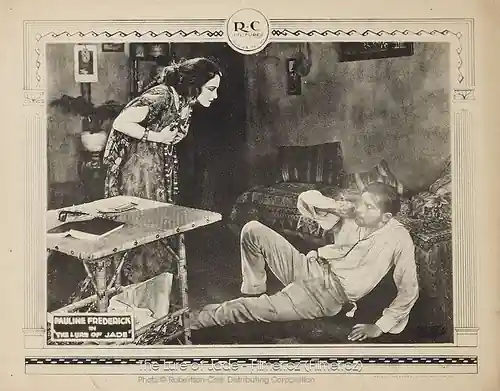
The climax—Allan’s drunken murder—arrives in a torrent of German-expressionist angles: staircase askew, lamp swinging like a metronome counting guilt. When Sara steps forward, palms outward, to take the blame, Frederick lets a tremor ripple through her shoulders, nothing more. The restraint is shattering. One thinks of Falconetti’s Joan, of Garbo’s Marguerite, yet Frederick predates both. The final dolly-back shows her framed between two colonial guards, the horizon behind a bruised violet, as if the sky itself were jade bruised by human folly.
Orth’s intertitles deserve their own monograph. Gone are the declarative banalities of many silents; in their place, haiku-like condensations: “Scandal travels on silk slippers,” or “Revenge is a seed that learns to swim.” Coupled with a haunting score—reportedly a live accompaniment of flute, tabla, and brushed cymbals at the premiere—the effect is synesthetic.
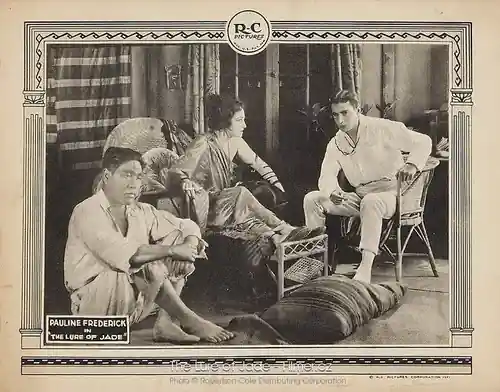
Yet the film is not flawless. A subplot involving Tôgô Yamamoto’s plantation owner is so truncated that one suspects lost reels. Allan’s alcoholism is announced rather than examined; a single insert of an empty bottle hardly suffices. These gashes, however, merely expose the ambition: the film bites off more colonial gothic than it can masticate, but the attempt leaves teeth marks on the era’s conventions.
Compare it to contemporaries. The Caprices of Kitty frolics in drawing-room fluff; A Victim of the Mormons wields religious paranoia as a cudgel. Jade aspires to the moral murk of later von Sternberg, the cosmic fatalism of Borzage, while remaining moored to the cliff-hanger mechanics of 1910s serials. That tension—between pulp and poetry—gives the picture its pulse.
Restoration-wise, the 2022 4K transfer from Eye Filmmuseum reveals textures previously smothered: the nap of velvet lapels, the glint of Sara’s hairpins shaped like tiny jade spears. The tinting strategy—olive for London, cobalt for open sea, amber for island nights—respects historical palettes while deepening emotional legibility. The uncompressed score, now performed by the Brussels Philharmonic, underlines every emotional pivot without pleading for tears.
Why revisit The Lure of Jade now? Because we, too, live in an age where a single image—a screenshot, a meme—can exile individuals from digital society as swiftly as Alida’s gossip banished Sara. Because the film intuits that colonizers carry their drawing-room toxins to any latitude, that paradise is merely another set for the same morality play. And because Pauline Frederick, in a medium that can feel like fossilized gestures, reminds us that stillness can roar louder than thunder.
Seek it out on the festival circuit, on the streaming service that dares to license silents, on 35 mm if you are lucky enough to hear the projector’s moth-wing flutter. Let the jade’s coolness settle on your own pulse. Feel it remember you.
IMDb —
1920
Community
Log in to comment.