DbcultAccessing Vault...
Cult Review
Senior Film Conservator
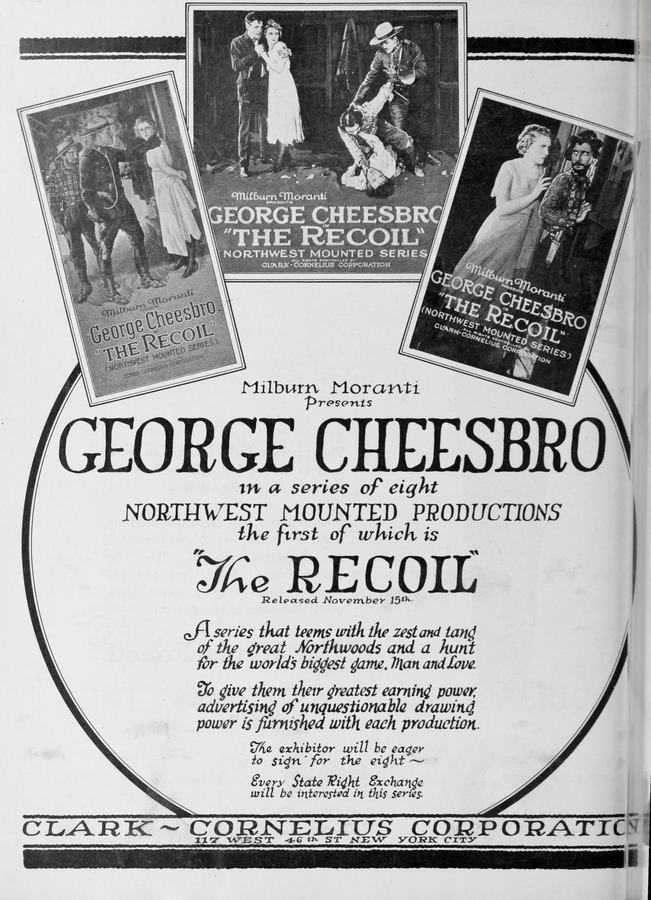
The Recoil (1921), a silent film that hums with the tension of a coiled spring, is a testament to the era’s ability to craft profound narratives without a single word. Directed by Jay Inman Kane, this cinematic relic is less a story of events than a study of the spaces between them—the lingering pauses, the heavy glances, and the brittle silences that speak volumes. Russell Tizzard, as the tormented protagonist, is a man fractured by the war’s aftermath, his every movement a choreography of restraint and collapse. Evelyn Nelson, as the enigmatic widow, is both siren and salvation, her character a prism refracting the film’s central theme: the impossibility of escaping one’s shadow.
Set against the backdrop of post-war disillusionment, The Recoil is a film that understands the human cost of conflict long before the term PTSD entered cultural lexicon. Tizzard’s character, a former officer, grapples with a guilt that manifests in physical and psychological disarray. His descent into paranoia is mirrored in the film’s visual language—long tracking shots that circle around him, as if the world itself is closing in. The script, lean yet incisive, avoids melodrama, instead opting for a stark realism that feels startlingly modern. A pivotal scene, where Tizzard discovers a stolen letter in the home of Nelson’s character, is rendered in near-silence, the tension amplified by the absence of dialogue. It’s a moment that echoes the iconic confrontation in The Branded Woman, though The Recoil’s restraint gives it a more visceral edge.
Evelyn Nelson’s performance is a masterclass in physicality. Her character, a woman trapped between loyalty and self-preservation, communicates volumes through micro-expressions—a flicker in the eyes, a tightening of the jaw. In one haunting sequence, she stands at a window, her reflection splintered by the rain-streaked glass, a visual metaphor for her fractured identity. The film’s use of negative space is equally telling; characters often inhabit vast, empty rooms, their isolation amplified by the silence. This visual austerity mirrors the tone of The Seal of Silence, though The Recoil distinguishes itself with a more intimate, claustrophobic atmosphere.
Kane’s direction is marked by a meticulous attention to detail that rewards close scrutiny. The film’s most striking sequence involves a train journey, where Tizzard’s character is pursued by a shadowy figure. The interplay of light from the train windows creates a strobe effect, his face flickering between clarity and obscurity. It’s a metaphor for his psychological state, a man teetering on the edge of revelation and oblivion. The editing, though rudimentary by today’s standards, is purposeful, with jump cuts used to disorient the viewer and mirror the protagonist’s fractured psyche. This technique prefigures the stylistic innovations of later directors like Der fremde Fürst, yet here it serves a more personal, character-driven narrative.
What elevates The Recoil beyond its era’s conventions is its refusal to offer tidy resolutions. The film’s climax, a confrontation in a dimly lit study, unfolds with the inevitability of a Greek tragedy. There are no heroes, only flawed individuals making choices they believe to be noble. The final shot—a close-up of Tizzard’s face, his eyes hollow yet resolute—is a masterstroke of ambiguity. Is it catharsis or surrender? The film leaves the question hanging, a testament to Kane’s confidence in the audience’s ability to sit with discomfort.
Technically, the film is a marvel of its time. The use of natural lighting in outdoor scenes, particularly a pivotal argument in a sun-drenched meadow, creates a stark contrast with the film’s darker, interior sequences. This duality—light and shadow, clarity and confusion—mirrors the thematic tension between truth and deception. The set designs, though modest, are rich in symbolic detail: a cracked mirror, a wilted rose, a pocket watch stuck at 11:59. Each object a silent witness to the characters’ unraveling.
Comparisons to other silent films are inevitable. The Recoil shares thematic DNA with The Might of Gold in its exploration of moral compromise, though where that film leans into operatic grandeur, The Recoil opts for a more restrained, observational style. Similarly, the psychological depth here rivals that of Signori giurati..., but with a focus on individual rather than societal decay. For modern viewers, the film’s pacing may feel deliberate, even languid, but patience is rewarded with a narrative that unfolds like an onion, layer by layer revealing the futility of human attempts to outrun their pasts.
In retrospect, The Recoil is not merely a relic of early cinema but a prescient exploration of the human condition. Its themes of guilt, betrayal, and redemption are timeless, yet its execution is deeply rooted in the silent era’s unique ability to convey emotion through image and movement. For those seeking a film that marries technical ingenuity with profound emotional resonance, The Recoil remains a cornerstone of classic cinema—a film that, despite its age, continues to echo with relevance.
IMDb 6
1931
Community
Log in to comment.