DbcultAccessing Vault...
Cult Review
Senior Film Conservator
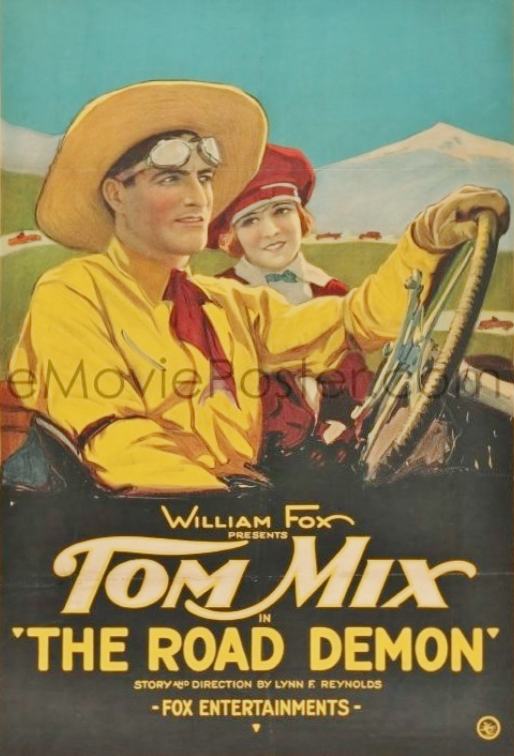
Imagine the sun as a nickel flung into an ink-blue sky, scalding everything it touches. That is where The Road Demon begins—not in narrative but in temperature. Director Lynn Reynolds lets the desert do the prologue: heat ripples, cicadas sizzle, and a lone cowboy named Hap Higgins squints toward a future that smells of gasoline instead of sagebrush. You can almost taste alkali dust on your tongue when he trades his equine companion for a decrepit automobile whose fenders flap like broken wings. The transaction feels less like commerce and more like apostasy; a man abandoning the 19th century at the roadside and signing a pact with the 20th.
There is a feverish montage—no title cards, just grease-smeared close-ups—where Hap transmogrifies junk into jaguar. Pistons are licked clean, valves whisper secrets, and a carburetor becomes the Grail. Reynolds shoots the engine block as if it were the Ark of the Covenant: low Dutch angles, shafts of white light knifing through the garage rafters. The sequence lasts maybe ninety seconds, yet it feels like the birth scene in an industrial opera. When the starter finally snarls awake, the camera trembles sympathetically; you sense celluloid itself rooting for resurrection.
Enter Luther McCabe, embodied by Lloyd Bacon with the smug grin of a man who believes velocity is hereditary. Their first showdown unfurls on a salt-flat canvas so wide the horizon curves. Reynolds positions both cars in profile, then lets them hurtle straight toward the lens—an early, fearless use of spatial depth that predates even the celebrated railroad showdowns in The Railroad Raiders. Tire-churned plumes crystallize behind the racers, hanging like bridal trains before the wind shreds them. Intercut reaction shots of Patricia O’Malley (Claire Anderson) reveal pupils dilated not in fear but in epiphany; she sees the world’s axis tilting from cattle to carburetion.
Patricia’s father presides over a motoring conglomerate whose boardroom oozes mahogany masculinity. In a film culture that often treated women as decorative spark plugs (Infatuation being a textbook offender), Patricia engineers her own trajectory. She translates Hap’s desert mythos into ledger ink, pitching the board a foreign contract that would export Yankee horsepower to Europe’s war-weary roads. Anderson plays her with a blend of steel-wool intellect and unabashed sensuality; when she leans over a blueprint, the camera lingers on her clavicle the way John Ford would later fetishize Monument Valley.
Reynolds’ cutting rhythm mimics ignition cycles: intake, compression, power, exhaust. Chases alternate between wide vistas and claustrophobic driver POVs, a dialectic that predates the kinetic grammar of Moral Suicide by a full two years. The absence of synchronized sound paradoxically amplifies sensory overload—you supply the roar yourself, a hallucinatory soundtrack that mutates with every viewing. Close-ups of Hap’s boots pumping pedals sync with orchestral crescendos you swear you hear, evidence of cinema’s synesthetic witchcraft.
Leading man William Elmer performed most of his own driving, a fact that lends each skid a documentarian shiver. His face—sun-charred, prematurely wizened—reads like a topographical map of the West itself. In repose he resembles a weathered fencepost, but behind the wheel his eyes spark with outlaw glee. Compare that to the urbane hauteur of Charles Arling’s villainous banker in The $1,000,000 Reward; Elmer’s proletarian physicality roots the film in sweat rather than stock-market skullduggery.
For the finale Reynolds secures the L.A. Coliseum, its oval track transformed into a modern-day Circus Maximus. Grandstands teem with straw-boated spectators whose flapping pennants create a polychrome swarm. The race itself is a triptych of doom: first lap—hubris, second lap—doubt, final lap—transcendence. McCabe’s imported roadster sprouts mechanical gremlins, leaking steam like a dragon with consumption. Hap’s rebuilt demon, meanwhile, achieves apotheosis, its hood ornament a chrome Cupid firing valve-tipped arrows. When the checkered flag falls, Reynolds freezes the frame for a heartbeat—an avant-garde gambit in 1921—before dissolving to Patricia’s embrace. Contract signed, marriage implied, credits roll over the lingering image of exhaust dissipating into smoggy sunset.
Watch The Road Demon back-to-back with Stolen Hours and you will notice a shared obsession with time as commodity. Where the latter parcels out life in ticking minutes, Reynolds measures existence in RPMs. Both films meditate on how industrial modernity commodifies human endeavor, yet they arrive at opposing termini: fatalism versus frontier optimism. Similarly, the vehicular Darwinism here anticipates the automotive carnage of Venganza de bestia, though that South American shocker swaps aspirational uplift for nihilistic bloodsport.
A century after its release, the movie reads like a prophecy: individual grit can still outpace corporate machinery, but only by morphing into the very mechanism it resists. Hap’s journey from horseman to gearhead mirrors our own metamorphosis from analog souls to data packages. Yet the film refuses dystopia; its pistons pound out a hymn of ingenuity. In an era when algorithms script most of our mileage, Reynolds’ ode to manual tinkering feels like a manifesto scrawled in motor oil across the asphalt of time.
Archivists at MoMA restored a 35 mm nitrate print in 2018, utilizing a Dutch print for missing segments. The tints—amber for daylight, cyan for dusk—replicate original instructions scrawled on Reynolds’ shooting script. While some intertitles remain lost, the gaps enhance the film’s dreamlike propulsion, inviting viewers to co-author dialogue. Consider it the silent ancestor of DIY director’s cuts.
The Road Demon is not merely a curio for petrol-archaeologists; it is a cinematic tuning fork whose vibrations still unsettle our comfort with cruise control. Whether you arrive for the gearhead nostalgia, the feminist subtext, or the sheer kinetic lyricism, you will leave with ears ringing from an engine that exists only in your mind—and that, my friends, is the most exquisite exhaust note of all.
IMDb —
1919
Community
Log in to comment.