A definitive 6.6/10 rating for a film that redefined the boundaries of cult cinema. Violettes impériales remains a cornerstone of transgressive art.
Violettes impériales from 1932? Yeah, it's a tough sell for most folks today. If you're into super old-school melodramas, silent film vibes mixed with early talkie quirks, and a story about devotion to royalty, then maybe, *just maybe*, you'll find something here.
But for anyone expecting modern pacing or even just clear sound, you'll probably be bored stiff. It’s definitely a curio for film historians or those obsessed with French cinema from way back.
The premise itself is pretty simple: a Romani girl, Violetta, becomes incredibly devoted to a Spanish noblewoman, Eugénie, who eventually marries Napoleon III and becomes Empress of France. It’s all about this almost **unwavering, saint-like devotion**.
Right away, the film’s age hits you. The sound mix is… well, it exists. Sometimes the music swells randomly. Other times, it just cuts out. You really have to strain to catch some of the dialogue, especially when someone turns their head away from the microphone. 🗣️
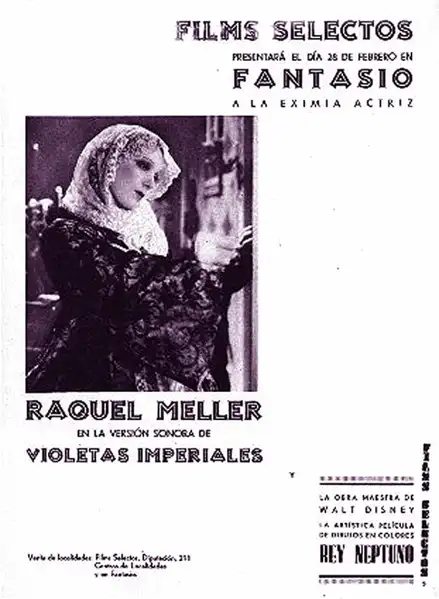
Raquel Meller plays Violetta. She has this **intense, almost theatrical presence**. Every gesture feels big, designed for a stage, not a close-up. There’s a scene where she’s reading tea leaves, and her expressions are so dramatic, you can almost *feel* her trying to project emotion from the screen.
The Empress Eugénie, played by Suzanne Bianchetti, feels a bit more grounded, but still very much a grand figure. It’s hard to connect with her, though. She’s often just *there*, looking regal.
One thing that sticks out is the pacing. Things happen, but slowly. Then, suddenly, years pass in a title card. You get used to it, but it’s a constant reminder of how much film language has changed. A scene where Violetta is just *waiting* feels like it goes on forever. Then, boom, we're in a new decade.
The costumes are beautiful, though. Lots of ruffles and big hats. You can tell they put effort into making it look grand, even with the limited tech. The sets feel a bit like painted backdrops, but charmingly so. It’s like watching a play where the scenery is a little wobbly.
There’s a moment when Violetta, after some event, just *appears* in a new location, working as a street performer. It’s not really explained how she got there, or why. She’s just… there. It makes you wonder if some reels got lost over the years. Or maybe it was just common to skip these details back then. 🤷♀️
The film really pushes this idea of **absolute, unshakeable loyalty**. Violetta faces all sorts of personal setbacks, but her dedication to Eugénie never wavers. It’s almost *too* much at times. You want to shake her and say, "Hey, what about *your* life?"
The movie keeps coming back to Violetta’s unwavering devotion. It’s the central pillar. But sometimes, you wish Eugénie, the Empress, would show a bit more direct reciprocation. It’s mostly Violetta *doing* things for her, while Eugénie is often just reacting. This makes the emotional core feel a little one-sided, honestly. You root for Violetta, but you also kinda feel bad for her. She just keeps giving.
There’s a whole segment about political upheaval, which feels important for a minute. Then it quickly fades back into the background, just setting up another scenario for Violetta to show her loyalty. It’s like the film remembers it's a historical drama, then goes, "Oh, wait, no, it’s about *devotion*." The grand events of history are mere props for personal sacrifice.
The political stuff, the big historical events, they're mostly background noise. It's not about the empire, it's about these two women, even if one is just a symbol for the other's devotion. It doesn't dig deep into anything.
The camera work is pretty static, as you’d expect. Lots of long shots, few close-ups that really get into someone’s head. When they do a close-up, it’s usually someone looking worried or determined. No deep dives into the eyes, you know? It’s more about the *tableau* than the intimate feeling. This adds to the feeling of it being a stage play captured on film.
There are these little bits of singing that pop up, almost like a musical number but not quite. Raquel Meller, being a singer, gets a few moments to belt out a tune. They're pretty good, but they sometimes interrupt the flow, such as it is. It's a bit jarring.
The ending, without giving anything away, ties things up rather neatly. Maybe a bit *too* neatly for all the drama that came before. It tries to feel profound, but it mostly just feels… over. You finish it and think, "Okay, that was a thing."
Who should watch this? If you're specifically interested in early sound films, or the transition from silent to talkie in French cinema, then it's worth a look. As a piece of history, it's pretty neat. But as pure entertainment, it's a **tough sit**. You need a lot of patience.
It's got this old-world charm, sure. But it also has all the rough edges of early cinema. It's a film that definitely *was*, and now it's just *is*. Not for everyone, by a long shot. It's like finding an old, dusty photograph. Interesting for a moment, but you wouldn't hang it on your wall. 🖼️