Arthur Conan Doyle
actor, producer, writer
- Birth name:
- Arthur Ignatius Conan Doyle
- Born:
- 1859-05-22, Edinburgh, Scotland, UK
- Died:
- 1930-07-07, Crowborough, Sussex [now East Sussex], England, UK
- Professions:
- actor, producer, writer
Biography
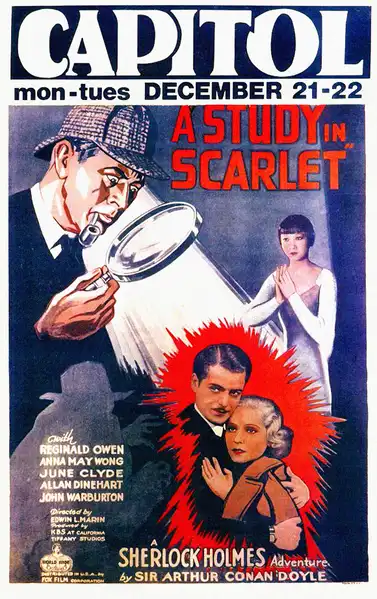
Arthur Conan Doyle entered the world in 1859 on Edinburgh’s Picardy Place, the offspring of a gifted but unraveling illustrator and a storyteller mother who kept the household afloat when alcohol and melancholy dragged her husband under. The boy grew up ringed by artistic uncles—antiquarians, caricaturists, gallery men—yet the family coffers were kept by prosperous relatives who paid for Jesuit classrooms first at Hodder Place, then the stern stone corridors of Stonyhurst, and finally the mountain air of Stella Matutina in Feldkirch, where German vowels mingled with boys from half of Europe. Medicine, not literature, was the plan. From 1876 he dissected and diagnosed at Edinburgh’s Medical School, supplementing lectures with risky self-experiments on the toxic plant Gelsemium and publishing the results in a scientific journal. Between shifts on the whaler Hope and the steamer Mayumba, he sharpened a different scalpel—his pen—placing a demon-haunted South-African tale in Chambers’s Journal in 1879. A Plymouth partnership collapsed, so he hung out his own shingle in Southsea, where sparse patients left long afternoons for writing. In 1886 he stitched together a detective armed with icy logic, a violin, and the observational flair of his old professor Joseph Bell. Ward, Lock & Co. paid £25 for A Study in Scarlet; it slipped into print in November 1887 and never slipped from sight. Lippincott’s commissioned a second helping, The Sign of Four (1890), and The Strand Magazine soon beckoned for shorter exploits, eventually 56 in all, alongside four novels that stretched from 1887 to 1927. Crime paid the rent, yet Doyle’s heart strayed to history. Between 1888 and 1906 he unfurled seven novels—Monmouth rebels, Black-Prince mercenaries, Waterloo scarred veterans, Huguenot refugees, Sir Nigel’s Hundred Years’ campaigns—books he prized above Holmes, though readers disagreed. War rerouted him. In 1900 he sailed to Bloemfontein’s typhoid wards during the Boer conflict, later defending Britain’s conduct in two dispassionate, best-selling chronicles that earned him a knighthood in 1902 and induction into the Venerable Order of Saint John a year later. Home again, he turned detective himself, exposing the shaky conviction of solicitor George Edalji; the public outcry helped force Britain’s first Court of Criminal Appeal in 1907. Another crusade bled onto the page in 1909 when Doyle condemned Belgian atrocities in The Crime of the Congo. The Great War shredded his circle: son Kingsley mortally wounded on the Somme; brother Innes and brother-in-law E. W. Hornung both claimed by pneumonia soon after. Bereavement flung Doyle into Spiritualism; the 1920s found him lecturing from Sydney to Vienna, bankrolling a temple in Camden, and publishing tracts on life beyond death. On 7 July 1930 the heart that had beaten for cricket pitches, battlefields, séances and storytelling stopped at Windlesham Manor. He was 71. Refusing Christian rites, he was first laid among the roses of his garden, later moved to Minstead’s churchyard beneath a headstone that salutes him: “Steel true / Blade straight.” He left two sons, two daughters, and a shelf that will never stop growing: four Holmes novels, 56 shorter cases, Challenger’s lost worlds, Brigadier Gerard’s swagger, historical door-stops, war dispatches, spiritualist pleas—and a template for every detective who ever studied a footprint and said, “Elementary.”