DbcultAccessing Vault...
Film vs Film
Select two cult films to compare side by side.
Her Surrender Synopsis
Rhoda Cortlandt, daughter of Theodore Cortlandt, a millionaire who is interested in charity, is beloved by Webster, son of Madeline Stuyvesant, a philanthropist who is Cortlandt's competitor. Burton Woodrow, employed by Cortlandt in order to send his consumptive mother to Colorado, steals $250 from his employer. He is detected and sent to prison for a year. Clarice Lee, a thief, is beloved by Chicago Jim, a gang leader. Mrs. Stuyvesant and Rhoda are visiting a poor family residing in the apartment adjacent to Clarice's. Chicago Jim discovers Clarice in the arms of Pugsy, a member of his gang, and beats her. Her cries reach Rhoda and Mrs. Stuyvesant, who go to her rescue. Jim escapes. Clarice, to work upon the sympathies of Mrs. Stuyvesant, declares that Jim beat her because she would not steal for him. Mrs. Stuyvesant takes Clarice to her home. Cortlandt, believing that Mrs. Stuyvesant has procured a million dollar contract through bribery, calls her a trickster in Webster's presence; he defends his mother. A quarrel ensues. Cortlandt orders Webster from his home. Clarice while in the home becomes infatuated with Webster, who ignores her. Hearing of his love for Rhoda, she persuades Pugsy, her admirer, to lure Rhoda to his room for the purpose of degrading her. Pugsy entices and attempts to assault her there. Rhoda, defending herself, is severely wounded and suffers great loss of blood. At the hospital to which she is taken the doctors declare that only a transfusion of blood will save her life. Webster, hearing of Rhoda's condition, offers his blood. The offer is refused by the stubborn and angry Cortlandt, who orders the doctors to advertise and offer $500 for the necessary blood. Burton, released from prison, unable to secure employment, reads the advertisement and applies at the hospital, where after a rest he is accepted and a quantity of his blood is transfused to Rhoda's veins. Before his discharge from the hospital Burton learns that the recipient of his blood is the daughter of the man who sent him to prison. Cortlandt and the Stuyvesants become reconciled. Burton in the presence of Rhoda offers to return to Cortlandt the money he stole. Rhoda prevents her father from accepting it, and insists that he re-employ Burton. Cortlandt grants Rhoda's wish. Mrs. Stuyvesant gives a reception in celebration of Rhoda's recovery, during which the engagement of Webster and Rhoda is announced. Rhoda is horrified by constantly recurring visions of Burton. Wherever she goes Burton appears before her, whatever she does recalls him to her mind. His vision constantly calls to her. She struggles against the thought, but realizes that with the blood given her by Burton has come love. Unable to restrain the call of his blood she surrenders herself to it and telephones asking him to visit her. He does so, and she confesses her love for him. Burton tells her that he loved her long before he was sent to prison, but that his past is a shadow that will darken her future. Rhoda pleads with Burton and declares that his shadow will fade in the warmth of her love. That evening Webster finds Rhoda in Burton's arms, and is horrified. Rhoda returns the engagement ring to Webster, telling him, "Condemn me if you will, Burton gave me blood, and with it came love." Webster, realizing the power of true love, sacrifices his own love for Rhoda's sake and takes back the returned engagement ring. Cortlandt enters the scene, learns the truth. He is shocked and in great excitement denounces and orders Burton from his house. Webster tells Cortlandt that his stubbornness of not permitting him to give his blood caused it all. He pleads and moves Cortlandt to consent to the marriage of his daughter to the man he sent to prison.
The Faded Flower Synopsis
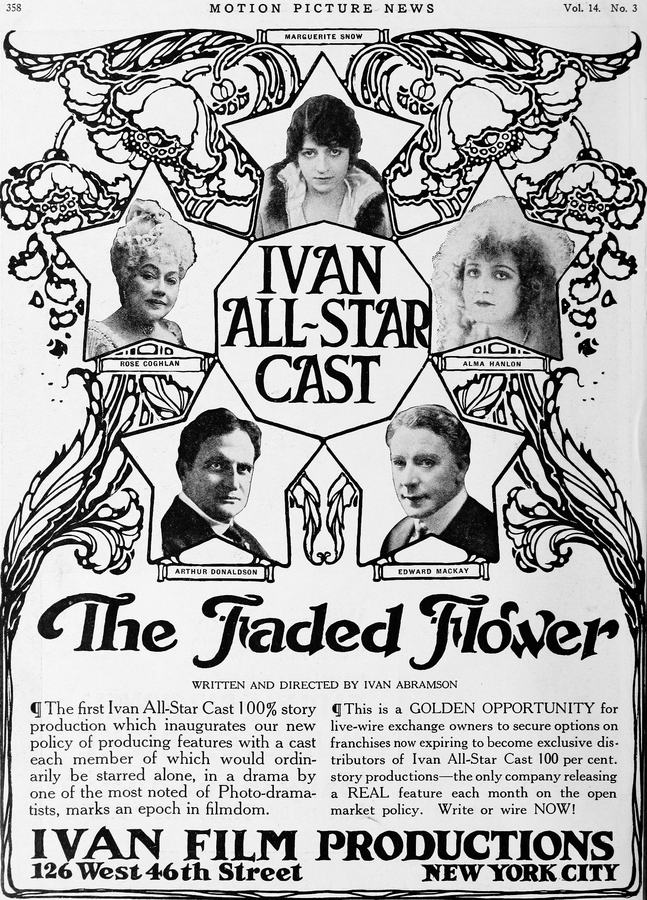
Elderly millionaire widower Wilbur Mason, father of only child Anne, proposes to his stenographer Lillian Hill, who accepts him because he declares that he will devote his fortune to restoring her blind mother's sight. In the presence of struggling playwright Henry Parker, Lillian introduces Mason to her mother as her future husband. Parker, who thinks himself in love with Lillian, imagines that his heart is broken. After the Masons' honeymoon, Mason engaged a renowned specialist whose operation on Mrs. Hill is unsuccessful. Lillian now sadly realizes that her sacrifice was in vain and becomes cold towards Mason. Two years later Lillian and Anne meet Parker, of whose great success they have read. Parker and Anne fall in love; at Anne's suggestion, Lillian invites him to call on them. He does, hoping to see Anne, but finds Lillian alone. She gives him a rose from among those Mason plucked for her that morning because he knew she loved them. Mason, unseen, sees this gesture and concludes that Lillian's love for Parker is the cause of her indifference toward him. His jealous rage becomes ungovernable and he makes his presence known and orders Parker from the house after tearing from the latter's coat the rose Lillian gave him. Mason thereafter repeatedly charges Lillian with being false to him and in love with Parker. Parker meeting Anne, accompanies her to the gateway of her home, where she leaves him. Mason discovering him there alone believes that Parker has clandestinely met Lillian, whom he later upbraids, again thrusting the rose before her. Lillian, as the result of Mason's accusations, becomes grief stricken and ill. Despondent she leaves her husband's home and returns to her mother where she fades like roses in the autumn winds. Mrs. Hill, fearing for her daughter's life, goes to Mason who is moved by her heart-broken and anguished appeal. He accompanies her, repentant and remorseful, to Lillian's bedside which he reaches in time to receive with her expiring breath the pardon for which he pleads and to hear the doctor pronounce her dead. Crazed with sorrow, scarcely hearing the doctor's words, Mason is about to lift the coverlet from Lillian's face when he is stricken with paralysis. Later at his home he weeps in secret at sight of the now-faded rose which to him has become a symbol of Lillian. Repenting his mistake, he bids Anne send for Parker and consents to their marriage. Troubled by his conscience, Mason's overwhelming woe permits him no rest, and he goes at dead of night to Lillian's burial place, carrying with him roses which in life she so dearly loved, which he tenderly places over her dust. "Lillian, my faded flower," he cries, "you died a martyr to my unfounded jealousy. May your soul find peace in the Kingdom of Heaven."
"Her Surrender" holds a slight edge in general audience appreciation, but "The Faded Flower" offers its own unique cult appeal.
Suggested Watch:
The Faded Flower