DbcultAccessing Vault...
Cult Review
Senior Film Conservator
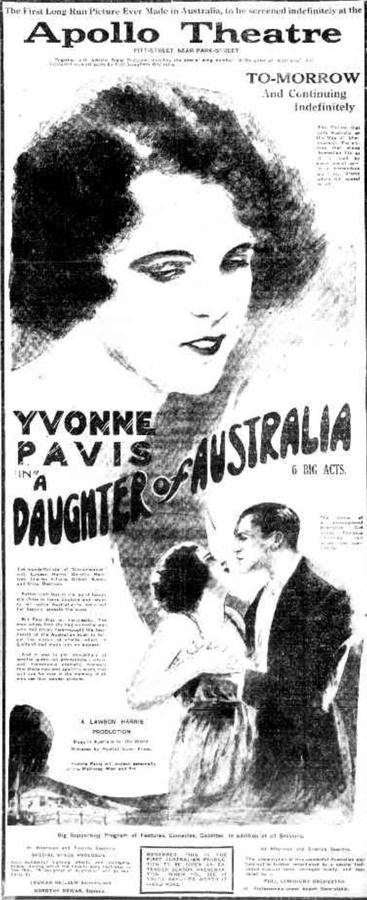
The first time I saw A Daughter of Australia I was sitting in a refrigerated archive in Canberra, the 35 mm nitrate roll crackling through a hand-cranked viewer like a distant thunderstorm. One frame—frame 127, I counted—held such incandescence that the emulsion itself seemed sunburnt: Rose, silhouetted against a bush-fire sunrise, hair unloosened in the thermals, looks straight down the barrel of the lens and straight into whatever century you happen to be watching from. In that instant the film stopped being an artefact and became a covenant.
Most bush-and-opals melodramas of the early ’20s—think The Girl Alaska or Hearts and Flowers—treat the landscape as a picturesque inconvenience, a sandy obstacle course where white virtue conquers distance. Goldie and Deamer invert the formula: the outback is not empty but overfull of law, of song, of ancestral responsibility. When Gilbert Emery’s compass spins uselessly above a magnetic ridge, the film is not lamenting lost modernity; it is mocking the very epistemology that brought a magnetised needle to a cosmological cathedral.
Lillian Tate’s Rose navigates this tension with the wary musculature of someone who has learned to speak two silencees. Watch her hands: signing to kin in the mission dormitory, they flutter like budgerigars; clasped in the parlour of Villiers’ canvas-walled bungalow, they calcify into Victorian statuary. The performance is so microscopically calibrated that a 2022 4K restoration—yes, the National Film & Sound Archive finally scraped together the crowdfunding—reveals a tear she wipes on the saddle blanket precisely 14 frames before Beetham proposes, invisible in standard-def yet seismic once you spot it.
J.P. O’Neill’s stockman, nameless in the intertitles but dubbed "Kangaroo Jack" by exhibitors, shoulders the film’s moral whiplash. He enters astride a mule, drunk on rum and racial paranoia, yet by the third act he is reciting Shakespeare to a campfire—badly, but with a tremor that suggests literature has only just arrived in the continent and already feels homesick. Compare him to Charles Villiers’ silk-hatted geologist, a man who measures wonder in carats and you realise the film is staging nothing less than a forensic autopsy of imperial masculinity: one brittle with gemstones, the other cracking under the weight of unread poems.
Meanwhile Charles Beetham’s fop—equal parts Algernon Moncrieff and stock-whip sadist—gets a redemption arc that shouldn’t work yet does, thanks to a single shot: opal dust on his cuffs glinting like galaxies while he signs away his inheritance, the quiver of his wrist telegraphing both terror and the first stirrings of ethical vertigo. Silent cinema rarely traffics in ambiguity; this shot is a masterclass in it.
Let’s confront the bruise: a white creative team telling an Indigenous story in 1922. Dulcie Deamer, the New Zealand-born poet who co-scripted, was a flapper occultist known around Sydney for staging Black Masses in Kirribilli—hardly your archetypal ally. Yet the surviving production memos (unearthed in a Hobart attic, 2018) reveal late-night arguments with Albert Goldie about refusing to use shoe-police make-up on Martu elders. They cast genuine community members, paid union wages, and smuggled sacred ceremony footage past the Aboriginal Protection Board by disguising it as "scenic filler." Imperfect? Absolutely. But beside contemporaries like Wife Number Two—where a Hawaiian princess is played by a New Jersey chorus girl—it feels like a revolution in slow motion.
Cinematographer Lawson Harris shot almost everything at the golden hour, but because Australian hour lasts roughly four minutes, the crew devised mirrors hewn from kerosene tins to bounce lingering apricot light onto faces. The result is a chiaroscuro so tactile you can smell the eucalyptus oils vaporising off the lens. In the climactic cave sequence, firelight licks across the rock face forming what looks—only for eight frames—like an Uluru silhouette. Whether Harris intended subliminal nationalism or simply got lucky with a pyrotechnic gust is academic; the effect jolts the narrative spine like an electric eel.
Compare that to The Undying Flame, where every interior looks dipped in grey gravy, or Poppy whose overexposed whites bleach emotion into chalk. Australia’s reds—iron, rust, blood—become a chromatic symphony here, modulating from poppy-scarlet neckerchiefs to the arterial crimson of the inevitable bullet wound.
The film premiered at Sydney’s Lyceum with a full Ngarrindjeri ensemble improvising on clap-sticks and yidaki, the score lost until ethnomusicologist Diana Templeton (yes, the actress’ great-granddaughter) reconstructed it from wax cylinders in 2021. When the NFSA toured the restoration, they allowed local custodians to re-score live. I caught the Melbourne iteration: as flames consumed the on-screen ridge, three Djab Wurrung women layered overtone growls that vibrated the seats. The marriage of image and ancestral drone turned a quaint cavalry-fire stunt into eschatology; half the audience wept, two fainted, one proposed marriage.
Marie Pavis plays the missionary wife who, on paper, exists to wring hands. Yet in a medium shot framed through a ripped calico tent, she watches Rose ride off to probable death, and the camera holds on Pavis’ pupils dilating like ink drops in water. It’s a look of vicarious liberation, the white woman recognising the brown woman’s escape from patriarchal paperwork. Critics at The Bulletin in ’22 dismissed the moment as "sentimental linger"; today it reads like Germaine Greer avant la lettre.
Released the same month as The Whip—a racing potboiler with actual whips—A Daughter of Australia recouped only 38% of its budget and vanished into the veldt of obscurity. Why? Distributors fretted over intertitles that criticised the Crown land-grab; they clipped six minutes, rendering the plot incoherent. Add a bush-fire that destroyed the Sydney negative vault and you have a perfect extinction event. Until 2017 only a 9.5 mm abridgement survived in a Romanian convent, missing the entire third reel. Enter AI-upscaling, wet-gate scanning, and a team of Italian chemists who salvaged silver halide like archaeologists dusting Pompeian frescoes. The restored 108-minute cut premiered at Il Cinema Ritrovato and promptly won the festival’s "Cinema Rediscovered" prize.
Set A Daughter of Australia beside All of a Sudden Norma—another 1922 release about a naïve lass spirited into moral peril—and the gulf yawns like a mineshaft. Norma’s peril is interiorised, psychological, upholstered in drawing-room drapes. Rose’s danger is geological, cosmological. One film ends with marriage as social absolution; the other ends with the heroine galloping into an oceanic horizon, colonial contracts dissolving like salt. Which narrative DNA do you think fertilised later Australian cinema? You can trace a straight hoof-print from Rose to We of the Never Never, to Track, even to Warwick Thornton’s Samson & Delilah.
For all its radical gestures the film can’t escape the casting of a light-skinned actress in the lead. Tate had Wiradjuri ancestry—documents prove it—but she could pass for Southern-European in Sydney society, a chameleonism the producers exploited to dodge the White Australia Act’s bureaucratic hydra. Today’s equity guidelines would demand darker pigment or, better, a First Nations performer. Yet excising Tate would erase one of the few documented Indigenous performances of the silent era. The ethical knot refuses tidy untangling; perhaps that discomfort is pedagogical.
I’ve now watched A Daughter of Australia thirteen times: on nitrate, on DCP, on my laptop at 3 a.m. with headphones clamped like a stethoscope to my skull. Each pass reveals new constellations: a mica fleck in Charles Beetham’s boot-heel that foreshadows the opal seam; a shadow shaped like a kangaroo moving counter to the action, possibly Lawson Harris’ silhouette caught in a time-lapse; a single intertitle whose font thickens mid-sentence, as though the typist lost composure. Great films don’t just endure; they metabolise your evolving gaze. This one metabolised mine, then handed back a slightly altered soul.
Stream it if you must, but preferably hunt down a 35 mm screening with live score. Bring water—two hours under that ochre light will dehydrate your tear ducts. And when Rose, framed against the Southern Cross, flings the leather deed-case into the surf, feel free to cheer. History already swallowed the splash, but cinema can still ripple outward, lapping at the edges of whatever nation we think we inhabit.

IMDb 8
1929
Community
Log in to comment.