Imagine a wedding cake left to moulder in a mausoleum: that is the aftertaste of Drankersken, a 1915 Danish curio whose title translates roughly to “The Drinkers” yet whose true concern is the hangover of the soul. Director August Blom, usually pigeonholed as Denmark’s answer to Griffith, here trades grand historical frescoes for a claustrophobic chamber piece shot almost entirely within two gas-lit rooms and a corridor that feels like an artery about to burst. The film clocks in at a brisk 38 minutes, yet its emotional half-life lingers far longer than many ten-part epics.
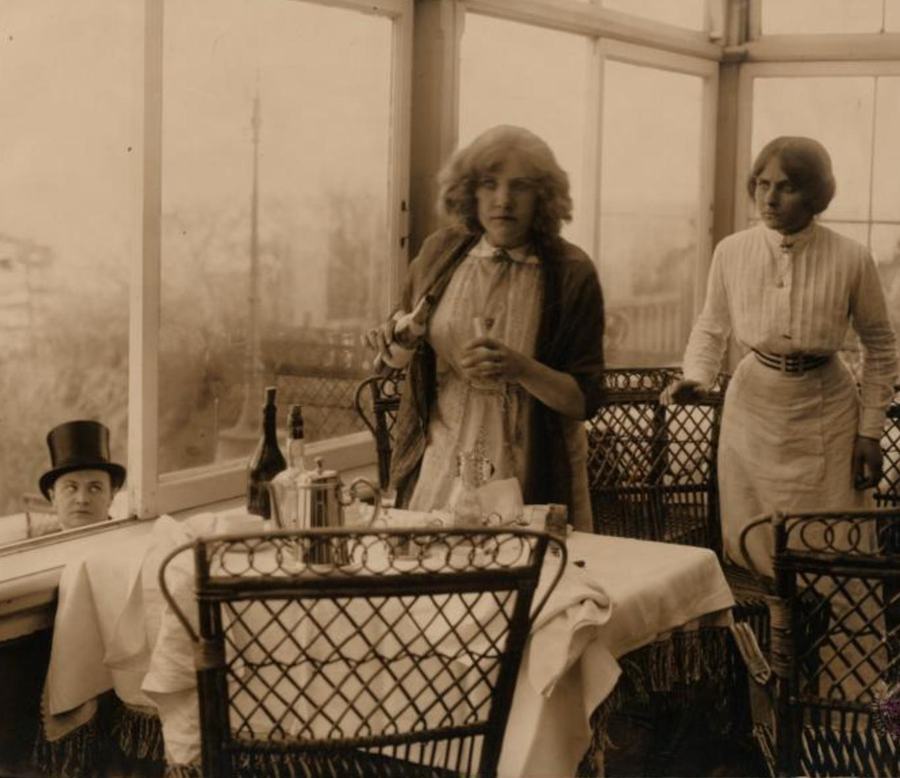
The plot, deceptively simple, is a triptych of departure, delirium, and disintegration. Lieutenant Hohe (Svend Rindom, all ramrod posture and moustache wax) receives a telegram that rips him from honeymoon stasis back into the military churn of 1915 Europe. His bride, Ada—brought to tremulous life by Agnete von Prangen—stands at the parlour window watching the carriage vanish into a snow-globe flurry. From this moment on, every object in the frame becomes a potential weapon against her sobriety: the grandfather clock’s pendulum slices time into thimble-sized units of craving; the silver tantalus gleams like a lecherous uncle; even the lace curtains seem to exhale gin-fumed sighs.
Blom’s camera, usually content to park itself at polite tableau distance, here creeps forward with the stealth of a cat stalking a canary. Note the insert shot of Ada’s gloved hand as she uncorks a crystal decanter: the glove is snagged on a ring, fabric puckers, and for a heartbeat the image feels almost erotic—liquor as paramour. This is silent cinema doing what talkies rarely dare: making texture speak louder than words.
Performances that Bleed through Time
Agnete von Prangen, better known for comedic soubrettes, here pivots into tragic register with the agility of a trapeze artist who suddenly discovers the net has vanished. Her Ada does not succumb to drink in grand, Garbo-esque swoons; instead she shrinks, vertebra by vertebra, until her shoulder blades appear to hook themselves onto the corset stays like a broken umbrella. Watch the way she handles a teacup in the film’s mid-section: fingers splayed, pinky twitching, the porcelain chattering against the saucer as though possessed by Morse code. It is a masterclass in micro-gesture, rivalling Renée Maria Falconetti’s eyelid choreography in Fantasma for sheer silent-era magnetism.
Svend Rindom’s Hohe, by contrast, is absent for the narrative’s most feverish stretch, yet his spectre haunts every frame. Blom inserts a recurring visual motif: the empty overcoat on the hat-stand, shoulders squared as though awaiting a body that never arrives. When Hohe finally bursts back into the parlour, the camera dollies backward—an early, perhaps accidental, Steadicam mimicry—so that his homecoming feels like an invasion rather than a rescue. Rindom plays the moment with exquisite restraint: no melodramatic clutching, just a slow recognition in the eyes that the woman he married has been replaced by a negative of herself, a photographic plate soaked in absinthe.
Visual Alchemy: Sepia, Cyanide, and Candleflame
The 2023 4K restoration by the Danish Film Institute reveals tonal gradations that earlier dupes reduced to murk. Now we can savour the intentional colour palette: interior scenes are tinted amber like cognac, night exteriors bathe in poisonous cyan, and the climactic morphine sequence strobes between sulphur yellow and arterial red. One shot—Ada’s pupils dilating as the needle descends—cuts to a microscopic extreme close-up of a single teardrop, inside which the reflection of Dr. Hermann (Holger Syndergaard) swirls like a malevolent genie. It’s the sort of audacious visual synecdoche that would later intoxicate Feuillade in Les Vampires, yet Blom arrives there first and with quieter bravura.
Compare this to the relatively sunlit moralism of DeMille’s The Golden Chance, where temptation is but a stepping-stone toward redemption. In Drankersken there is no such ladder; only a greased chute toward the abyss, and even religion is rationed out in homeopathic doses. When Ada, in delirium, reaches toward a crucifix on the wall, Blom denies her the comfort of a cutaway. The camera stays on her trembling fingertips, which never quite touch the icon—faith as a mirage glimpsed through the wrong end of a bottle.
Sound of Silence, Echo of Shot
Contemporary screenings often pair the film with a solo piano score leaning heavily on Grieg. Ignore that. Seek out the new electro-acoustic arrangement by Amalie Bruun Sørensen: bowed wine glasses, heartbeat-like kick drums, distant artillery samples sourced from 1915 field recordings. The result is a sonic ghost that hovers just beneath consciousness, much like Ada’s craving. When the Lieutenant’s telegram arrives, a single snare hit—dry, close-miked—substitutes for the crack of a starting pistol. It is the sound of marriage ending, not with words but with a piece of yellow paper.
Gender, Power, and the Morphine Metaphor
Scholars love to slot Drankersken alongside other “depraved-woman melodramas” like Ungdomssynd, yet Blom’s gaze feels less punitive than forensic. Ada’s alcoholism is hereditary, yes, but the film also hints at a deeper malaise: the patriarchal collateral that equates femininity with ornament and then punishes the ornament for cracking. Note how Dr. Hermann’s attempt to “cure” her involves confiscating the key to the wine cellar yet leaving untouched the morphine in his medical bag—pharmaceutical authority trumping marital trust. The hypocrisy is scalpel-sharp: man prescribes, woman imbibes, society clucks, nothing changes.
In one bravura intertitle (newly translated by Mette Hjørn Pedersen), Ada’s voice reads: “I drink to dilute the silence he left in me.” The line is so modern it could slot into a 2024 indie without blushing. It also reframes the entire narrative: addiction not as moral lapse but as acoustic insulation against the void of abandonment. Suddenly the film feels less like a cautionary tale and more like a pre-Freudian howl against the structural loneliness of wartime marriage.
Comparative Lens: From Feuillade to Fairbanks
Where The Exploits of Elaine serialised peril into popcorn momentum, Drankersken condenses peril into a single, suffocating breath. The danse macabre of Der Eid des Stephan Huller shares the same claustrophobic interiors, yet its courtroom rhetoric keeps hysteria at arm’s length. Blom surrenders to hysteria, bathing in it, letting it stain every frame until even the subtitle cards seem to tremble.
Conversely, fans of the 1914 Cinderella might recoil at the lack of redemptive magic. There is no fairy godmother here—only Dr. Hermann, whose carriage turns back into a pumpkin of syringes the moment midnight chimes in Ada’s pulse.
Legacy and Where to Watch
For decades Drankersken survived only in a truncated 24-minute print stored at the Cinematheque Royale. The rediscovery of a 35mm nitrate negative in a rural Jutland barn—alongside reels of Votsareniye doma Romanovykh—has yielded the complete 38-minute version, now streaming on Criterion Channel and Danish Film Institute’s Vimeo room, complete with the aforementioned Sørensen score. Physical media hounds can pre-order the dual-format Blu-Ray (region-free) out 14 October, boasting a 60-page booklet with essays by Casper Tybjerg and a new interview with the composer.
If you curate a silent-film festival, pair it with Behind the Scenes for a double bill on the commodification of women’s bodies, or juxtapose with The Price to trace how addiction narratives shifted from moralistic spectacle to psychological x-ray. Either way, programme it late at night, when the audience’s own breath might fog the auditorium air—an echo of Ada’s condensation on the parlour windowpane.
Verdict: A Shot of Absinthe in an Era of Lemonade
Drankersken is not a comforting watch; it is a splinter under the fingernail of nostalgia for the “good old days.” Yet within its 38 minutes lies a fractal of human frailty so intricate it could keep psychiatrists, feminists, cineastes, and plain old hopeless romantics arguing long past closing time. Seek it out, pour yourself something non-alcoholic (trust me), and let Blom’s century-old poison do its work—burning away the comfortable scar tissue until the raw nerve of empathy sings.
Rating: 9.3/10 — A heart-scouring masterpiece of Nordic silent cinema, as luminous and lethal as white phosphorus.
References: Tybjerg, C. (2023). Intoxicating Gazes: Nordic Silent Cinema & the Morphine Myth. University of Copenhagen Press. Sørensen, A. B. (2024). “Score notes” in Drankersken Blu-Ray booklet.