DbcultAccessing Vault...
6/10
Senior Film Conservator
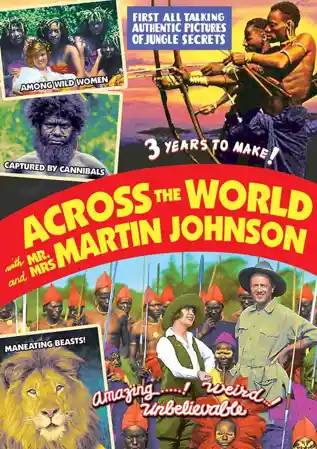
A definitive 6/10 rating for a film that redefined the boundaries of cult cinema. Across the World with Mr. and Mrs. Martin Johnson remains a cornerstone of transgressive art.
Alright, so you stumble upon Across the World with Mr. and Mrs. Martin Johnson in a dusty corner of some streaming service. And you think, 'Oh, an old travel film.' And yeah, it is. But if you're into historical docs, or just curious how adventure looked nearly a century ago, this is actually pretty cool. It’s a definite watch for history buffs, or anyone fascinated by early filmmaking. But if you need fast pacing, a clear plot, or modern sensibilities, you’re probably gonna hate it. Just being honest.
The film basically follows Martin and Osa Johnson as they trot the globe. They start in Hawaii, move through the South Pacific — places like the Solomon Islands and New Hebrides — then Australia. After that, it’s a trip through the Suez Canal, down the Nile, and into Africa, specifically Tanganyika and the Belgian Congo. They wrap up in Uganda. It’s a lot of ground to cover. 🌎
What really strikes you is the sheer scale of their journey for the time. No easy flights here, just boats, trains, and a lot of walking. You get a real sense of _effort_ behind every frame.
Martin and Osa are quite the pair. Osa, especially, feels like the real star. She’s often right there, front and center, interacting with animals or local people. There’s a scene where she’s holding a baby chimpanzee, and it feels genuinely sweet. Like, you can tell she has a real soft spot for animals. ❤️
Their narration, well, it’s _of its time_. Martin does most of it, a very matter-of-fact voice. Sometimes it’s a bit dry, but other times he throws in these little observations that make you chuckle. He’s very much the explorer archetype from that era.
The African segments are probably the most captivating. The amount of wildlife they captured is just astounding. Herds of elephants, rhinos looking surprisingly chill, huge prides of lions just hanging out. They got really close to these animals, sometimes _too_ close, you wonder how they pulled it off without getting eaten. The way a rhino charges at their truck, it’s a bit heart-stopping, even now.
There’s a part with a leopard that feels genuinely tense. You really feel the danger there. And these amazing shots of giraffes, just graceful against the vast plains. It’s a beautiful, wild world they're showing us. 🦒
Then you get to the parts with the indigenous tribes, especially the pygmies in the Belgian Congo. This is where it gets a little… uncomfortable. You can tell the Johnsons are trying to be friendly, but there's a definite sense of them being observers, almost anthropologists with a camera. The way they present the pygmies, for instance, it’s very much from a 1930s Western viewpoint. They’re fascinated, but there’s an inherent power dynamic that feels kinda off to a modern viewer.
“Look at this curiosity.” That’s the feeling you get sometimes. It’s a historical document, sure, but it's also a product of its time in ways that are hard to ignore.
Osa tries to give some beads to the pygmy women, and it’s meant to be a friendly exchange. But the camera just lingers a little too long, like a scientific study. It makes you think about how these encounters were framed for audiences back home. It's not malicious, but it _is_ a bit colonial.
You can almost feel the heat and dust through the screen during the African safari bits. The light in those wide-open plains, especially. It’s just stunning sometimes. ☀️
The movie doesn't really have a 'climax' or anything. It just... goes. From one adventure to the next. It’s a travelogue in the truest sense. It ends, and you’re left feeling like you’ve just flipped through someone’s very impressive, slightly dated, photo album.
Is it a perfect film? Nah. Does it hold up to modern documentary standards? Not really. But it’s a fascinating, sometimes problematic, look into a different world and a different time. And for that alone, it’s worth checking out if you’re curious. Just don't expect a big narrative payoff. It’s more about the journey, for better or worse.
Community
Log in to comment.