DbcultAccessing Vault...
Cult Review
Senior Film Conservator
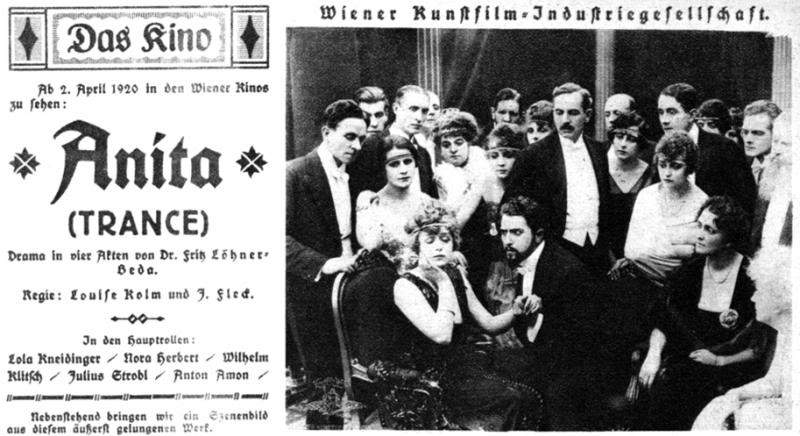
The film’s first act plays like a jeweled fever dream shot through cut-glass: chandeliers fracture faces into kaleidoscopic shards, champagne bubbles rise in slow-motion complicity. Director Fritz Löhner-Beda doesn’t just show wealth; he weaponizes its shimmer until the audience itself feels surveilled by money. When Anita—embodied by Lola Urban-Kneidinger with the languid cruelty of a cat who has read Nietzsche—floats across the parquet, the camera clings to her train as though addicted. The aristocrats around her converse in epigrams sharp enough to shave with, yet the subtext is unmistakable: these people have already sold their souls at discount and now haggle for rebates.
Enter Julius Strobl’s self-styled magnetist. He sports a goatee that looks grafted from a second-rate magician’s top-hat and carries the pendulum like a pocket watch missing its sense of time. His introductory close-up—a full fifteen seconds—tilts from the shoes upward, exposing worn seams, nicotine nails, the fray of ambition. Within this single tracking shot the film telegraphs the coming collapse: the higher the camera rises, the emptier his gaze becomes, until his pupils resemble bullet holes in a billboard. The screenplay, merciless, grants him no back-story; we never learn whether he believes his own patter or merely monetizes the vacuum where conscience should sit. That opacity is the horror.
Once the hypnosis takes hold, the narrative mutates into a masquerade of consent. Anita’s friends notice her new, eerie placidity yet compete to book the mesmerist for luncheons, eager to sample the spectacle of a woman turned living ventriloquist dummy. The critique is scalpel-clean: patriarchal society prefers its femininity docile, and if a quack can achieve what centuries of etiquette manuals only promised, the ruling class will trade ethics for entertainment faster than one can say ‘post-war inflation.’ A montage of invitations piles up on-screen—each embossed card slammed atop the last until the stack becomes a paper tombstone—while intertitles flash headlines like ‘BARONESS UNDER SPELL: COURTSHIP ADVICE?’ By the time the film has finished roasting them, Vienna’s bourgeoisie emerge as co-conspirators, accessories to their own moral extinction.
As Anita, the actress toggles between dazzling volatility and waxen submission without relying on the exaggerated gestures so common in early silent melodrama. Watch her pupils dilate the instant the pendulum crosses its meridian; the shift is micro-cosmic yet seismic. Later, when commanded to laugh at a joke no one has told, her throat produces a brittle cackle that ricochets off ballroom frescoes like a bullet in a cathedral. The performance is so surgically precise you can practically hear flesh tear even in a medium without sound.
Cinematographer Wilhelm Klitsch treats every reflective surface as a potential lie. Mirrors never yield faithful doubles: they elongate necks, bifurcate mouths, or fracture the hypnotist into a hydra of shadows. In one bravura sequence Anita stands before a triptych mirror; the side panes show her swaying under orders, while the center pane remains eerily empty, as though the genuine self has absconded. Meanwhile cigarette smoke—an omnipresent haze—curls around characters like rhetorical questions no one dares answer. Exterior night scenes are shot along the Danube, where barges leak kerosene light onto water so black it appears mineral. The river becomes a subconscious that refuses to reflect stars, swallowing them whole.
Though silent, the picture manipulates rhythm like a composer. Intertitles appear irregularly, jagged as broken piano keys; some last only four frames, others linger long enough for the eye to re-read twice. Meanwhile the orchestra score—reconstructed from contemporary cue sheets—alternates between Strauss waltzes played off-tempo and atonal shrieks produced by scraping violin strings with glass rods. The effect is synesthetic: you swear you can hear Anita’s will snapping even in a vacuum.
Scholars often plant Anita as the missing link between In the Lion’s Den and The Clown, yet its DNA feels closer to Caligari’s hysteria. Where the Cabinet exposes madness as authoritarian spectacle, Anita reverses the polarity: here the public demands the spectacle, and madness is merely the cheapest raw material. Both films feature a showman puppeteer, but while Caligari weaponizes a somnambulist to kill, Anita’s villain merely wishes to dine out on the glow of possession. The stakes are smaller, which paradoxically makes the corruption more intimate and therefore more nauseating.
The camera itself performs hypnosis. Repeated point-of-view shots from the mesmerist’s perspective turn viewers into unwilling accomplices; when Anita undresses behind a screen, the silhouette reveals itself only when the lens tilts at the exact angle of the predator’s eye. Yet the film refuses pure victimhood. In the séance scene her subconscious stages a revolt, projecting a doppelgänger who strangles the hypnotist with his own pendulum cord. Whether fantasy or premonition remains unresolved, but the image sears: female rage weaponizing the very totem used to enslave her.
Released in 1920 Vienna, the film throbs with post-imperial malaise. Inflation has rendered banknotes confetti; aristocrats cling to titles the way drowning passengers hug debris. The mesmerist’s modest fee—paid in American dollars—buys him entrance into salons that would have sneered at him a decade earlier. Thus hypnosis becomes a stand-in for foreign capital: a debased currency purchasing souls at fire-sale prices. Every time Anita robotically signs a check, the intertitle flashes the sum: an impossible figure that erodes itself between ink and paper, a nation’s savings turning to smoke in real time.
The climax rejects grand guignol. The hypnotist, cornered by creditors, hustles Anita to a provincial inn intending to auction her compliance to a cabal of industrialists. Instead, the camera fixes on a lone corridor mirror cracked by previous gunfire. As dawn infiltrates the corridor, Anita’s reflection multiplies into jagged selves, each shard staring back. The film cuts to an extreme close-up of her eye; a tear forms, suspends, then rolls—not down her cheek but sideways across the bridge of her nose, obeying gravity re-written by trance. The tear lands on the mirror’s fracture, seeping into the split like solvent. Cut to black. When we re-enter, the mesmerist lies unconscious, the pendulum snapped, Anita vanished. Whether she escaped, awoke, or shattered along with her own image is withheld. The last intertitle reads: ‘THE MIRROR REMEMBERED.’ Roll end.
In an era when algorithms map desire better than most lovers, Anita’s tale of outsourced volition feels prophetic. Streaming platforms monetize attention; influencers monetize personality; data brokers monetize the unconscious. The Viennese mesmerist’s velvet cape has merely been replaced by a silicon valley hoodie. Restored prints screened recently at Pordenone revealed nitrate tints thought lost: poison greens, septic ambers, bruise purples that make the spectacle both gorgeous and toxic—a perfect visual metaphor for how technology seduces before it subjugates.
Anita is not a film you merely watch; it is a film that watches you back, its mirrored DNA replicating inside your mind long after the lights rise. It indicts the hunger for control, the commodification of identity, the ease with which a society will trade empathy for entertainment. Yet it also glimmers with defiance: the possibility that even a fractured reflection can reclaim agency, one shard at a time. Seek it out, but beware—once its pendulum begins to swing, the ticking may follow you home.
IMDb 6.5
1923
Community
Log in to comment.