DbcultAccessing Vault...
7/10
Senior Film Conservator
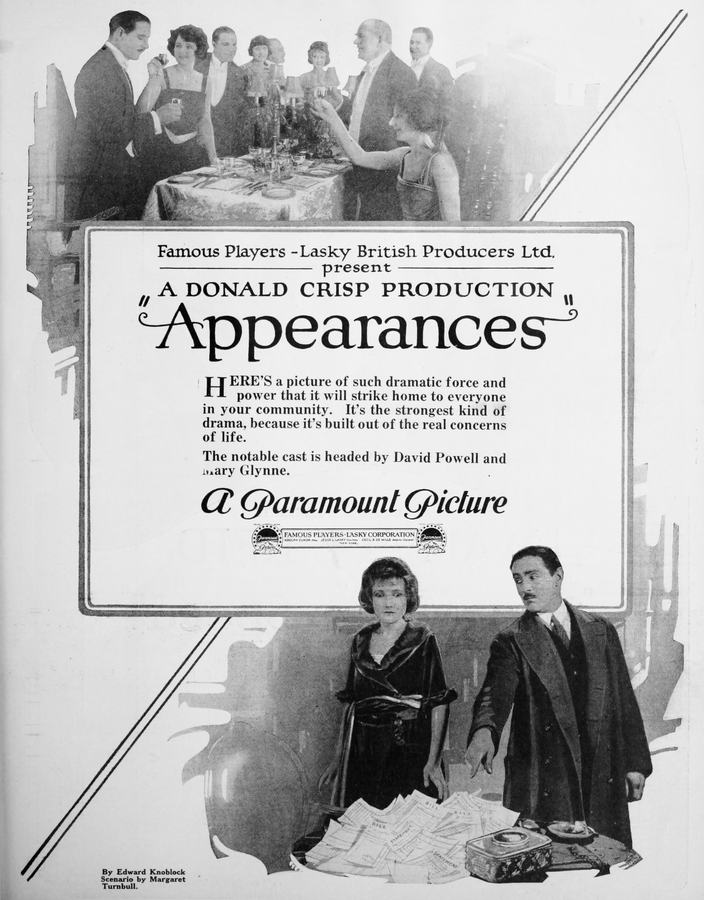
A definitive 7/10 rating for a film that redefined the boundaries of cult cinema. Appearances remains a cornerstone of transgressive art.
If the silent era had an olfactory signature, Appearances would reek of sealing wax and panic-sweat. David Powell’s Lord Chetwynd—tailored so sharply you could slice foie gras on his lapels—opens the narrative by gifting Marjorie Hume’s Lady Adela a cheque bereft of numerals. It is a gesture so elegantly passive-aggressive it feels plucked from a Henry James subplot that never dared confess its own sadism.
Powell plays the moment with the languid precision of a card-sharp palming an ace: eyelids half-mast, breath held as though the air itself were auctionable. The camera, frozen in a medium close-up, lets us count the pulse on his temple. We read the unspoken dare: write your price, dear lady, and let us discover what bankruptcies of the soul you will tolerate.
Enter Percy Standing as the husband—Hubert Anstruther—whose moustache alone deserves separate billing. Standing has the rubbery posture of a man who has mistaken solvency for virility. When he fills in £500—roughly the annual wage of a junior clerk—he isn’t merely forging a cheque; he is underwriting his own extinction. The ink dries like a death warrant.
Money, in Appearances, is never neutral; it is a liquid morality that stains gloves, letters, and reputations with equal enthusiasm.
Director George L. Cox keeps his visual grammar parsimonious. A repeated shot—half-open doorway, oblique angle—evokes the terror of being surveilled from every corridor of one’s own house. The camera does not move; the characters glide past it like guilty thoughts. Intertitles arrive sparingly, often no more than ten words, each card a white flag waved in a war of manners.
Compare this austerity to the baroque flourishes of She Loves and Lies where tracking shots chase lovers through confetti storms, or to The Voice of Conscience with its triple-exposure dream sequences. Appearances opts for claustrophobia, the better to press its characters against the griddle of propriety.
Marjorie Hume’s performance is a seminar in micro-expression. Watch her pupils dilate when she realises the cheque has been cashed: the iris seems to recoil like velvet singed by a cigarette. The moment lasts perhaps three seconds, yet it conveys the vertigo of social free-fall more vividly than pages of exposition.
Mary Dibley and Mary Glynne, as the scandal-hungry Anstruther cousins, function like a Greek chorus in lace chokers. Their whispers flutter through drawing rooms, staircase landings, even a seaside boardwalk—locations rendered cavernous by silence. Each cousin is a moral thermometer: Dibley’s eyebrows arch like circumflexes whenever sin is mentioned, while Glynne’s laugh—shown via intertitle in ornate serif—reads like a guillotine descending in slow motion.
Langhorn Burton, as the family solicitor tasked with hushing things up, supplies the film’s only breathing space. His legal jargon, condensed into curt intertitles, becomes a kind of absurdist poetry: “Indecorum actionable; damages discretionary.” Burton’s weary shrug—captured in a single long shot—suggests the Edwardian legal apparatus is as porous as a lace doily.
Cinematographer Allen G. Siegler shoots interiors in low-key lighting that anticipates German Expressionism by a couple of years. Shadows pool like spilt burgundy across Persian rugs. The blank cheque itself—glimpsed repeatedly—becomes a fetish object: crisp, luminous, terrifyingly innocent. Its whiteness is a dare, a canvas, a void into which reputations vanish.
The score, reconstructed in recent restorations, threads Debussyan harp arpeggios against timpani heartbeats. Each appearance of the cheque on screen syncs with a muted trumpet exhalation, a sonic blush that hints at both seduction and disgrace.
Comparative intertextuality buffs will note structural echoes in The Flash of Fate, where a single railway ticket becomes the linchpin of downfall, or in Peace and Riot where a mislaid telegram detonates domestic Armageddon. Yet Appearances is more merciless: here the object is willingly, even gleefully, weaponised.
Some historians slot the film beside post-Great-War disillusionment texts, arguing that the £500 blood-money allegorises reparations. I find that reductive. The picture’s cynicism is older, colder, more Oscar Wilde than Siegfried Sassoon. It suggests that cataclysm merely unmasks the bankruptcy that was always ledgered in human hearts.
Gender readings prove equally fertile. Adela’s body becomes collateral the instant her husband monetises the cheque; yet the film denies her the martyr’s halo. She, too, luxuriates in the purchasing power of allure, flirting with Chetwynd in hothouse shadows. The result is a Möbius strip of exploitation: victim and accomplice swap faces every twelve frames.
Modern viewers may balk at the supposed triviality of £500. Contextualise: equivalent to roughly £25,000 today, enough to finance a suburban villa or annihilate a working-class rival. More telling is the social grammar of the transaction. The aristocracy’s power once derived from land; by 1920 it is liquid, portable, scribbled on a scrap. Thus the film chronicles not merely adultery but feudalism’s last gasp, distilled into a rectangle of paper.
The editing rhythm deserves laurels. Cox alternates tableau compositions—actors frozen in ornate blocking—with jarring close-ups that feel like gloved hands grabbing your collar. The technique anticipates Soviet montage but keeps its gloves politely on, never breaking the drawing-room skin.
Restoration notes: the 2018 4K scan by the BFI reveals textures previously smothered in duped grain—powder on Hume’s cheek now glimmers like frost on damask; the cheque’s water-mark blooms clandestinely under lamplight. Nitrate decomposition claimed roughly seven minutes; those gaps are bridged by stills and textual description, yet the lacunae feel oddly apposite—like pages torn from a diary too scandalous to survive intact.
Influence tentacles reach forward to The Immigrant, where Chaplin’s tramp pockets a coin that isn’t his and spends the film atoning, and back to East Lynne’s moral absolutism. But Appearances refuses redemption. Its final shot—Chetwynd alone on a fog-tuned Thames embankment—offers no epiphany, only the silhouette of a man folding something into his breast pocket, perhaps another blank cheque, perhaps nothing at all.
Performances resist silent-era histrionics. Powell’s Lord exudes ennui so refined it borders on Buddhist detachment. Observe how he pockets his gloves: thumb and forefinger form a perfect O, the gesture of a man who has reduced life to algebraic notation. Hume answers with minute hesitations—an eyelid flutter here, a breath caught there—that feel like Morse code from a suffocating soul.
The screenplay, adapted from Turnbull’s stage play, prunes subplots mercilessly. Gone are the comic servants, the red-herring burglar, the philanthropic aunt. What remains is a haiku of cupidity: gift, conversion, exposure. The compression intensifies the moral chill; you exit the film feeling that civilisation is a veneer as thin as onionskin paper.
Cultural footnote: contemporary critics carped that the film lacked “relief.” They missed the point—its very relentlessness is the relief, the catharsis of watching pretence eviscerated without the anaesthetic of comic subplot. To blink is to forgive; Cox denies us the blink.
Themes ricochet still. In an age of cryptocurrencies and NFTs, the blank cheque mutates into a private key, a password, a string of code that can liquidate marriages, ministries, memories. The Edwardians feared paper; we fear the cloud—both are vapours anchored by nothing sturdier than collective hallucination.
Viewing tip: watch at dusk, volume high enough to catch harp-string tremors, window cracked so urban ambience leaks in—sirens, bus brakes, the city’s own blank cheques. Let the anachronisms mingle; history is a palimpsest, and Appearances bleeds through every layer.
Verdict: a brittle, luminous shard of a film that anticipates Renoir’s La Règle du Jeu in its cynicism and Ozu’s Equinox Flower in its understated despair. It will not cuddle you; it will hand you a cheque, leave the amount blank, and watch while you decide how much of yourself you can afford to forfeit.
IMDb —
1920
Community
Log in to comment.