DbcultAccessing Vault...
Cult Review
Senior Film Conservator
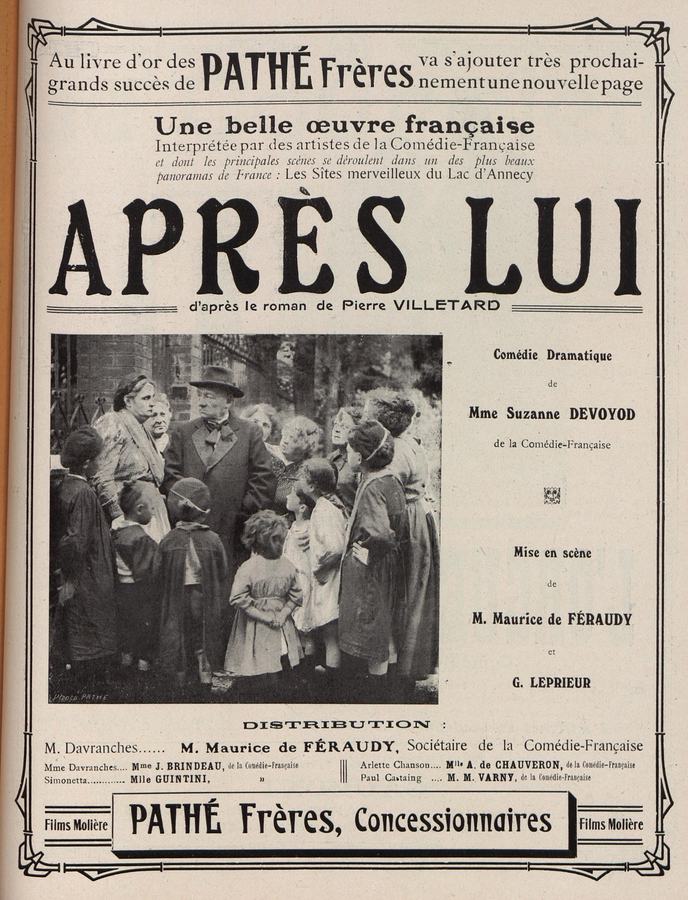
In the twilight of the Great War, French cinema underwent a profound metamorphosis, pivoting from the frantic energy of early shorts toward the psychological depth of feature-length dramas. Après lui (1918) stands as a towering testament to this era, a film that eschews the bombast of contemporary spectacles to focus on the seismic shifts occurring within the human soul following the cessation of a patriarch’s heartbeat.
The narrative architecture of Après lui is built upon the heavy silence of an empty chair. Unlike the visceral conflicts found in The Miner's Curse, where the struggle is external and physical, Pouctal’s film internalizes the battle. The plot revolves around the aftermath of a death that doesn't just end a life, but destabilizes an entire ecosystem of social standing and financial security. The brilliance of the screenplay by Suzanne Devoyod and Pierre Villetard lies in its refusal to offer easy catharsis. Instead, it invites the audience to witness the slow, agonizing disintegration of a family unit that was held together solely by the gravity of its late leader.
Maurice de Féraudy, a titan of the Comédie-Française, brings a stage-honed gravitas to the screen that feels remarkably modern. His ability to convey complex internal monologues through nothing more than the tightening of a jaw or the shifting of a gaze is a masterclass in silent performance. While many actors of the period leaned into the histrionics seen in The Eternal Strife, de Féraudy opts for a restrained, almost skeletal portrayal of emotional exhaustion. He embodies the titular concept—the living embodiment of what happens 'after him'—carrying the burden of continuity in a world that seems increasingly eager to move on.
Visually, the film is a study in shadows and domestic geometry. The cinematography captures the opulence of the French home not as a place of comfort, but as a gilded cage. Every frame is meticulously composed to emphasize the distance between characters. When we compare this to the more fluid, albeit less emotionally dense, camerawork in The Studio Girl, we see a clear distinction in intent. Pouctal uses static shots to create a sense of permanence and stagnation, mirroring the characters' inability to escape the shadow of their predecessor.
"The true tragedy of Après lui isn't the death itself, but the realization that the living are merely echoes of a voice that no longer speaks."
The supporting cast, including Jeanne Brindeau and Andrée de Chauveron, provide the necessary friction to de Féraudy’s central performance. Brindeau, in particular, portrays the widow with a haunting fragility that eventually hardens into a desperate resilience. Her character arc serves as a poignant counterpoint to the more overt social climbing seen in Le scandale. Where that film deals with the public fallout of reputation, Après lui deals with the private rot of the spirit.
One cannot discuss this film without acknowledging its moral complexity. It occupies a space similar to The Bitter Truth, where the lines between victim and opportunist are blurred beyond recognition. As the family members squabble over the remnants of the estate, the film poses a devastating question: Is love ever truly unconditional, or is it merely a contract that expires upon the death of the provider? This cynical undercurrent is balanced by moments of genuine tenderness, though these are fleeting, appearing like sunbeams in a dusty attic.
The pacing of the film is deliberate, perhaps even demanding for modern audiences accustomed to rapid-fire editing. However, this slow burn is essential. It allows the viewer to inhabit the space of the bereaved, to feel the ticking of the clock and the oppressive weight of the mourning veils. It shares a certain atmospheric kinship with Ene i verden, focusing on the isolation that comes even when surrounded by family. In Après lui, loneliness is a communal experience, a shared burden that paradoxically keeps the characters apart.
From a technical standpoint, the film’s restoration (where available) reveals a surprising sophistication in lighting. The use of natural light filtering through heavy curtains creates a chiaroscuro effect that underscores the film's thematic obsession with things hidden and things revealed. This is far more nuanced than the flat lighting often found in contemporary American productions like On Record. Pouctal understands that the eye is drawn to what is partially obscured, using the visual medium to replicate the half-truths and secrets that define the family’s interactions.
The script by Devoyod and Villetard is remarkably lean. In an era where intertitles often over-explained the plot, Après lui trusts its actors to carry the narrative weight. The dialogue, when it appears, is sharp and purposeful, avoiding the melodramatic excess of As a Man Sows. Instead, we get a surgical dissection of social obligation. The film explores the concept of 'duty' not as a noble virtue, but as a shackle that prevents the characters from achieving true autonomy.
In the broader canon of 1910s cinema, Après lui occupies a unique niche. It lacks the pastoral idealism of The Flower of Faith and the industrial grit of The Valley of Decision. It is, instead, a chamber piece—intimate, focused, and devastatingly precise. It shares a thematic DNA with The Writing on the Wall, specifically in its portrayal of the inevitable collapse of a house built on unstable foundations. However, Pouctal’s work is more interested in the emotional debris than the structural failure.
Maurice Varny and Gaston Leprieur provide excellent support, representing the younger generation’s struggle to reconcile their own desires with the expectations of their lineage. Their performances highlight the generational divide that was becoming increasingly apparent in post-war Europe. While Pride examines the virtue in a more abstract sense, Après lui shows pride as a corrosive force, something that must be maintained at the cost of one’s own happiness.
Ultimately, Après lui is a film about the persistence of memory and the tyranny of the past. It is a somber, beautiful, and deeply intelligent piece of work that deserves a place in the pantheon of great French cinema. It doesn't offer the simple morality of Your Obedient Servant or the adventurous spirit of The Venturers. Instead, it offers a mirror—a dark, silvered surface that reflects our own fears about what we leave behind and what we are forced to carry.
For those seeking a cinematic experience that challenges the intellect and stirs the soul, Après lui is an essential watch. It reminds us that cinema, even in its infancy, was capable of profound psychological realism. It is a silent film that speaks volumes, echoing through the decades with a relevance that remains undiminished. While the 'silent voice' of the patriarch may be the catalyst for the plot, the film itself is anything but quiet; it is a resonant, haunting cry from the past that still vibrates in the heart of the modern viewer, much like the lingering resonance found in The Silent Voice.
Verdict: A Haunting Masterpiece
A definitive 1918 drama that explores the complexities of grief and inheritance with unparalleled sophistication. Maurice de Féraudy is simply magnificent.
IMDb —
1922
Community
Log in to comment.