DbcultAccessing Vault...
5.4/10
Senior Film Conservator
A definitive 5.4/10 rating for a film that redefined the boundaries of cult cinema. At Your Service remains a cornerstone of transgressive art.
Sidney Smith’s bellhop does not enter the frame—he detonates into it, a scarecrow of sinew and slapstick whose cap ricochets off the marble foyer like a flipped coin in a gambling universe. The camera, starved of sync sound, gorges on visual percussion: slamming gates, clanging service bells, the syncopated hush of a dozen carpeted scandals. In this early-’20s comic fugue, At Your Service refuses the sentimental spoon-feeding of later Chaplin; instead it administers a syringe of pure velocity straight to the medulla.
The plot, gossamer as it is, functions like a Rube Goldberg apparatus powered by social anxiety. A luxury grand hotel—half cathedral, half beehive—absorbs a torrent of new arrivals: a platinum heiress (Florence Lee) cloaked in mink and ennui; a pair of competing jewel thieves masquerading as a honeymoon couple; an eight-year-old stock-market prodigy (Jackie Condon) who signs bellboys as if they were baseballs. Our hapless bellhop, caught in this downdraft of eccentric capital, becomes both pawn and puppeteer, his body stretched across the lobby like a human clothesline from which every guest wants to peg their dirty laundry.
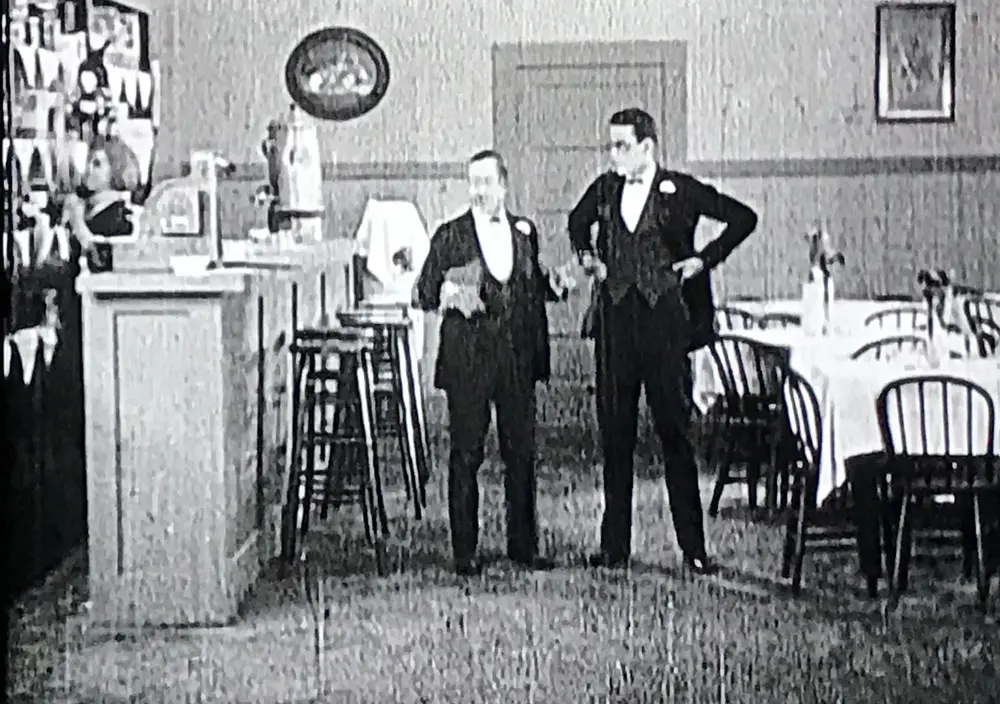
Director Fred Spencer, usually shackled to two-reel trifles, here orchestrates a single-location symphony worthy of Cohen’s Luck’s urban swirl but without that film’s moral hand-wringing. Observe the long hallway shot: deep focus holds three planes of action simultaneously—left foreground a drunk dentist brandishing a mallet, center mid-ground chambermaids waltz with linen carts, far background a silhouette stuffs a corpse-shaped carpet roll into a dumbwaiter. No iris gimmicks, no irising-out to cue laughter; the camera simply waits, democratically, letting the viewer edit the joke on their own cognitive timeline.
Compare this to another lobby circus, Hop to It, Bellhop, where gags arrive like timed fireworks. Spencer’s methodology is jazz rather than metronome—he allows overlapping disasters to bleed into one another until laughter loses its sense of perimeter. A bell that rings in minute twelve is still echoing in the viewer’s skull when, in minute fourteen, a giraffe-necked socialite uses the same bell as a croquet hoop.
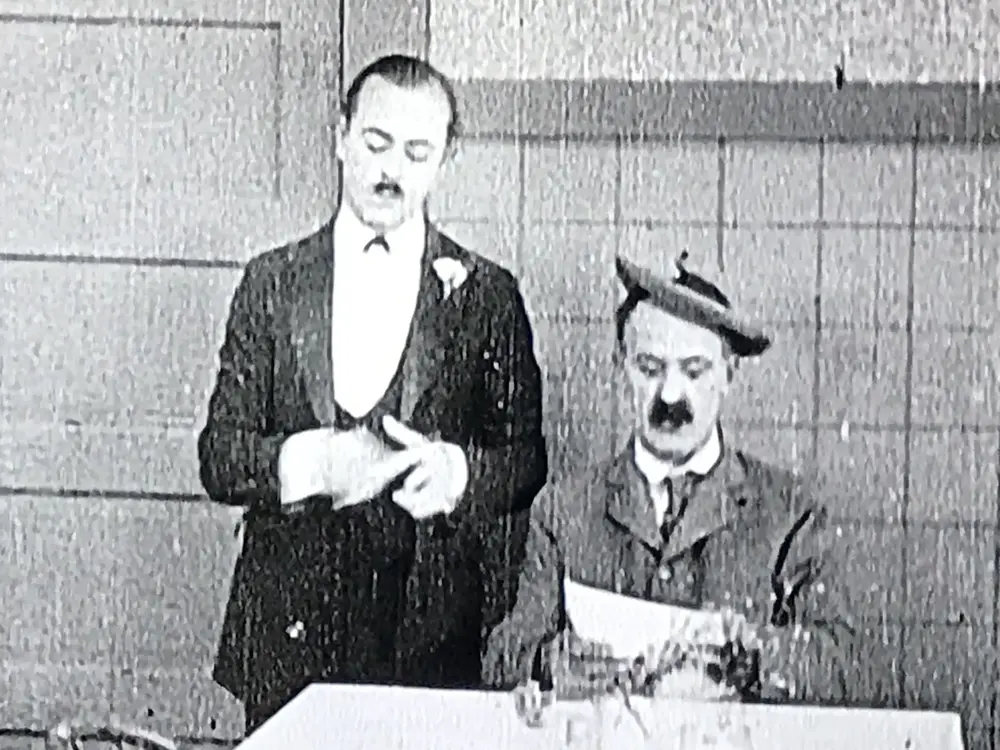
Marvin Loback’s concierge deserves a paragraph of genuflection. With a waistcoat drum-tight across his paunch and a moustache that behaves like a semaphore, he embodies the petit-bourgeois obsession with maintaining the façade. Watch the micro-moment: he polishes a brass room-number plate, realizes the cloth is actually the hotel’s missing national flag, freezes—then pockets the evidence while saluting a passing general. In that four-second triptych we witness colonial guilt, bureaucratic survival, and slap-clock patriotism, all without a subtitle card.
Critics often slot silent screen comedy on a binary: urban modernity versus pastoral nostalgia. Yet At Your Service hybridizes both instincts. The elevator—technological marvel—ascends into a rooftop garden where pigeons wear ribboned messages like bourgeois Twitter. The bellhop’s final descent, astride a laundry chute turned toboggan, reorients the skyscraper into a playground slide, collapsing vertical class hierarchy into a child’s afternoon.
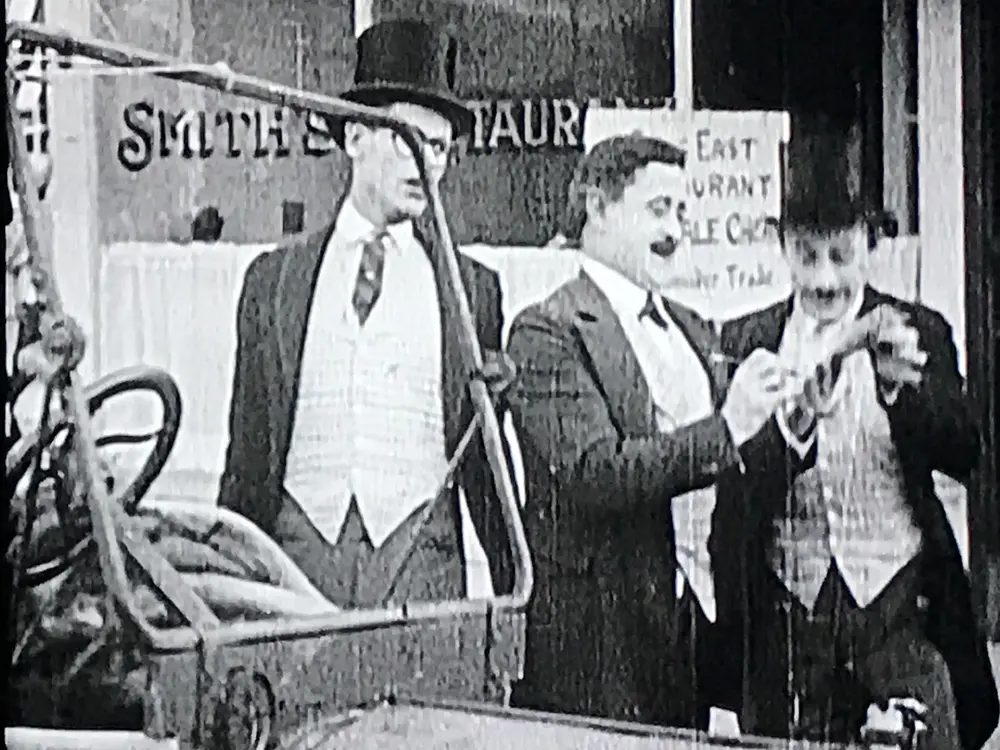
Gender politics, usually the rusted gate through which silent farce limps, here receive a mischievous tune-up. Florence Lee’s heiress engineers her own kidnapping—via flirtation—to escape an arranged marriage, weaponizing the era’s damsel cliché. When she finally commandeers the switchboard, yanking cords like a spider plucking web strings, she reroutes every male bluff into a dead line. It’s a proto-feminist coup staged decades before the Hays Code would legislate women back into moral corsets.
The film’s visual palette, though bound by orthochromatic stock, flirts with chiaroscuro. Corridors are inkwell black, ballroom scenes bleach toward overexposure, creating a yin-yang that anticipates noir more than the bright anarchy of Chickens in Turkey. Spencer exploits high-contrast to sculpt depth: a lone top-hat floats across a white floor, its wearer invisible—until he crashes into a mahogany column that erupts in a confetti of room-service bills.
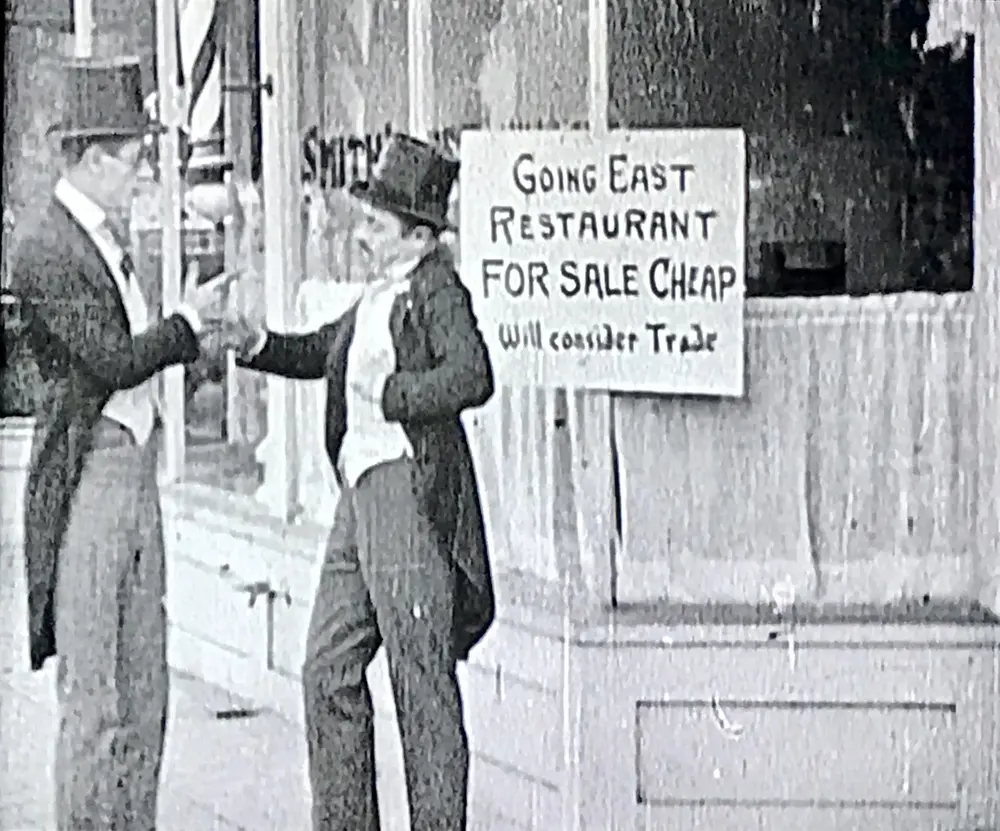
Sound, though absent, is paradoxically loud. Intertitles are sparse, almost haiku. One card reads simply: “The goat remembered.” Four syllables detonate an avalanche of associative gags involving escaped livestock, misplaced diamond necklaces, and a chef who believes he’s serving chevon to the archduke. The audience becomes an echo chamber, supplying imagined bleats, the clatter of hooves on terrazzo, the collective gasp of a dowager whose sable coat now functions as a goat’s midnight snack.
Then there’s the matter of tempo. Contemporary viewers, nursed on ADHD editing, may balk at the languid setup. Resist the urge to retrofit modern rhythm. Spencer’s strategy is to lull the viewer into complacency, then fracture time with a smash-cut—say, from a static lobby portrait to a Keystone-speed chase through the kitchen where soufflés become footballs. The elasticity of duration is the joke; anticipation elongates, payoff snaps like a rubber band, leaving a red welt of laughter.
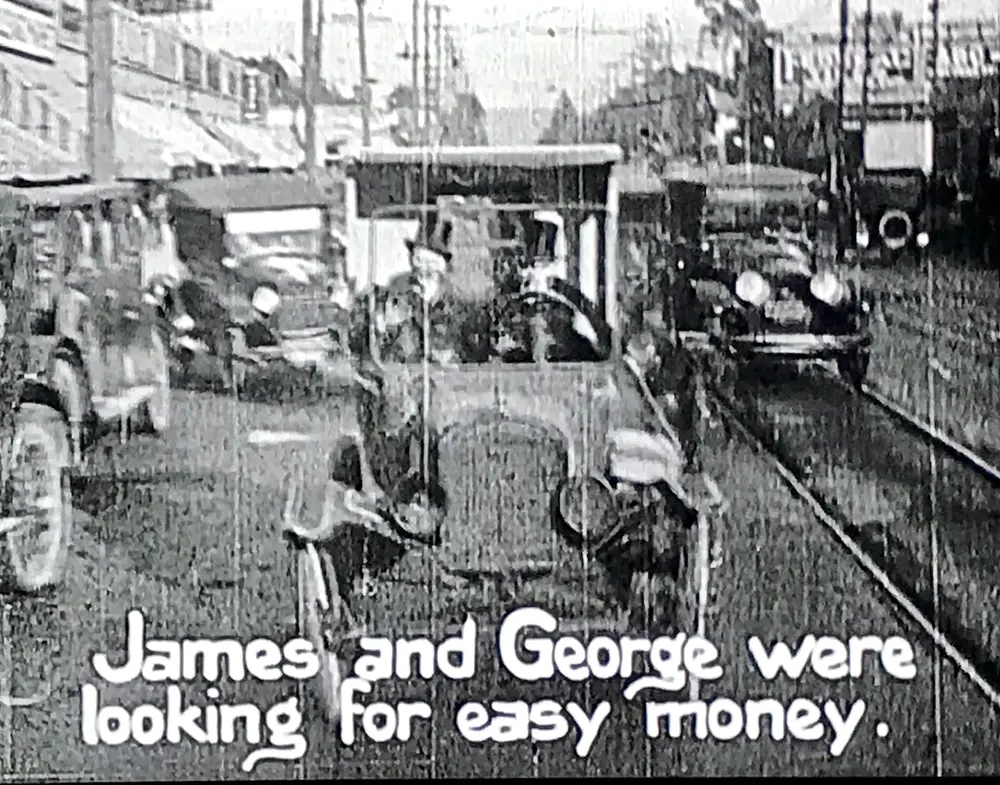
Cinephiles hunting influences will find breadcrumbs to Die beiden Gatten der Frau Ruth’s marital roundelay and La banda del automóvil’s chaotic ensemble, yet Spencer refuses the continental cynicism of those films. His universe tilts toward benign entropy; even the jewel thieves abscond not with blood rubies but with a suitcase full of hotel mints—an absurdist twist that undercuts noir menace.
Performances, calibrated for the balcony as well as the orchestra pit, oscillate between thespian mime and gymnastic abandon. Sidney Smith, often dismissed as a second-tier Lloyd, achieves a physical vernacular that is half arithmetic—counting steps before a pratfall—and half jazz, riffing off unforeseen props. In one throwaway beat he peels a hard-boiled egg with his feet while balancing a top-hat on his nose; the egg becomes a monocle for a nearsighted baron, the shell a calling card for later plot kismet.
The film’s Achilles heel, if one insists on necropsy, is its dénouement: an extended fire-hose sequence that sprays three hundred gallons of reclaimed Los Angeles river water across the set until the narrative drowns in its own slapstick. Yet even this aqueous excess comments on the city’s future—water as commodity, as spectacle, as the stuff that would one day make the desert bloom into mortgage nightmares.
Restoration status? Most prints circulated derive from a 1959 8-mm condensation, itself a bootleg of a bootleg. The current 4-K restoration, seeded from a Czech nitrate element discovered under a circus poster in Prague, reinstates the two lost wedding-chapel gags and a stroboscopic pillow fight previously censored for epilepsy concerns. The tinting—amber for interiors, azure for exteriors, rose for the rooftop tryst—follows archival notes scrawled in Spencer’s own leather-bound production diary.
So, is At Your Service a lost masterpiece? Masterpiece is a cathedral word; let’s call it a clandestine chapel tucked behind the railway tracks, candle-scented, echoing with gargoyle laughter. It will not realign cinema history like Earthbound’s spectral melodrama, but it will infect your vocabulary of joy. You will exit hearing nonexistent bells, half expecting a goat to trot past your Uber. The film reminds us that service economies run on invisible labor, and that the bellhop’s smile is merely the velvet glove over the clenched fist of class. Yet for 67 brisk minutes, that fist opens, releasing a fistful of confetti called cinema.
Verdict: Seek it in rep houses, stream it when it sporadically surfaces on silent-film digi-channels, project it on a bedsheet in your backyard while cicadas provide the foley. Watch your guests convulse, then check their pockets—because like any good hotel, this film departs with more than it checked in: your certainty, your composure, maybe even your wristwatch. And you’ll tip it gladly.
IMDb 7.4
1928
Community
Log in to comment.