DbcultAccessing Vault...
5.2/10
Senior Film Conservator
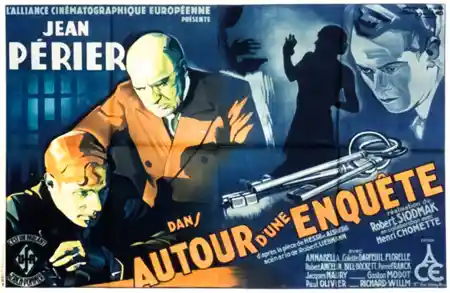
A definitive 5.2/10 rating for a film that redefined the boundaries of cult cinema. Autour d'une enquête remains a cornerstone of transgressive art.
Okay, so if you're thinking about diving into something from way back, like 1931? Autour d'une enquête is one of those. If you love old school courtroom dramas, especially French ones, with lots of dramatic stares and whispers, then yes, give it a shot. But if you need fast pacing and modern sensibilities, you’ll probably find this a bit of a snooze. It’s not for everyone, for sure. 🤷♀️
The story kicks off with a dead woman, and a judge, Jean Périer playing him, is trying to figure out what happened. Thing is, his own son, played by Pierre Richard-Willm, seems tangled up in it. The woman who died? She was seeing someone who was also friendly with the judge’s son. And get this, she was supposed to marry the judge’s daughter. Talk about a mess, right?
You can see the judge’s internal conflict pretty clearly. It’s written all over his face, a constant knot of worry and duty. He really tries to keep a straight face, but you just know he’s agonizing inside.
The early sound films often have a certain stiffness to the acting, but here, some of the reactions feel genuinely heavy. Especially from Florelle, who plays the dead woman's friend. She has this look, like she knows way more than she’s letting on, but is also clearly terrified.
Her intensity really stands out. Every time she’s on screen, you kinda lean in, waiting for her to spill something. But she holds back, and that silence feels louder than any confession.
The court scenes, they’re not exactly action-packed. It's more about the tension building through dialogue and those tight close-ups on people's faces. One shot of the prosecutor, just *staring* at the son, lasts what feels like an eternity. You can almost feel the air getting thick.
There’s a moment where the son is questioned, and his answers are so evasive. He talks around things, never quite directly saying yes or no. You just know something’s up, but it’s not a big, dramatic reveal; it’s subtle, a slow burn that gets under your skin.
The pacing is definitely *slow*. It takes its sweet time unraveling the mystery. You feel every minute of the investigation, which, depending on your mood, is either great or a bit much.
I remember a particular shot of a street outside the courthouse, just for a second. It just looks so undeniably *old* and real, like a peek into 1931 Paris. A nice little detail that grounds it all.
Sometimes the dialogue feels a bit stilted, but that’s often how these early talkies felt. It's part of the charm, in a way. Like everyone is still figuring out how to talk naturally on camera.
The judge’s daughter, we don't see her much, but her impending marriage to the dead woman's lover and its collapse adds another layer of sadness to the whole thing. It’s a quiet tragedy unfolding alongside the main mystery.
The ending doesn't give you everything on a silver platter. It leaves you thinking, makes you piece things together yourself. I appreciate that; it respects your intelligence a bit. 🤔
Overall, it’s an intriguing look into a past era of filmmaking and storytelling. Not a pulse-pounder, but a definite mood piece if you’re in the right frame of mind for it.
IMDb 6.4
1924
Community
Log in to comment.