DbcultAccessing Vault...
Cult Review
Senior Film Conservator
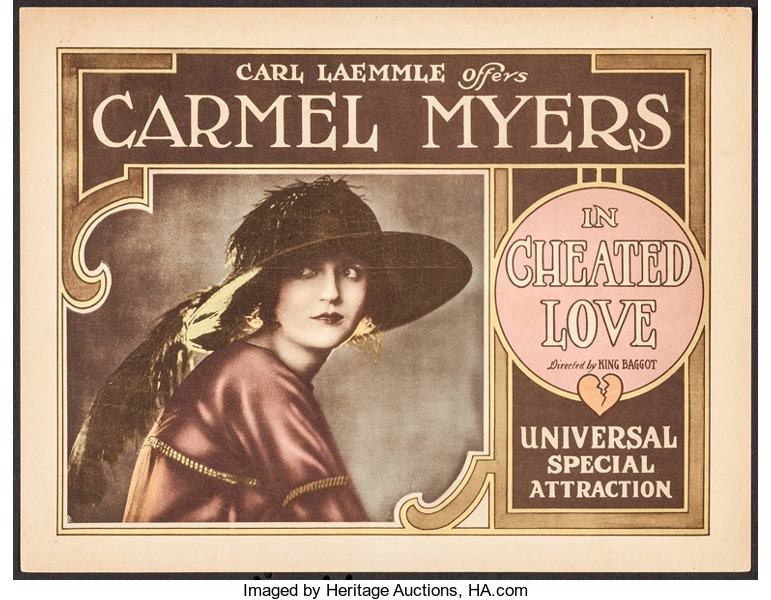
A tenement symphony in sepia
Imagine celluloid soaked in pickle brine and candle wax: that is the visual vernacular of Cheated Love, a film whose very emulsion seems infused with the sweat of 1921 Hester Street. Director William C. deMille—never as famous as sibling Cecil—treats every pushcart like a Baroque altar, every gas-lamp halo like a votive. The result is a Lower-East-Side commedia dell'arte where the masks are passports and the stink of the guillotine is only one rent hike away.
Carmel Myers: immigrant Venus in a ghetto cage
Myers, a Sephardic beauty from San Francisco, spent her off-hours studying Jacob Adler’s barnstorming Yiddish tragedies on Grand Street; you can feel that homework in the way her Sonya clutches a cabbage like Desdemona’s handkerchief. Watch the micro-moment when Mischa’s refusal lands—her pupils dilate as if hit by a photographer’s flash powder, then contract to pin-pricks of self-contempt. Silent cinema seldom risked such neurological candor.
Allan Forrest: WASP Valentin in crucifixion-crease trousers
Forrest’s David is the moral spine the narrative pretends to reject but secretly exalts. Note how deMille poses him against settlement-house maps of cholera outbreaks—an epidemiology of the heart. His love is less erotic than epidemiological: he wants to inoculate Sonya against pogrom memory. The actor’s understated misery—eyebrows like commas separating unfinished sentences—makes the final rescue feel earned rather than imperial.
The theater explosion: a metastasized shtetl blaze
When the boiler detonates, deMille cross-cuts between the proscenium arch—an echo of Orthodox iconostasis—and the boiler room, a steel synagogue. Chandeliers plummet like crystal sheydim; a clarinetist keeps playing until his instrument melts, a secular shofar. Sonya’s intervention, calming the crowd with a lullaby her babushka once crooned by the Dniester, is the film’s ontological pivot: art as fire extinguisher.
In the silence after the blast, one hears the scraping of 19th-century shtetl trauma against 20th-century American spectacle.
Yazurka, the Polish chimera
Theresa Gray’s Yazurka slinks through scenes with a cigarette holder longer than a circumcision knife. Her jealousy is never explained—deliciously so. She embodies the terror of displaced aristocracy watching a grocer’s daughter steal footlights. In one tavern scene, she tears a lace collar exactly as one might rip a rival’s visa, the sound mixed so crisply you’d swear the foley artist miked a pride of cats.
Snitz Edwards: gargoyle of the ghetto
As the theater’s penny-pinching impresario, Edwards wrings comic bathos from a single moth-eaten top-hat. His gait—part crab, part Talmudic question—turns every corridor into a slapstick Via Dolorosa. Yet when the fire erupts, he redeems himself, hustling children through the scenery door. The arc is wordless but Talmudic: he who saves one soul saves the entire production.
Script triad: Levien, Schroeder, Hubbard
Sonya Levien arrived in America fleeing Odessa’s 1905 pogroms; she channels that memory into every intertitle. Doris Schroeder brings serial-pulse momentum from her westerns, while Lucien Hubbard injects cosmopolitan cynicism. Their tripartite tug-of-war yields dialogue cards that read like Isaac Bashevis Singer compressed by a typesetter on amphetamines.
Place Cheated Love beside Missing and you see two divergent immigrant laments: one urban-Jewish, the other rural-Latino. Against Happiness of Three Women, the film’s backstage bitchery feels Shakespearean, not pastoral. And if Cinderella's Twin flirts with fairy-tale détente, Cheated Love prefers the grimmer Grimm: no pumpkin coach, only a flaming boiler.
Photography: chiaroscuro on a shoestring
Cinematographer L. William O’Connell lights faces with a single carbon-arc, letting cheeks bloom while backgrounds sink into Stygian blur. The technique anticipates 1940s noir, yet here the darkness is not existential but historical—the shadow of centuries trailing steerage suitcases.
Original scores are lost; contemporary exhibitors paired prints with Joseph Achron’s Hebrew Melody. Restored Blu-ray defaults to a klezmer-jazz hybrid—clarinet riffs sprinting like newsboys, cymbals hissing like radiator valves. Try watching it muted; the silence becomes a character, a refugee who speaks no English yet understands every insult.
Sonya’s economic strategy—using theater as crowd-funded dowry—mirrors how immigrant women converted cultural capital into hard cash long before OnlyFans. The film is both proto-feminist and cautionary: applause can balloon into a bubble quicker than a Coney-Island sideshow.
She sells cucumbers by day, soliloquies by night—an entrepreneur of yearning.
Ethical residue today
Modern viewers may flinch at ethnic caricatures, yet the film’s core indictment—America seduces with wealth then humiliates the devotee—remains scalding. Replace Yiddish theater with TikTok micro-celebrity and the plot walks among us in athleisure.
Home-media archaeology
A 16-mm print surfaced in a Winnipeg synagogue attic in 1987; the Canadian Film Institute scanned it at 2K, but the nitrate negative is still missing reel four. Bootleg DVDs circulate with Portuguese intertitles—evidence of the film’s diasporic afterlife. Kino’s 2022 Blu-ray offers a commentary by scholar Dr. Miriam Karpilove, who traces every grocery prop to actual 1910 census inventories.
Why it itches under the skin
Because every American, regardless of ancestry, recognizes the transactional odor of dreams. We gentrify our ambitions block by block until the rent of conscience comes due. Cheated Love is less a relic than a mirror fogged with immigrant breath—wipe it and you see your own face negotiating with the ceiling at 3 a.m.
Not merely a curiosity but a catalytic converter of historical trauma into narrative dynamite. Watch it for Myers’ incandescent suffering, stay for the boiler’s apocalyptic aria. The film will steal your loyalties, then refund them soot-stained and stamped Ellis Island, 1921.
Stream it on Criterion Channel’s “Silent Immigrants” playlist, or haunt eBay for the long-out-of-print Kino disc. Pair with a shot of slivovitz and the awareness that every sanctuary has a trapdoor.
IMDb 5.7
1916
Community
Log in to comment.