DbcultAccessing Vault...
Cult Review
Senior Film Conservator
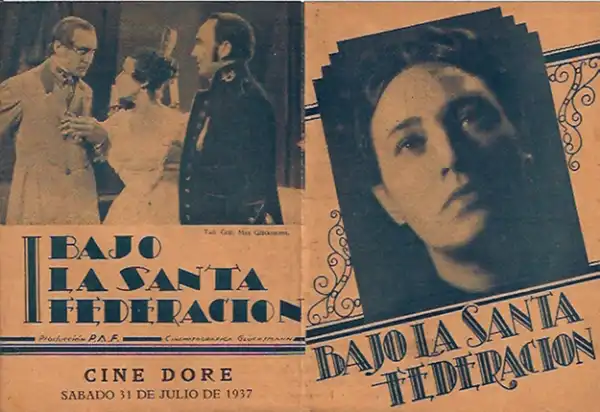
"Bajo la Santa Federación" is a tricky one. If you're into old Argentine cinema, or just curious about how stories were told almost a century ago, then yeah, it's worth a look. Folks expecting fast pacing or complex character arcs will probably find it a bit of a slog, honestly. But for a peek into a specific historical period and filmmaking style, it's pretty neat.
The movie starts, and right away you're dropped into this Buenos Aires from the 1800s. It’s the time of Rosas, lots of red ribbons and talk of "Federación." The sets feel… lived-in, somehow. Not super grand, but you can tell they really tried with the period details. That feeling of a specific era, it comes through.
Tulia Ciámpoli plays the young woman at the center of it all. She's supposed to be this strong Federalist, but there's a certain _fragility_ in her eyes. It's like she's already questioning things, even before the real trouble starts brewing. Her performance is quiet, mostly.
Then there's Arturo García Buhr as the Unitarian conspirator. He's got this intense, almost haunted stare. You can practically _feel_ the danger he's in, just from the way he moves. Every whispered conversation among his group feels super risky. The way he sometimes just *stops* and looks around, it sells the paranoia.
Pepita Muñoz, who plays the mazorquero, though. _He_ is something else. He doesn't need to do much to make you believe he's a real force of menace. A single glance, a slow walk across a room, and you just know he's bad news. His presence, it’s heavy. Really heavy.
The love triangle itself is the main pull here. It’s not subtle, not by a long shot. Our heroine is pulled between loyalty, passion, and, well, *survival* in a very dangerous political landscape. It’s a bit melodramatic, sure, but that was absolutely the style back then, wasn't it? Like watching a stage play almost.
One particular scene, the one where the conspirators meet in secret, it's surprisingly tense. The camera holds on their faces for what feels like a bit too long, maybe. But that just makes you feel the sheer weight of their choices. You can almost hear their hearts pounding, waiting for a knock at the door.
And the Rosas regime, it's always lurking. The constant fear of the mazorqueros, the casual brutality. It's hinted at more than overtly shown, but those hints are absolutely enough. The red ribbons everyone wears, it feels less like fashion and more like a uniform. A rather scary, enforced one.
There's a quiet moment when Ciámpoli's character is just standing by a window, looking out onto a street that looks like it could be from any era, almost. It's a really quiet beat. No dialogue, just her expression. You wonder what she's thinking, how much of this political mess she truly believes in, or if she's just trying to get by day to day. It’s a small, human moment that sticks.
The pacing is definitely _slow_. Like, really, really slow. If you're used to modern movies, the kind that jump between scenes every few seconds, you might find yourself wanting to fast-forward a bit. But if you settle into it, you start to notice the little things. How people greet each other, the detailed architecture of those old Buenos Aires streets. It’s a genuine time capsule, no doubt. 🕰️
The dialogue, it's very formal. A lot of "my dear" and "pray tell" and long, flowery declarations. It takes some getting used to. Sometimes, it makes even the more dramatic lines feel a bit stiff, like the actors are reciting a play rather than just talking to each other. It's a charm, though, in its own way. A specific charm.
I kept thinking about how different filmmaking was back then. The way they framed shots, the acting style, the way emotions were conveyed. It's a whole different language, really. It reminds me a bit of some of those early talkies, where the stage influence was still super strong. It felt like watching The Power of Silence, but with added, sometimes booming, dialogue.
The movie doesn't really try to give you easy answers. The politics are messy, the loves are complicated, and the resolutions aren't neat. It just lays it all out for you. And then it ends. Not with a huge bang or a grand pronouncement, but more of a quiet, reflective sigh. Which, for the subject matter and the era, feels surprisingly right.
This isn't a film you'd put on for a casual movie night with friends expecting big action or laughs. No way. But for anyone who wants to see where early Argentine cinema comes from, or just loves old historical dramas with a distinct flavor, it certainly offers something. It's not perfect, it has its quirks, but it does stick with you, a little. It makes you think.
IMDb 5
1936
Community
Log in to comment.